Friday, March 15, 2024

Falling, Falling, Falling Down That Rabbit Hole!


It was one of those days when I had a hint pop up on Ancestry.com, something about Tomlinson McCarty, the husband of my Third Great Aunt, Mary Ann Elizabeth Slade. So, I click on it, and I found myself spiraling down that research rabbit hole. I clicked on the hint because I hoped to learn when Elizabeth (her preferred name) Slade McCarty died. Did I learn about her death? NO, but I learned was a lot about the Tomlinson family, things that kept me busy for the better part of a week. 

I started my search with the Ancestry hint and learned more about The Rev Tomlinson McCarty who died in 1868 and was buried at the Ebenezer Methodist Church Cemetery in Lamar County, Georgia. We would expect the wife of a minister to be buried along side him, but I could find nothing on FindAGrave, Billion Graves, or random Google searches to indicate a burial place anywhere for Elizabeth Slade McCarty. 

Next I tried using US Census records where I found entries for her in 1850, 1860, 1870, and 1880 but wasn't able to find her in any later census records. Those records did provide some interesting information that indicated Elizabeth moved with all of her younger children to Clay County, Georgia by 1870 and then moved further to Randolph County, Georgia, by 1880. With each of these moves, the children 18 and younger moved with her while her older children, at times, lived elsewhere.

Since census and burial records had not provided the information I was seeking, I decided to use a technique I call "So, Where's Mama?", researching the children of a mother to see if she eventually ended up living with any of them or was buried in the same cemetery as one of her offspring. Since Tomlinson McCarty and Elizabeth Slade McCarty had 14 children, it took a while to see who lived where through the years. 

Here is a brief summary of what I learned about the McCarty children, my first cousins, 3x removed.

  • Martha R McCarty (1844-1914) had no record of any marriage. She lived with her parents and later with her mother through the 1880 census, but according to the 1870 census Martha was living next door to her mother, living with the family of Seaborn and Julia McCarty Jones, most likely a relative of her father. Later in 1900, Martha was living with her brother James McCarty and his family in Dothan, Alabama, where she died in 1914 and was buried.
  • Julie E McCarty (1845 - unk) has no record of marriage up through 1880. Julie lived with her mother according to the 1850 and 1860 census records, but in 1870 she lived with her uncle Herbert Turner and aunt Lavinia Slade Turner. According to the 1880 census, Julie was still living with her mother's sister Lavinia Slade Turner and had moved with that family to Whitfield County, Georgia. I was unable to find any further census, marriage, or death record for Julie.  
  • Samuel A McCarty (1846-1916) left his mother's home in 1870 after his marriage to Armonia Crawford. The young couple, in 1870, lived with the family of Alexander McCloude where Samuel was a laborer on the McCloude farm. Samuel continued to farm for the rest of his life. Sometime after the mid 1880s, Samuel and his family moved to Union County, Arkansas. The 1900 census showed the McCarty family living close to the family of D W Crawford who seems likely to be Daniel Crawford, a brother of Armonia Crawford McCarty. After Armonia died about 1910, Samuel's son James and his family moved to live with Samuel until Samuel died in Arkansas and was buried there in 1916.
  • Joseph Cicero F McCarty (1847-abt 1892) married Susan Oxford in 1868 after which the young couple lived in their own home in Pike County, Georgia according to the 1870 census. Some time about 1878, Joseph and Susan moved to Texas as indicated in birth information for some of their children in the 1880 census record for Smith County, Texas. James was originally a farmer, but later became a County Treasurer and then a state Tax Adjuster. The 1891 City Directory for Dennison, Texas listed Susan McCarty as the widow of Joseph and indicated that two of her sons were living with her at her Dennison home. An entry in FindAGrave listed Joseph's death in 1888 and his burial in an unmarked grave in Dennison, Texas, but once again no mention of his mother Elizabeth being buried in that cemetery. 
  • Sarah Lavinia McCarty (1851-1875), following her marriage to Jehu Clark, lived in Pike County, Georgia were the couple raised a family. Sadly, Sarah died in 1875, possibly due to complication of childbirth as her fourth child was born that same year. After her death, Sarah was buried in the Ebenezer Church Cemetery of Lamar County, Georgia, the same cemetery where her father was buried.
  • James H McCarty (1852-1922) was living with his mother Elizabeth in Clay County, Georgia until his marriage to Caroline Bell in 1876. By the 1880 census James and Caroline were living in Randolph County, Georgia, and his mother Elizabeth's census information was the next family on the census record. James, Caroline and their four children had moved to Dothan, Alabama by the 1900 census enumeration, and at that time, his sister Martha or "Mat" was living with them. As mentioned previously, Martha lived with James and his family until her death in 1914. The 1920 census listed Mary Bell, the sister of Caroline Bell McCarty, as living with the family, even though Caroline had died in 1918. James McCarty passed away in 1922 and was buried in Dothan, Alabama.
  • William C McCarty (1855-1933) lived in Clay County, Georgia for a number of years, first with his mother and by 1880 living on another farm where he was a hired laborer. Sometime after the marriage of William and Hattie Naramore in 1887, the couple moved to Colquitt County, then by 1910 to Early County, Georgia where they lived with Hattie's father Cyrus Naramore. Later, in the 1920 and 1930 census records, William was living in Polk County, Florida with the family of Clarence Bell, a younger brother of Caroline Bell McCarty. The Florida death index records that William died in 1933, but I was unable to find a burial site for him.
  • Charles W McCarty (1857-1888) lived with his mother in Clay County, Georgia until he married Rosa Thornton in 1878. Following their marriage, Charles and Rosa were living in nearby Stewart County, Georgia. Some time before Jan, 1889, Charles, Rosa, and their family had moved to Texas. Charles died in January of 1889 and was buried in Dennison, Texas. His wife Rosa never remarried and lived in Texas where she died and was buried in 1933.
  • Mary P McCarty (abt 1859 - unk) is one member of the family for whom I could find no record beyond her living with the mother Elizabeth in the 1870 census. Age wise, she might have married by 1880.
  • Simon S V McCarty (abt 1860 - unk) like his sister Mary, has no record beyond his mention in the 1860 census and no burial information. HOWEVER, the 1870 census included information about a Thomas McCarty, born about 1859. Perhaps it was Simon T McCarty in 1860 and Thomas in 1870 because there is information about Thomas McCarty.
  • Thomas McCarty (1860- 1907) IF Simon V was really Simon T for Thomas, it was fairly easy to trace the life of Thomas McCarty. Thomas was listed as living with his mother Elizabeth in the 1870 and 1880 census records. In 1881, a marriage for Thomas McCarty and Willie Glenn was recorded in Henry County, Alabama. Thomas and Willie continued to live in Dothan, Alabama until Willie died in 1901 and Thomas in 1907; both are buried in Dothan, Alabama in the same cemetery as Thomas's brothers James and Richard and his sister Martha.
  • Emma McCarty (abt 1862 - unk) like her sister Mary had left no record beyond her mention in the 1870 census where she was living with her mother.
  • Richard C McCarty (1862-1931) left lots of records for tracing his life. He stayed with his mother through the 1880 census then married Mollie Glenn in 1883. Apparently soon after their marriage, the couple moved to Florida where their two oldest children were born after which the family moved to Alabama by 1893 where their youngest child was born. Living in Geneva County, Alabama, Richard and his family were near his brother James. The family continued to live in that area until Richard died in 1931 and his wife Mollie in 1941.
  • Albertus S McCarty (1865-1945) was one family member who moved away from farming, becoming a jeweler and watch maker for his entire career. In 1896 Albertus, or Bert as he became know, married Eulalia Stawall. By 1910 the couple had birthed five children, but only two daughters were still alive in 1910. The family moved to Tampa, Florida by 1920 and lived there for the remainder of the lives of Bert and Eulalia.
  • John R McCarty (1867-1944) apparently lived with his mother Elizabeth until he married Lillian Sims in 1892. By the 1900 the young couple were living in Dothan, Alabama, the same town as his brother James and his family. The 1910 census found John and his family living in Decatur County, Georgia where he farmed and was a carpenter. John's wife Lillian died in 1930 and John in 1944; both are buried in Bainbridge, Georgia.

Lessons Learned
  • Sometimes it's OK to spiral down a rabbit hole in researching a family. I was somewhat familiar with the Slade family, but the McCarty family was new to me. I found that using many of the resources already familiar to me helped me find a lot of information about a new family. 
  • It was also interesting to see the connections between family members living near or with each other through the years, something not so much the norm in today's mobile society. The westward movement of individuals was similar to what I had found in other families in the post Civil War time period as individuals sought more land and perhaps a new sense of adventure. The variety of occupations within the McCarty family was also interesting to note. 
  • Finally I continually wished that more Georgia counties had maintained an index of marriage for women and not just had an index for males. With an index of women, it might have been possible to find marriage records for Julia, Mary, or Emma.
  • As for Elizabeth, I will continue to return to her from time to time as see if newly digitized records can help me learn more about her.

Resources used: (rather than 100+ footnotes)
  • U S Census records, various years, accessed www.Ancestry.com
  • "U S City Directories, 1822-1995" various cities, accessed www.Ancestry.com
  • "Florida Death Records", accessed www.Amcestry.com
  • FamilySearch.org
  • FindAGrave
  • BillionGraves
  • Georgia's Virtual Vault "Marriage Records" various counties. accessed https://vault.georgiaarchives.org/digital/collection/countyfilm
Labels: Genealogy Resources: Lessons Learned; Rabbit Hole Genealogy; Slade

Tuesday, May 31, 2022

Stories from a Bible


It all started when a friend dropped by my house to show me an old Bible she had picked up at a thrift store. She carefully handled the small leather bound book as she showed it to me. The leather binding was intact, and all of the pages seemed to be there. The Bible itself was small, approximately 3 and 4 ½ inches, and it contained just the New Testament and the book of Psalms. The cover, definitely showing the effects of wear, appeared to be a tooled leather design, and the brass hinge on the side was still operational. I could see why my friend was so pleased to add it to her collection.


The Bible was published in Glasgow, Scotland in 1853, given to someone in Massachusetts in 1863, and purchased from a Georgia thrift store in 2022. Surely there were some interesting stories relating to that Bible. I was hooked and knew I wanted to learn more about that Bible and the name written on it so I started taking pictures of the Bible as we talked. Later I spent the afternoon researching Henry Bailey and trying to find a few answers to our questions.


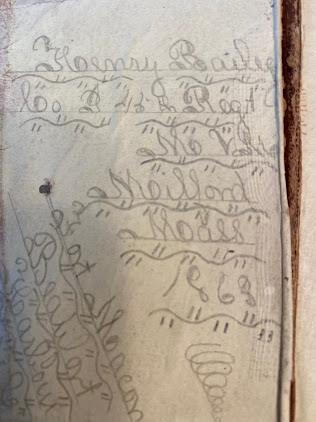
Left front end page

Question 1: Who was Henry Bailey and what was his role in the Civil War?

 The starting place for me was reading the left front end page which had these two inscriptions: 

"Henry Bailey, Co I, 45th Regt, M Voll, Milford, Mass, 1863" 

"Fort Macon, Beaufort Harbour, NC"

Imagine my surprise when my initial Ancestry search for a Henry Bailey in Milford, Massachusetts, turned up some very helpful information. The first reference was from Ancestry’s database U.S., Civil War Soldier Records and Profiles, 1861-1865. This record provided a wealth of information about the Henry Bailey who had owned or been given the Bible, including:

  • Birth date and place
  • Enlistment and discharge dates and places
  • Military unit (Co I of the 45th Massachussetts Infantry)
  • Death date (1922) and burial place

It was enough information matching the inscription on the Bible’s front end page that I felt I was on the right track. It was also specific enough for me to start a Family Tree Maker tree for Henry Bailey so I had a place to record any information I found about him.

 The Ancestry search also had references to years of US census records, enough for me to learn the names of his parents (George and Harriet) and that of his sister (Ella). In addition, the 1920 US census entry indicated that Henry immigrated to the United States in 1849 and was naturalized in 1868, more parts to the story of Henry Bailey. This meant that Henry came to the United States as a young child of three, enlisted to fight in the US Civil War although he was not yet an American citizen, and chose to denounce his English citizenship after fighting in this war.

 I was also interested in learning more about the military union in which Henry served, Co I of the 45th Massachusetts Infantry. The Action Memorial Civil War Library had a short piece of Henry’s unit.(1) It was clear that Henry enlisted in the early days of the unit, traveled with the unit to Fort Macon, Beaufort, NC, and stayed with the unit until it was mustered out of service in July of 1863.

 A second period of action for Henry in the Civil War showed up on the 1890 US Census Veterans Schedule on Ancestry.com. Henry apparently enlisted a second time in December of 1863, staying with Co A of the 1st Massachusetts Battalion until the end of the war.(2)


Question 2: Who is the “Emma” who inscribed the Bible on the right flyleaf?


Inscription: "Remember the Sabbath day to keep it holy.
Emma"

Alas, I did not seem to find an answer to this question. From US census records, it was clear that Henry had a younger sister, Ella. There is no indication that Henry was married in 1863 when the Bible was apparently in his possession, probably eliminating the chance that a wife named Emma has given him the Bible. When he did marry in 1872, it was to Ella Jeannette Morse, another Ella, not an Emma.(3)


Question 3: How did that Bible get from Massachusetts to a Georgia thrift shop?

Finding a possible answer to this question took some searching and, admittedly, some speculation. Using US Census records and FindAGrave memorials, I found a descendent of Henry living in Georgia in the 1980s. Her obituary listed a grandson living in the Atlanta area. A few quick Google and social media searches showed an individual with the exact same name as that grandson living just a few miles from the thrift shop where my friend purchased the Bible. Is this the answer? A coincidence? Maybe, maybe not, but it at least seems to be a possibility.

So, it turn out that my friend picked up a real treasure, that small Bible over 160 years old with its leather binding and brass hinge both still present and functioning. Researching shed some light onto a family who emigrated from England and established themselves as Massachusetts business owners, a family whose son enlisted to fight in the Civil War, a family where both father and son eventually become American citizens. Had this been part of my family, I definitely would have included it in one of my “Coming to America” posts for events such as these are common to many of our families.

Now back to researching my family, helping to transcribe the 1950 US Census, and indexing patriot records for the DAR, at least until some new treasure catches my interest.

1. "Forty-Fifth Regiment Massachusetts Volunteer Militia (Infantry) Nine Months", Action Memorial Library Civil War Archives, https://www.actonmemoriallibrary.org/civilwar/index.html.

2. "1890 Veterans Schedule, Massachusetts, Worcester, Milford, p 7, entry for Henry J Bailey", accessed www.ancestry.com.

3. "Milford, Births, Marriages, and Deaths", image 779 of 2038, Massachusetts, U.S. Town and Vital Records, 1620-1988, www.ancestry.com.

Sunday, August 8, 2021

Coming to America: Cyprian and Margaret Prou, Indentured Servants

Sample Indenture Contract
source: http://www.virtualjamestown.org/indentures/sample_indenture


Several years ago I came across an interesting book on FamilySearch.org, Anderson, Cockrill, Moffett, Smith & Allied Families of Northern Virginia. I was actually looking for another ancestor when I stumbled across a chapter about Cyprian/Cyprien Prou, my 7th GreatGrandfather. For once, I actually downloaded the information about Cyprian and then returned to my original quest.

Fast forward to several years to 2021. I was now a member of the Daughters of the American Revolution, thanks to my 4th GreatGrandfather Enoch Benson. I was now living in Georgia, close to where Enoch lived and a number of relatives were buried. Covid days gave me the opportunity to spend a lot more time learning about Enoch and his ancestors. And this lead me to Enoch's 3rd GreatGrandfather and my 7th, Cyprian Prou.

I was surprised at the pieces of information I had found over the years about Cyprian, some for which I had actually recorded a source. The thing that peaked my curiosity right away was a notation that Cyprian Prou had been an indentured servant. I wanted to know more about this circumstance, what lead to it, and what happened after he arrived in America. Looking for these things definitely took me back in time and introduced me to a variety of resources, all helping Cyprian become more real to me.

The first sourced information I found about Cyprian was a marriage record for Cyprian and his wife Margaret. According to the Vestry Register for the Collegiate Church of St Katherine by the Tower in London, Cyprian Prou and Margaret Vensanden where married there on 16 Jul 1683.(1) Another source concerning their marriage was found in Ancestry's "Virginia, Marriages of the Northern Neck of Virginia, 1649-1800". This entry provided the same date and place of their marriage and also included that Cyprian Prou had been born about 1663 in France. Cyprian's name suggested that he was of French descent while Margaret's suggests that she may have had Dutch or other European ancestors. Trying to verify their births and ancestors will have to wait for other days.

I found several records indicating that Cyprian had been an indentured servant as was his wife Margaret Vensanden Prou. The Virginia Colonial Records Project accessed through the Library of Virginia had online transcriptions of "Quarter Sessions Records, Plantation Indentures 1682/3 - 1684.(2) Report #2152 provided the following entry:
Margaret Prou(?), about 24, to Richard Bray. 4 years, "working in the ground excepted". 28 August 1684.

Cyprian Prou(?), about 21, to Richard Bray. 4 years, "working in the ground excepted". 28 August 1684.

What an entry! Name, age and probable birth year, length of the indenture, and a date to explore.

The records of Virtual Jamestown presented similar information but with some important clarifications.(3) The records were in table form and indicated:

  • Margaret and Cyprian were going to Virginia.
  • The date of 28 August 1684 was the date their indenture was signed.
  • The normal indenture period was four years.
  • Richard Bray of Maryland was the agent to whom they were indentured.
A bonus on the Virtual Jamestown web site was the transcriptions of two indenture contracts. Both contracts provided interesting information about the indenture process. In the 1755 contact for William Buckland, he was referred to as a "Covenant Servant" who was to serve the Executor on the "Plantation of Virginia beyond the seas" for a period of four years. It also mentioned his skill as a carpenter and joiner.  Furthermore, the contract stated that Buckland would be paid the standard annual rate of "20 pounds sterling, payable quarterly". From the entries for Margaret and Cyprian, it seemed that they would not be farming or "working in the ground", as they were excepted (exempted) from that type of work. Perhaps this meant that they, too, had some special skills.

The contract for Richard Lowther, written over 100 years earlier, provided more details about the person to whom Lowther was indentured or covenanted, Edward Hurd. Mr. Hurd as to "provide sufficient meate, drink, apparrell, and other necewaryes for his livelihood and maynetence dureing the said time", and at the conclusion of the contract, Hurd was to give to Richard Lowther "fifty acres of land in Virginia" for Lowther, his heirs, and assignees forever. Both documents were actually signed in England but apparently came with them to the Virginia colony.

I stumbled upon yet one more interesting part of Cyrprian and Margaret's story. On 8 Jun 1684, Marie Prou, the daughter of Cyprian and Margaret was baptized at the French Huguenot Church on Threadneedle Street in London.(4) This meant that they were embarking on a new life, one that would require significant labor on their parts, with a two month old infant. I cannot imagine what that experience would have been like.

Admittedly some of the journal articles I found concerning the status of indentures servants suggested that life may not have turned out to be as they had expected, but one record for Cyprian points to a more successful life in the Virginia Colony. In April of 1704, 20 years after Cyprian and Margaret arrived in the colony, Cyprian and several others petitioned the Virginia House of Burgesses to become naturalized citizens.(5) His naturalization petition was then approved in the House of Burgesses on 8 May 1704.(6)

"And upon consideration of the report of the said Committee upon the Petitions of John Gill, Stephen Gill, Samuel de Monville Teleije Alverton, Isaac Garret, Peter Rucks, and Clypian Prou praying to be Naturalized. The House agreed to the report of the Committee - That it is reasonable the said persons should be naturalized when they are qualifyed by taking the Oathes Enjoyned by Law."

Through the years Cyprian apparently acquired property and was able to support his growing family of five daughters for he wrote and signed a will on 16 Oct 1712.(7) Were he still indentured or without any property or other assets there would been little reason to draw up such a legal document. In his will, one page of which appears as a picture attached to an Ancestry Tree, Cyprian left some furniture to his daughter Frances (my 6 GreatGrandmother). He also named three daughters, Margaret, Susan, and Frances, as executors and stipulated that the remainder of his estate to be divided equally among the three.(8) All of this points to Cyprian having a sizeable estate at the time of his death. For Cyprian Prou, coming to the Virginia Colony seemed to have enabled him to have a prosperous life.

Tale of the Timeline shows the following

  • 1683 - living in England
  • 1683 - married to Margaret Vensanden
  • 1684 - birth of oldest child, Marie
  • 1684 - signed contract to be an indentured servant in the Virginia Colony, came to the Virginia Colony
  • 1704 - petitioned for naturalization and was approved to be a naturalized citizen of the Virginia Colony
  • 1712 - died, his will filed for probate on 5 Nov 1712
Learning something about an ancestor causes me to want to know still more about that person. Things such as what caused Cyprian and Margaret to decide to come to the colonies?  I would be thrilled to find the actual indenture contract that he or Margaret signed, especially if it explained why the couple was "excepted from working in the ground". Perhaps I can locate and read Cyprian's complete will and additional probate documents to get a better picture of the life that he had made for himself and his family in the colony. There are also some unsourced suggestions that Margaret may have died before Cyprian and that he later remarried. After I learned that Cyprian Prou's name appears in the "List of Qualified Huguenot Ancestors" of the National Huguenot Society, I need to look into their research materials. Then I saw several online trees that suggest that another ancestor, Thomas Benson, was also an indentured servant, coming to the Virginia Colony at about that same time. 
And, the list goes on ...

------------------------------------------------------------------------------------------------------------------------

#indenturedservants #immigrantancestors #ProuGenealogy

1. London, England, Church of England Baptisms, Marriages and Burials, 1538-1812 [database online]. "Church of England Parish Registers, 1538-1812", records from City of London, Collegiate Church of St Katherine by the Tower, 1680-1695; record accessed through Ancestry.com.
2. Library of Virginia. Virginia Colonial Records Project, Middlesex County Record Office, "Quarter Sessions Records, Plantation Indentures 1682/3-1684." Indentures for service in Virginia, 1684; record accessed through www.lva.virginia.gov
3. Virtual Jamestown [web site], "Registers of Servants Sent to Foreign Plantations, 1654-1686; record accessed through http://www.virtualjamestown.org
4. "England Births and Christenings, 1538-1975" database, FarmilySearch.org
5.  Whitley, Edythe Johns Rucker. History of the Rucker family and their descendants. Hermitage Printing, 1927; accessed through www.hathitrust.org
6. McIlwaine, H R, ed., Journals of the House of Burgesses of Virginia 1702/3-1705, 1705-1706, 1710-1712, p 74, accessed through www.ancestraltrackers.net.
7. Burgess, James A. Anderson, Cockrill, Moffett, Smith & Allied Families of Northern Virginia; record accessed through FamilySearch.org.
8. Ancestry Tree 168705053, person 212209830156.


Saturday, June 26, 2021

Thoughts From Ferabrew Cemetery

 It was great to finally be out on a cool summer day with a hiking group on a trek into the North Georgia Mountains. Our guide mentioned that we'd be walking through part of a national forest for a while then heading to see two different waterfalls (which was the reason I signed up for this hike in the first place).

The four mile hike on an unpaved, forest service road lead us to Ferabrew Cemetery. It also lead us back in time and left me with a head swirling with questions. After reading the brief history provided on the sign, I was anxious to see this old cemetery.

US Forest Service sign giving a brief history of the cemetery

I was surprised to see that it was a small, abandoned, overgrown cemetery, filled with a number of large rocks scattered around the cleaning. In the center of the approximately 30 x 20 foot area was a large stone box, apparently the burial place of Alias Ferabrew, the lid of which seemed simply placed (rather than adhered) onto the box. The inscription on the lid was virtually impossible to read. You can see where the first hikers in had tried to clear off the leaves to make it easier to read.


The only stone crypt we saw, reportedly that for Alias Ferabrew


Inscription on the lid of the crypt
    
Near by were two marble or granite markers, definitely more contemporary than the stone box, indicating that Mahula Brown Brady and James Dean Brady were also buried there.


As I walked through the rest of the area I kept seeing more rocks, various sizes, different shapes, located here and there in the cleaning with no names, dates, or even apparent intended order to their arrangement. For whom were these the markers of their final resting place?


The next day as I was looking at my pictures, I found myself wanting to learn more about the Bradys. My first step was to set up a family tree for Mahulda Brown Brady in Family Tree Maker. In a short time, census records for 1850-1900 provided me with information that, just as I thought, Mahulda Brown Brady and James Dean Brady were husband and wife as well as parents of at least 10 children. From their marriage in 1841 (according to the 1900 census) the family seemed to have resided in this same section of Habersham (now Stephens) County in northeast Georgia. The same surnames of other families also kept appearing in those census records. It all suggested a small, stable farming community that had developed in what had formerly been Cherokee Indian tribal land. 

Probate records also provided some additional information about Mahulda and James. Although his marker indicated that James died in 1902, probate records for (then) Hambersham County indicated that James had died in March of 1901.(1) A son, James Elias Brady was appointed guardian for Mahulda until her death in 1902. The Brady estate was finally settled in 1905 following the last sale of property and distribution of funds to the heirs.

The markers for Mahulda and James seemed new, not a hundred plus years old. After a little more research, I now think they had been placed there in the past 20 years. According to information posted on USGenWeb a cemetery survey done in 2004 indicated that "a total of 34 graves were counted with 33 being marked with field stones, no inscriptions, and 1 marked with soap stone slabs stacked to form a vault with inscriptions." This may suggest that someone, perhaps family members, placed the markers for Mahulda and James after this 2004 cemetery survey.

There were also some photos of the cemetery on the blog "Faded Footprints, the Lake Russell Wildlike Management Area". A group had apparently cleaned the cemetery area back in 2012, noting at that time that there were 30 graves and four stone crypts. On our hike in 2021, we only saw the one large crypt which, according to the forest service sign, was Alias Ferabrew's burial site.

Oh, yes, later in the day, we stopped at that 180 foot waterfall. I marveled at its beauty, took some pictures, and enjoyed the peace of that area. In addition I'll always have another memory from that hike, the memory of that abandoned cemetery and the glimpse into past lives that it stimulated.

Final thoughts:
  • There was no information on either Find A Grave or Billion Graves for Ferabrew / Ferabre Cemetery so I added the cemetery and my photos of the markers for Mahulda Brown Brady and James Dean Brady onto Find A Grave. Perhaps someday this might help one of their descendants.
  • I keep wondering who the first settlers were who moved onto this land, most likely having been some of the "fortunate drawers" in one of the Georgia Land Lotteries.
  • Today so much of this area is part of a national forest. Where are all the descendants of those early families today?
  • "Rabbit Hole Genealogy", my term for suddenly chasing a name or unconnected tidbit of information, can sometimes be an interesting learning experience. Now I wonder if the Brady I stumbled across in the Cherokee Land Lottery of 1837, the one who draw a lot for land in Habersham County, was kin to James Dean Brady?

1.  Georgia, Wills and Probate Records, 1742-1992 [database on-line], Habersham, Estate Case Files, 1800-1915, Brady, J D-Crow, Ervin and Nettie; folder of J D Brady, accessed on www.Ancestry.com.


Wednesday, May 6, 2020

Getting From HERE to THERE In Quarantine Time

After seven weeks of self-imposed quarantine and state mandated "shelter-in-place" during the Spring of 2020, I had put a big dent in my pile of research documents that had needed to be filed. I was actually studying, documenting, labeling, and filing almost every other day. But then one day, I came across a land record that had been in my pile for almost three years. I was ready to do a "Genealogy Happy Dance" because that record sparked my curiosity, making me want to learn more about it, and, admittedly, letting me leave filing for a while without feeling any guilt.

The document was a land warrant conveying 236 acres in Green(e) County, Tennessee to Joseph Bogle, my husband's fourth GreatGrandfather. Were my husband still alive, I knew this would have been some research he would have wanted to help me explore. And explore I did.


"Ancestry.com. North Carolina and Tennessee, Early Land Records, 1753-1931"


Step 1: The first thing I needed to do was to transcribe that document written over 230 years ago. I had found the record in Ancestry's database of "North Carolina and Tennessee, Early Land Records, 1753-1931", but the transcription made the record so much easier to read. For convenience, I also photocopied my transcription onto the source citation I had downloaded with the record.

Step 2: Although I no longer lived in the area, I still had a real interest in learning more about where the land belonging to Joseph Bogle was actually located. I wanted to see if I could find the 236 acre plot on a topographic map of Greene County, Tennessee (today the name of the county is spelled with that final "e").

Google Maps made it quick to find Little Chucky Creek in Greene County, but locating Delaney Creek took some time. The USGS (United States Geological Survey) now had free map downloads available on their website using the the TNM download. It was relatively easy to follow the course of Little Chuckey Creek on the topographic map of Greene County. After a few minutes of sizing and resizing portions of the sectional maps for Greeneville and Mosheim (towns in Greene County), I found "Little Chuckey at the mouth of Delaney Creek" or Little Chucky Creek and Dulaney Branch as they are labeled on the current topographic map.


The red diamond indicates where Dulaney Branch runs into the Little Chucky Creek


Step 3: The warrant was for 236 acres, but knowing the hills, valleys, creeks, and rivers of this area, I had to wonder what that plat of land might look like. I knew there was platting software available to purchase, but I was hoping to find a free way to plat the land warrant. Online I found two great articles that explained just how to do that. Both articles are now printed and in my "Land Records" research folder.

Mark Hamilton's The Walden Effect blog had a post on "How to Map Property Boundaries From a Deed". (1) I especially appreciated the photos of his platting process. Hamilton also included a diagram of a surveyor's compass, an instrument that turned out to be much easier to use than the old school protractor I found in my desk. I followed his suggestion to photocopy the compass and was finally able to get my final plat line to join back to the starting point of my property drawing. Hurrah!

The second helpful article "Land Platting Made Easy" was written by Kimberly Powell.(2) It featured a step by step process for platting as well as helpful descriptions and examples. Basically I followed Powell's list of steps and referred to Hamilton's post for visuals.

Powell's article called for transcribing the deed or land warrant and creating a call list before ever attempting to plat the deed. Transcribing the land warrant I had found online made it much easier to read and to double check my directions. The call list is simply a list of the directions that were taken in the survey, things like:
  • Beginning at Gamel's at a dogwood  (Starting point of the survey was apparently property belonging to a Mr. Gamel, at the corner where there was a dogwood tree)
  • On a line South 47 East (From the dogwood tree, go on a course of SE 47 degrees)
  • One hundred and ten poles to a hill to a poplar (Go on this SE course for 110 poles or 1815.0 feet as 1 pole equals 16.5 feet to the poplar tree on the hill)
Having the list also made it simple to check off each step as I had marked it on my graph paper which had been a free download from PrintFreeGraphPaper.com.


My transcription and Calls List for the land warrant.


After switching from the school protractor to the surveyor's compass, I finally came up with a plat that was a visual for the information presented in the land warrant.  


My plat drawing, made with the help of a paper surveyor's compass.


Step 4: The final step was to compare my drawing with the topographic map I had found. Would my drawing fit? Unfortunately I had not made my land plat on the same scale as the downloaded USGS map so I had to do so thinking here. Going back to the map segment I downloaded in Step 2, I noticed that it was shown with the scale of 2 cm equals 1000 feet. With that basic information I copied the photo of my plat drawing and resized it on a Word document until that long East to West line from a stake to the poplar was 5 1/2 cm / 2 1/8" to more accurately represent the 165 poles / 2722.5 ft indicated in the land warrant.

After cutting out the resized shape, I tried putting it onto the larger 2 cm = 1000 feet map, hoping to find a place where Joseph Bogel's property seemed to fit. No matter where I placed the plat shape, I wasn't able to find a spot near the juncture of Little Church Creek and Delaney Branch that had a hill where the shape indicated one should be. The exact location will need to be determined by someone who actually knows what s/he is doing.


Plat template and the map


Spending this time looking at the deed, drawing the boundary lines for the property, and trying to locate the area was a welcomed break from filing. I also leaned about some new resources that I expect to use in the future.

And, of course, I ended up with more questions. After all, Joseph Bogle was living about 50 miles away in Blount County at the time the land warrant was written, living there up to his death in 1790. Did Joseph Bogle ever set foot on this property? Was the land meant to be payment to him for his service in the Revolutionary War? Did he sell it? Did he not act on the land warrant such that it just went to someone else? More questions for another day. And perhaps I will find another treasure to examine when I return to filing.

.....................

(1) Hamilton, Mark, "How to map property boundaries from a deed". The Walden Effect. accessed 4 Apr 2020. http://www.waldeneffect.org/blog/How_to_map_property_boundaries_from_a_deed/.
(2) Powell, Kimberly. "Land Platting Made Easy." ThoughtCo, Feb. 11, 2020, thoughtco.com/land-platting-made-easy-1422116.

Wednesday, July 17, 2019

Who Was Joshua Stevens and What Were He and Solomon Kemp Doing in My Files?


It all started as I was going through things in the attic, doing the "50 Year Purge", trying to get years of files, folders, and contents of forgotten boxes under control. While going through a folder with my father's name on it, I found several things I remembered my mother giving to me years ago, but then I find a surprise. There, in the folder, along with my dad's military papers and a few old newspaper clippings was an envelope marked in my handwriting "An old deed". Inside that envelope I found this brittle, stained sheet of paper, apparently a document to record the sale of land by Solomon Kemp to a Michael G..... in 1842.


Sale Receipt for Solomon Kemp, 1842

I also found a second, smaller envelope, this one labeled in my mother's writing, "Old deed with seal attached". When I carefully opened the envelope, this is what I found.


Deed to Georgia Land Lottery Draw for Joshua Stephens, 1832

With a quick glance, I realized that I was looking at pieces of an original deed or document relating to a draw from the 1832 Georgia Land Lottery. And I knew I needed to learn as much as I could about these documents and the people involved. And I needed to come up with a research plan for gathering information about these documents beyond the obvious reading of the words on those pieces of paper.

In years past, someone had tried to tape together the fragile pieces of the Stevens document. Today, the fragments are almost too brittle to touch, so I tried to handle them with as gently as possible. After photographing the two documents, I felt the next step was to transcribe them. Having the transcriptions gave me sheets of paper that were much easier to read, papers I didn't need to be concerned about getting stains, spills, or anything else to cause further damage to the original documents.

So, here I am about 24 hours later, actually starting to learn a little about Joshua Stevens. Here is what I have come across thus far.
  • Step one, check in my Family Tree Maker software for a Joshua Stevens. I did not have that exact name among ancestors or relatives. I have one Stevens male, no given name, who married into my mother's side of the family in the late 1770s according to the Massachusetts Town and Vital Records found on Ancestry.com, but I doubted if he would have been part of the 1832 Georgia Land Lottery. Other Stevens family members were from a marriage into my father's side of the family in 1899, so I am ruling out an established Stevens connection for the present time.
  • I've decided to start a separate tree in Family Tree Maker for Joshua Stevens. This way whenever I come across anything noteworthy, I have a place to record it. 
    • My first entry, beyond his name, was to record the Property fact that he drew Lot 946 in the Fifteenth District of the Second Section of Cherokee County, Georgia. 
    • Next I added that at the time of the draw, he was a resident of Madison County, Georgia.  
  • Both my family and my husband's had members who had been involved in the Georgia Land Lottery of 1832. My first research was to look at James F Smith's fabulous book, The Cherokee Land Lottery, Containing a Numerical List of the Names of the Fortunate Drawers in Said Lottery, With an Engraved Map of Each District. This treasure is available to view through both HathiTrust and The Internet Archive or abstracted on Ancestry.com. 
    • Imagine my surprise when I learned there was NO map for the Fifteenth District, Second Section of the drawing, NO list in number of draw order for the lottery winners! This was due to the fact that this district, along with some others, was considered to be a "Gold District". No gold was promised on the land, just the feeling that there "might" be gold there. Information for lottery winners for Gold Districts turned out to be in another book, one I haven't been able to find available online.
    • Thanks to www.worldcat.org I've found that copies of Alphabetical Index to Georgia's 1832 Gold Lottery were available at several libraries around metro Atlanta, so heading to one of them and finding the book is on my To-Do List on a future trip to Georgia.
  • I located a Joshua Stephens living in Madison County, Georgia, in the 1830 census and also in the 1820 Madison County census. No success, however, in locating a Joshua Stephens anywhere in Georgia in 1840 ... yet
  • The Georgia Virtual Vault presents a number of digitized resources, the originals of which are housed at the Georgia Archives. One resource is their database of "Georgia Colonial and Headright Plan Index, 1735-1866". If Joshua Stephens was in Madison County Georgia in the early 1800s, there was a good chance that he had received land as a settler moving into the area.  Through this database, I learned that Joshua Stephens had received several grants totalling over 700 acres in Madison County so he was already an established land holder at the time of the Cherokee Land Lottery.
  • Next stop was FamilySearch.org where I looked through their collection of "Georgia, Headright and Bounty Documents, 1783-1909". This time I had the actual digitized documents to read including:
    • a survey request to lay off 30 acres for Joshua in Oglethorpe County, Georgia, in 1797 
    • Land Warrant #21 that gave Joshua 300 acres in Madison County, Georgia, in 1813 and
    • Land Warrant #174 that gave Joshua 450 acres in Madison County, Georgia, in 1826
  • My next research steps will be to find out what happened to Joshua Stephens after 1832. This means checking resources such as
    • FindAGrave, BillionGraves, WikiTree to find a possible death date
    • Wills and Probate records on Ancestry.com and FamilySearch.org to perhaps learn what happened to his land after his death
    • Fold3.com to see if Joshua had any military service that might have been the catalyst for acquiring his various land grants
    • Look for website, etc. where I can locate lot 946 on a present day map. This might help me have a clue as to who may have lived there.
Now for my Georgia To-Do List
  • Visit a metro Atlanta library, get a copy of Alphabetical Index to Georgia's 1832 Gold Lottery, and learn more about Joshua's fortunate draw.
  • Check in Cherokee County Georgia to learn who later bought the land from Joshua Stephens and try to trace the land's ownership into the Perkinson family.
  • After I finally figure out why I even have these things, I want to contact county or state archives to see if an Archive or local history center might be a more fitting home for this interesting old document, especially as I am not aware on any Cherokee Lottery Land still owned by our Perkinson family.
As for the 1842 document signed by Solomon Kemp, that will have to wait for another research spurt. Looks like I have enough to keep me busy, out of trouble (and the attic), and even writing a few more blog posts for quite a while.

Monday, June 10, 2019

It Never Hurts to Go Looking : Taking Time to Visit Enon


Enon Cemetery, Woodstock, Georgia, 4 June 2019
personal photograph


It was one of those perfect days for a cemetery visit, not yet Georgia summer hot, cloudy but not rainy, and an uncrowded midweek morning. I had visited several times over the past 20 years to take pictures, but this time I had another purpose. I knew that my relatives were buried in a family plot, but I wanted to record exactly WHO was WHERE and to be certain that I had a picture of each marker in the plot. It was time for me to make a map of the family plot.

Although it had been close to 10 years since my last visit to Enon, it was easy to locate the Perkinson family plot. It is the plot with the tall obelisk near its center.


Perkinson Monument
personal photo


Armed with pen and paper and my cell phone camera, I arrived at Enon Cemetery midmorning and was pleased to see that paved parking places were now available just next to the family plot. I decided to work left to right, front to back, to document all of those buried in the plot. 


Rough sketch of the Perkinson family plot


My quick sketch of the plot included a number and the name of the one buried there. It was not an architectural or even scaled drawing by any means, but it is enough for me to see who is buried where and to consider some relationships. The numbers on the sketch made it easy to locate the corresponding photo in my phone's camera roll for that day. The arrow pointing right at grave 24 refers to three more graves in that row, graves which I documented on another page. Later I plan to upload any new photos to BillionGraves.com so that all of the burials in the plot will be recorded in their database.


As I walked around the plot and made notes, I came across this section which I do not remember ever noticing before. It took looking at all three relatively recent markers to see the family connection among the unfamiliar surnames. And the box of artificial flowers here and on a few other graves was a touch I had not seen often at Enon. It made me wonder if there had recently been a Decoration Day at Enon. Decoration Day, a long standing tradition in the rural south, is a time for families to gather at the burial place of ancestors, clean the cemetery of weeds, leaves, etc., and perhaps leave flowers in memory of loved ones. DigitalHeritage.org has an interesting article about this observance.

Finally, once home, as I was writing the detailed list of the burials, it was interesting to determine who was the first one to be buried in the plot at Enon Cemetery. The first family member buried in the plot was six month old Willie Perkinson, a younger brother of my grandfather, who was buried at Enon in 1883. In 1894, Walter Dean, a grandson of my second great grandparents, was buried there at the age of four months. Then followed the interments of various Perkinson and Dean family members and relatives up to as recently as 2017. Perhaps I need to start referring to this plot as the Perkinson-Dean Family Plot in recognition of the blending of the two families.

Lessons Learned:
  • Taking the time to look at all the graves and markers made me want to be certain of the family relationship of each person buried there. Now that I'm home, I am listing each person buried in the family plot, their birth and death dates, relationship to anyone buried in the family plot, and a notation for any direct ancestor. Having this information along with a neater version of the plot map will help me. I plan to add the redrawn plot map, the relationship list, and labeled thumbnail photos to my Perkinson Family file folder. Plus, a copy will go to my brother. As the old saying goes, it's hard to know the players without a program.
  • There were a few recent burials in the family plot for whom I need to document their relationships in my genealogy software.
  • It was a time to pause and reflect when I saw the graves of six young children buried among the 34 family graves. I wondered if these young deaths corresponded to pandemics sweeping the area or if they were caused by genetic problems or undiagnosed health issues.
  • The variety of last names - Barnes, Dean, Drinkard, Felton, McAfee, Perkinson - give this plot the feeling of the small town where most of those buried had lived at some point in their life.
  • As I explore some of the relationships, I am reminded once again that there may be something new to learn when we revisit a genealogy resource. Documents, photos, even grave markers can continue to provide additional information when we take another look; they might even lead to new questions to research.
  • My decision to include a visit to Enon came as I was planning to visit the Woodstock Public Library, just across the street. My purpose for going to the library related to my quest to find an elusive marriage verification I needed for my DAR membership application. Still no luck finding any marriage information, even in among obituaries on microfilm of old newspapers, but the trip to Enon was a worthwhile endeavor. Combining research missions helped me have success in one area even if the other task was less fruitful.

Tuesday, January 8, 2019

Getting This Party Started

This year is going to be a special one in my hometown of Johnson City, Tennessee. Our town, being 150 years old, will celebrate its sesquicentennial in 2019, and the party has begun.


So much to see, hear, and do at this party.

On Saturday, Jan. 5, several hundred citizens, along with local politicians, a beauty queen, and a member of Congress all gathered in downtown Johnson City to get our party started. The focus for this event was the display of items previously placed in a time capsule back in 1969. This capsule had been created during the celebration of Johnson City's centennial. Wanting to look at the capsule's contents was enough to get me out of the house to attend the event. I'm so glad I did.


Metal sign from the actual 1969 time capsule

A portion of the sign from the time capsule was on display. I learned that the capsule had been installed during the construction of the high school which my children later attended. The accompanying list of artifacts showed that items ran the gamut from serious to fun.


There was an impressive variety of items in the 1969 time capsule.

The line to gaze at the items from the capsule moved slowly, but no one seemed to mind as virtually everyone could find something interesting in the display. There were items pertaining to city government such as the former city flag, a 1969 city map, a copy of the 1969 city budget and a key to the city. Also on display were photos and information about the city's hospitals of the day, our public school system, the two local colleges, and the university.

Admittedly, the line slowed as we passed by the displays relating to everyday life, things like a 1969 Sears catalog, newspapers with historical headlines like "Men Walk on Moon", samples of products made in our town, and some popular children's toys. There was a fascinating scrapbook of local newspaper articles covering the variety of events celebrating the 1969 centennial, and there always seemed to be school age students leafing through its pages. I was excited to learn that the time capsule items will remain on display in the downtown area for some time so that others can continue to take a closer look at our city's more recent history.


Another part of the official program included the reading of a letter written by the 1969 mayor of the town to the 2019 Johnson City mayor. Our present mayor, a woman with a distinguished record of public service, didn't seem to mind reading the salutation, "Dear Sir" and graciously accepted the letter's warm wishes for success and prosperity for our city in the year 2019.

My favorite part was seeing the number of children and younger families at the party. They would browse the numerous displays of photos of churches, businesses, and schools from the town's 150 year history. And there would usually be an older person close by who was glad to answer any of their questions about the past. I was one of them as I answered a few questions relating to the picture of my church's building back in the early 1900s.

It was interesting to see photos of city churches throughout the years.

Another fun spot was a craft table, complete with small cardboard boxes, markers, and stickers, whatever a child might want to make and decorate his or her own time capsule box to take home, fill, and then open at some point in the future. Seeing the kids working on their boxes made me wish my grandchildren had been in town and could make a box for themselves.


Making your own time capsule was a great family project.

There was no Photo Booth at this party. Instead, people could record a message to the future to be included in the 2019 time capsule. It turned out to be another great family activity. No one seemed to mind the spectators who gathered to watch and to hear the various individuals and groups contribute a 30 second message, a few even adding a little song and dance to their message. Hopefully, 2069 technology will permit these messages to be played and enjoyed in the future.


Recording a greeting for the 2069 Bicentennial

And the party wasn't just things to look at. We had a sing-along to "I Heard It Through the Grapevine", a hit song from 1969. We celebrated as three generations of a family blow out the three giant candles on the birthday cake. And what's a party without cake! Everyone was invited to sample the delicious birthday cake, made by a local baker who just happens to be scheduled to be on a Food Network program in the coming months. It all made for a pretty good party.

I'm already looking forward to attending future sesquicentennial events. The more, the merrier.


Display from the George Carter Railroad Museum at East Tennessee State University


Some Genealogy Musings:
  • The photo displays were well organized and labeled. The hard work of others provided lots of information in an interesting and accessible manner. In a similar vein, when we share old family photos, it might garner more interest from family members if we, too, include a little bit of the Who, What, When, and Where to accompany some of the pictures.
  • It was great to see the time capsule activity available for children. We just might have some new historians on our hands at the bicentennial in 2069, ones whose interest started with a simple craft idea.
  • Our public library had a display of some local history materials from the Tennessee Room, their genealogy collection area. There was also a member of the library staff present to talk with people about the library's genealogy resources as well as to provide information about our local genealogy society. This was a simple, effective marketing tool.
  • Additional photos and resources were provided for viewing at the party by East Tennessee State University and by the Archives of Appalachia which is housed at the university. This was another example of increasing exposure within the community as to the variety of historical (and potentially genealogical) resources available at the local level. It also spoke loudly of the important of providing accessibility to such resources.
  • The party was another reminder that we, too, are part of making history every day.

#JohnsonCity150 #citycelebrations #JCTNsesquicentennial