Showing posts with label Genealogy Do-Over. Show all posts

Saturday, January 2, 2016

New Year, New Numbers, New Goals

GOALS source: http://www.thebluediamondgallery.com/


The new year is a time for doing more than making resolutions. It's also a good time to look back over the past year, evaluate efforts, and set some personal goals.

A year ago, I posted about finding my ancestor score, as I looked at how many of my direct ancestors I had actually been able to name. Both Randy Seaver in a blog post and Christa Cowan of Ancestry.com's YouTube videos had suggested reasons to do this, and the new year is a logical time to repeat the report. I described my methodology and my results in a previous post

Here is my latest report based on my research in 2015. In running the report I added a new column at the right, how many new direct ancestors I had identified in the past year. It was exciting to see that I now know the surname and given name of 25% of my direct ancestors, compared with only 18% last year.

GenerationRelationship# in generation# identified% identified2015 increase
1Self11100%
2Parents22100%
3Grandparents44100%
4GreatGrandparents88100%
52 GreatGrandparents1616100%
63 GreatGrandparents323197%1
74 GreatGrandparents645688%14
85 GreatGrandparents1285644%20
96 GreatGrandparents2565722%37
107 GreatGrandparents512296%3
Totals102326025%75

It was relatively easy to explain that increase. I was a participant in Round One of Thomas McEntee's Genealogy Do-Over. What a difference my research took when I because more focused and more methodical in maintaining my research log. I chose to focus on learning more about my Norwegian ancestors, relatives constituting a fourth of my family tree. The majority of new ancestors I discovered in generations 7, 8, and 9 were among these Norwegian ancestors.

Besides learning names, birth dates, baptismal dates, marriage information, and death dates of these ancestors, I also learned about a variety of resources that spurred on my Norwegian research. With the help of Google Translate, I even got where I could "read" a number of the records I had located. I felt a real growth in my research skills and tools.

The best part, thought, was coming to see these ancestors as people. People who moved from farm to farm. People who lived with waves of illness that decimated the families. People who chose to immigrate to America. People who chose to stay in Norway. Because of this, most of my posts in January through March of 2015 concerned these Norwegian ancestors.

Participating in the Genealogy Do-Over was well worth the time. Whether you are a beginning researcher or have been at it for a long time, I would encourage you to look at the G D-O web site and consider participating in the program activities. 

Now for 2016. Over the past few months, I've been plowing through the wills and probate records available through both Ancestry.com and FamilySearch.org. Each will, each record of probate returns seems to provide a new tidbit of information. I've taken a break from my regular posts as I've been reading virtually every line of each record I find. Tedious at times, but definitely worth it.

Goal 1 is to continue to explore these will and probate records for my family tree and then for my husband's also.

Goal 2 is to help a family member learn more about her family history. Because the majority of her ancestors and relatives seem to be clustered for several generations in a few neighboring Georgia counties, I'm already seeming how helpful it will be to use the Cluster Research approach, looking at Family, Associates, and Neighbors, as suggested by Elizabeth Shown Mills.

Goal 3 relates to Family Tree Maker. Like so many other users of FTM, I was surprised to learn of Ancestry's decision to no longer update or sell this product. Over 2016 I expect to decide my final reaction to this news. Will I stick with FTM even after moving to Windows 10 on my research laptop or just stay using Windows 7? Will I switch to another brand of genealogy software? Will I hope that some other company opts to add FTM to their line of products? Whatever my decision, my research will continue.

So there are my goals - records to continue researching, a research approach with which to become more proficient, and a software decision to may. And maybe, along the way, I'll find some new stories to celebrate.

Happy 2016 to all of you.

Monday, October 12, 2015

Now I'm Three!!!


photo by Debbie Chialtras, Soapylove.blogspot.com

Today is my blogiversary. Three years ago, I decided to start writing a genealogy blog, and I'm still at it, two hundred and fourteen posts late.

Looking back over the past year, I am glad that I took part in Thomas MacEntee's Genealogy Do-Over, being part of Round One. Through participating, I found that I have developed some new habits that have led me to be more focused in my research. I am also glad I chose to focus the GD-O on researching my Norwegian ancestors. Otherwise there would probably still be many blank areas in that section of my family tree.

Another side benefit of the GD-O came through the numbers of you who read my weekly posts on aspects of the GD-O. In terms of readership, this year's Top Five Posts were:

  1. Nana, Why Do You Write Stories About Dead People? explaining genealogy to a grandchild
  2. No Need to Stop Fueling the Find participating in FamilySearch Indexing
  3. Getting Ready to Get Started GD-O
  4. Dealing With All Those Bookmarks GD-O
  5. Tracking My Research GD-O

This year I also found myself working on several series of posts. In addition to my posts related to the GD-O, I had another series of posts titled "Did You Hear the News?" This gave me a way to focus on how much information can be gathered by reading newspapers articles. Now, I'm constantly finding new treasures as I explore various wills and probate records which I am finding online. I'm all for trying to learn more about an ancestor's life, more than just the Birth/Marriage/Death records.

I truly appreciate all of you who follow me, who read my posts, and who comment on them. Thanks for being part of this with me. Now, I'm off to read another ancestor's will and plow through some probate documents ...

Monday, April 13, 2015

Mappy Monday : Here Comes the Syversen Family, part 3

The Syversen Family
created using Wordle.net


Between 1870 and 1900, a number of members of the Syversen family immigrated from Lesja, Oppland, Norway, and settled in the United States. Following their move, family members usually took on a variety of surnames. The primary ones found through US and state census records or engraved on cemetery markers are shown above.

By 1900, the family members were scattered across the midwest and were known by a number of different surnames. Yet, they were still family. Below is a brief look at the Syversen family after they came to the United States.

Patriarch Syver Hansen kept the surname of Hansen. A few years after immigrating, he died in Jackson County, Wisconsin.

His oldest daughter Anne Syversdatter and her husband Haldor Ericksen remained in Norway, but all five of their sons immigrated to the US in the 1870s. The brothers at times lived near each other but eventually were scattered across the country.  Son Elias moved to Wabaunsee County, Kansas and was known as Elias Holvorson for many years. Their second son Syver moved to Umatilla County, Oregon. Lars went by the name of Louis Halverson after his move to Garvin County, Oklahoma. Their fourth son Mathias. known as Mat Halvorsen, lived in Morrow County, Oregon. Ole, their youngest son, ended up in California. Three versions of a surname, four different states, and that is just one part of the Syversen family.

Hans Syversen, the son whose immigration started this series of posts, eventually lived in Day County, South Dakota, and took the surname of Belle. His sons Hans, Ole, Anton, and Otto continued to reside in South Dakota but used the Belden surname, Belden being the name of the farm area where the family has resided in Norway. Anton was later known as Anthony Belden while his brother Otto was sometimes referred to as Oscar Belden.

Another daughter, Ronaug Syversdatter, married in Norway and later immigrated to the Trempealeau, Wisconsin area with her husband, Syver Johannansen.

Guro Syversdatter seems to have been the first family member to immigrate, coming to the Chicago area around 1870. After her marriage to Erick Pederson, the family lived in Jackson County, Wisconsin. Through the years, several family members would stay with Guro and Erick after they first arrived in the US.

The second son, Syver Syversen also lived in the Jackson County, Wisconsin area. Syver, however, was known as Siver Siem, Siem being the name of another farming area in Norway.

My Great Grandmother, Kari Syversdatter, immigrated to the US before 1881 and married my Geat Grandmother, Peter Petersen Myren, They homesteaded in North Dakota, and a descendant of theirs still owns the family farm. Two of Kari and Peter's daughters preferred to use the surname of Myron while the rest of their siblings, as well as the parents, chose to use the name Myren.


It has been interesting to follow the various paths taken by members of the Syversen family. As shown on the map above, by 1900 the siblings and cousins were scattered across the country. Each seemed to have a surname preference, and although many were farmers, they also followed a variety of career paths. My research in following the family has also led me to contacts with other family members living across the US today.

I chose to write this post without my usual citations, but trust me, they exist. Feel free to contact me if you are interested in the sources used for the information presented here.

A final thank you to Thomas MacEntee. His Genealogy Do-Over encouraged me to be more systematic in my research and in recording the information I located. Without these tweaks to my methodology, I probably never would have been able to write this post.

Now, I think I'll take a look at some of those Bright Shiny Objects I came across in this journey.

Monday, March 23, 2015

Genealogy Do-Over, Week 12: Sharing Research on WikiTree


Last week's e-mail had an interesting, make that huge, BSO (bright, shiny object). Someone had written me concerning a blog post I wrote over a year ago about my husband's 2GGrandfather, Elijah Hillhouse. In the post I had written about Elijah's military service in two different conflicts. This e-mail was a BSO as I have been running into dead ends in my Norwegian research and felt I could use a break.

The e-mail asked if I would share some of Elijah's information on WikiTree.  I had registered to participate in WikiTree several years ago, but I had not been involved in posting any information there.  This correspondence gave me the impetus to look more closely at WikiTree and how the site operates.


The primary reason I have been looked at WikiTree at all was its emphasis on citing sources for information and its collaborative nature in developing family trees. Before I started working in an existing WikiTree, I wanted to start building a tree of my one. This would give me a chance to learn more about how the whole system operates.


Because I have been so involved in researching my Norwegian ancestors during the Genealogy Do-Over weeks, I felt this was the time to share my work on WikiTree in addition to updating my tree on Ancestry.  I did a GEDCOM ancestor export from Family Tree Maker of my Grandfather Michael Myren (the son of two Norwegian immigrants) and his ancestors. The next day I received an e-mail from WikiTree accepting my contribution.  My contribution of Michael Myren's tree was accepted in its entirety as there were no apparent duplicate names with those in other WikiTrees. So far I haven't received any contact from others researching my ancestors, but I am hoping that sometime in the future I will.


Before I started to add some information about Elijah Hillhouse to the existing WikiTree, I spent time reading the details the website provides on editing and citing information.  Adding bits of specific information wasn't as simple as uploading my GEDCOM file. After all, the intent of WikiTree is to have only one collaborative tree for a family, not multiple ones. Admittedly, it took me about an hour to add a few facts about Elijah's family and the sources for the facts.  Entering information isn't as effortless as using the templates that I am accustomed to with Family Tree Maker, but it wasn't as difficult as writing a bunch of HTML code. Because the manager for the WikiTree (on which Elijah's family was a branch) had made me a trusted contributor, I was able to add several facts to the tree as well as to add Elijah's parents and grandparents to the tree. It was an interesting experience to share some of my research through contributing to someone else's WikiTree .


Now I'm ready to "head back to Norway".  Following up on that e-mail was like a breath of fresh air.  It provided me with an opportunity to see what WikiTree has become.  It provided me a reason to share research with others.  And, it has provided me with another place to look when I am researching an individual.  If you haven't used WikiTree before, I urge you to take a look and see if its collaborative research can help you.

P.S. If you are one of my former students, as with Wikipedia, the information on WikiTree is only as good was where the information was originally found. The format of WikiTree makes it easy to see the sources each contributor used.

Thursday, March 12, 2015

Genealogy Do-Over : Who Lived Where, The 1838 Norwegian Matrikul or Land Register

After spending a number of weeks plowing and plodding through the digitized parish registers for Lesja, Oppland, Norway found on the Digital Archives of Norway, I finally got brave enough to peruse some other records found in the Archives.  I decided to look at the digitized records for the 1838 Land Register.  This register ended up providing me with new information about some of my ancestors and relatives.


1838 Land Register for Lesja Parish, Oppland, Norway; source: Digital Archives of Norway

As soon as I started to look at the pages, it was clear that my first order of business was to translate the various column headings so it was easier to see what information was actually available here.  Using both Google Translate and my Germanic Alphabet Chart, I was able to come up with a loose translation for the column headings.  Basically the columns are

  1. Farm Number
  2. Name of Farm
  3. Name of Farm Section or Division
  4. Occupant of Section
  5. Amount of land registered
  6. Tax or Debt Information

My previous look at parish records and the 1801, 1865, and 1875 Norway census records provided clues as to whom might be residing on a specific farm in 1838.  It was helpful to read John Follesdal's article on background information about Norwegian farms for a better understanding of how important the Land Register of 1838 was to the country as a whole and to the individual farmers.  Another aid in understanding the register was the Norway Glossary on FamilySearch.org which defined a number of terms related to property ownership and farming.

Pulling things together, I was able to find the following information from 1838 concerning some of my ancestors and relatives.

My 2GreatGrandfather Petter Andersen resided on farm 36 on the section recorded as Myren North.  At the time of the 1838 registry, the amount of his farm land had apparently not yet been recorded but the tax on it was listed as 2 ort and 13 skillings.  Below Petter's name is another Andersen, Isak Andersen, registered as living on the Myren South section.  Interestingly, although it might seem logical that two brothers would divide a section of a large farm, I have not yet come across any relative named Isak / Isaac Andersen in my research, so Isak Andersen is a question mark for me at this time.


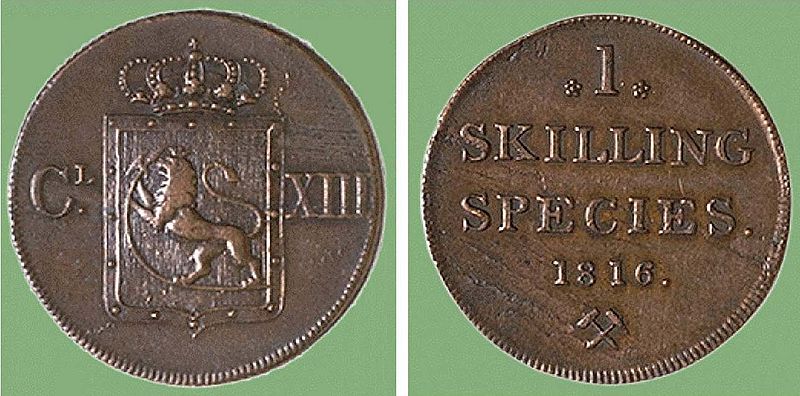
Further down the list on farm 49, the Mosenden Farm, was information about my 3GreatGrandfather Joen Olsen.  Joen and his family lived on the Mosenden North section.  His property had already been registered as being 7 units in area and having a tax of 3 ort and 13 skillings,  So far I haven't been able to determine the value of skylddalers, orts, and skillings in today's US currency, but I was able to find the picture below.

Norwegian Skilling, source: Wikipedia Commons

I also found another 2GGrandfather, Syver Hansen, recorded as the farmer for the south portion of the Bellen / Belden / Belle farm.  According to a family history, this farm had passed to Syver from his father Hans Syversen at the time of Syver's marriage in 1830. Quite a wedding present, and one I would like to be able to document.

A 4th Great Uncle, Hans Jorgensen, was recorded as the primary tenant of the Little Bjøkne section of Bjøkne farm.  Also living on Bjøkne farm on the Upper Bjøkne section was another 4th Great Uncle, Hans Bjørnersen.  Again, descendants of these two continued to live on these farm sections through the 1875 census.

The Overlien South section of the Overlien farm was home for yet another 4th Great Uncle, Syver Syversen.  His farm was taxed at a rate of 1 skylddaler, 2 ort, and 14 skilling.

I felt like doing the Genealogist's Happy Dance as I "read" over the property register.  Without the focused research of the past two months, I would not have recognized names of ancestors, relatives, farm names and sections.  And I would not have stayed so focused without the encouragement of Thomas MacEntee's Genealogy Do-Over.

Now if I plot the various farm locations on Google Map, I can see where people lived and perhaps better understand some of the relationships between the two Norwegian branches of my family tree.  Maybe I should take a look at the Real Estate Registers available on the Archives site to learn more about those living on the farms into the early 20th century.  And someday, I need to get my hands on a copy (or photocopy) of the Bydgebok for Lesja, a book tracing the history and land ownership in the Lesja Parish which was home to virtually all of my Norwegian relatives.  I might then do more of the Cluster Research that is a part of Genealogy Do-Over Week 9.  There is always something new just around the bend.

Monday, February 16, 2015

Wk#5GenealogyDoOver : Dealing With All Those Bookmarks

"PostIt Notes: by EraserGirl, source:  Wikimedia.org


Thanks to Thomas MacEntee's suggestions, some months ago I created a Research Toolbox on this blog.  It contains links to which I have referred in various blog posts as well as web sites I use on a regular basis.  Because it is not overly long, it has been easy for me to keep it current and updated as necessary.

Not quite the same with my genealogy related bookmarked web sites on my laptop. It is particularly bothersome in my list of web sites dealing with Norway, Immigration, and Naturalization.  Focusing on researching my Norwegian ancestors while participating in the Genealogy Do-Over has lead me to bookmark a lot of new-to-me web sites.  So much so, that my bookmark folder for Norway/Immigration was overflowing.  The same was true with a number of my other bookmark folders also.  The Genealogy Do-Over seemed like a good time to get these things under control.

My first step was to put all of my bookmark folders into alphabetical order.  (After all, I am a retired school librarian and teacher.)  Using Google's Bookmark Manager, it is simply a matter of highlighting a folder and dragging it to the place it needs to be.

The next step has been to put the bookmarks within a folder into alphabetical order.  It just makes it quicker to scan and locate the web site or topic I need.  This is another area where highlighting and dragging is an easy way to alphabetize them.  It also showed where I had bookmarked several parts of the same web site, something I really did not need to do whenever a web site itself had clear navigational links.  I then deleted the duplicate links.

I also took the time to see that the name of a link was descriptive and meaningful to me.  A web site that automatically saved with the title "Projects" meant nothing to me.  Taking the time to look again at the web site gave me a better idea as to how to rename the web site so I would actually find it when I needed some specific information.

Finally, looking at the links in my folder for Norway/Immigration showed that I had over 70 web sites  bookmarked.  That's a long list to scan when I'm looking for a specific web site or topic.  It also showed me it was time to move some of the links into a new folder.  It only took a few minutes to set up an Immigration/Naturalization folder and move all the applicable links into it.  By the time I finished moving links and removing duplicates, I had 38 links in my Norway folder and 20 links in the new Immigration/Naturalization folder.  The new folder will also prove to be useful when I'm researching immigrant ancestors from any country, not just those from Norway.

Contents of my new folder on Immigration / Naturalization

The process showed me that I need to take the time to look over my bookmarks as an annual project.  It turned out to be a  great project to assist me in locating resources for my current Norwegian research.  It was also a great project to tackle as I stayed warm inside and glanced at the snow falling outside.

Wednesday, January 28, 2015

Wk#4GenealogyDoOver : Getting From Here to There With My Research

Red River Gorge Rock Wall by By Jarek Tuszynski via Wikimedia Commons

Participating in the Genealogy Do-Over had made me so much more aware of my research strategies.  I've written previously about I've started being more methodical in tracking my research.  Now, as I continue to plow through digitized church records from Norway, I'm seeing that I'm following a path as I look for information about my ancestors.

My 2GreatGrandmother Marit Oldsdatter, according to the family history booklet I have, was born 26 Jan 1810 and died 23 Dec 1890.  Here are the steps I've followed to learn the names of her parents, siblings, and grandparents, steps I'm now using as I research other ancestors.  


  1. Using records on the Digital Archives of Norway, l found the parish record of Marit's birth.  The great thing about these records is that they (usually) provide the birth date, baptism date, names of parents, farm residence of father and mother, and names of witnesses to the baptism, usually other family members.
  2. After finding Marit's birth / baptism record, I knew her parents were Ole Jacobsen and Ronnoug Bjornersdatter.  Next I searched in FamilySearch.org's Norwegian records for any children born to these two parents.  This provided me with the names and birth dates of Marit's siblings, Jacob, Bjorner, Mary, Hans, Anna, and another Marit/Mari.
  3. Time to go back to the Digital Archives of Norway to find the digitized record for the birth / baptism of each of the siblings.  There is no substitute for being able to study the original record.  Having been a volunteer transcriber, I know that any transcription stands the chance of having an error recorded.  Seeing the actual record myself provides a second set of eyes on the document.
  4. Once I knew the birth order of the children, I started looking for the marriage record for Marit's parents.  Again, the original marriage record provides a lot of additional information.  Depending upon the year, the Norwegian marriage records can contain the marriage date, names and ages of the bride and groom, their farm residences, names of their fathers, names of bondsmen (who just might be other relatives), and possibly information about a previous marriage of either party.  Stuff that is definitely worth looking for.  Admittedly, finding the marriage record requires some speculation on my part.  My standard search plan is to look in the parish marriage records for 0-5 years prior to the birth of the couples' eldest child.  In the case of Marit, the oldest child, born in 1810, I found the record for her parents' marriage in the 1809 parish marriage records.
  5. After the marriage information of Marit's parents was located and recorded, I then started to look for the family in a census record.   Records for the 1801, 1865, and 1875 censuses are searchable through the Digital Archives of Norway.  If I've fortunate enough to find the family listed in one of these census records, I also can see, just as with US census records, who is living in the household, their ages, marital status, and occupation as well as basic information concerning their residence or farm.  In my search of the 1801 census I found Marit's father Ole Jacobsen, age 19, living with his parents and siblings on the family farm.  Marit's mother, Ronnoug Bjornersdatter, age 16, was living on a nearby farm working as a servant girl.
  6. Finding the family in a census record also provides an approximate birth date for any family members listed.  I loop back to Step 3 and search in a three year period for previously missing Birth / Baptism records.  This means searching the parish records for 1786-1788 for a Birth / Baptism record of a child listed as being age 14 in the 1801 census.  And this works just about every time.
  7. Death / Burial records are the last part of my current search strategy.  Finding them turns out to be much more of a "needle in a haystack" approach.  I start by searching the death records following the latest information I have for an individual, i.e. date of marriage, birth of last child, census record.  This "new" information becomes my starting point.  The first few times I tried this, I kept wondering WHY am I looking at so many records and how will I know it is the right record.  Bless those Lutheran clerics who recorded the farm residence so often along with the first name and surname of an ancestor.  If I can decipher the cleric's handwriting, I can then use Google Translate to determine the cause of death.  Once I found the death / burial record, I was also provided with the age at the time of death, enabling me to loop back to look for their birth / baptism record.    And so my plan continues.
As I watched pictures of the recent scaling of Yosemite National Park's Dawn Wall, I marveled at how much planning went into each inch of elevation gained by the two climbers.  I saw times when they had to drop back and try another route.  

The steps above are my planned route for researching my Norwegian ancestors.  Sometimes I get to where I want to be in a short time.  Other times I have to drop back and try something else, expand the years I search, head over to FamilySearch.org or check out any shaky leaves on Ancestry to see if there are hints I can follow up on or try to verify.  It is all part of getting from here to there.  It is also worth the effort.

Now, time to apply these steps to learning more about my three other 2GreatGrandparents from Norway.

Wednesday, January 21, 2015

Wk#3GenealogyDoOver: Tracking My Research

"Deer Mouse Tracks in the Snow"
by Jomegat.Jomegat, from Wikimedia Commons


Thomas MacEntee's Genealogy Do-Over is proving to be just the encouragement I needed to tweak some of my research habits.  Take "Tracking Research", one of the topics for this week.  Previously I had been fairly meticulous about recording where I found reliable information about a family member.  Not so, however, about where I had looked and not found anything of note.  Participating in the GD-O has changed that.

Some time back I had come up with a simple version of my Research Log as a Google Sheet to use during the GD-O time.  I showed a screen shot of it in a previous post.  Soon after I started using it, I added another column, Completed.  There is just something so satisfying about noting that a series of research tries finally has lead to success.  

Today, this is what my Research Log looks like as I am using it to learn more about my 4GreatGrandparents, Syver Syverson and Kari Gudbrandsdatter.  I'm finding that this Research Log is helping me stay more focused in my research.  


Prior to starting the Do-Over, I only knew that my 4GreatGrandparents were both alive at the time of the 1801 Norway Census.  Now I've started to use the Topic column as a To-Do List, indicating that I wanted to find Birth/Baptism, Marriage, and Death/Burial records for Syver and Kari.  Some of the information I have recently found through the record images available through the Digital Archives of Norway.  The items indicated in red show the things I still need to be seeking.  And that green box "DAofN Parish Register 4", that's where I will be starting to look for Kari's Death/Burial record once I finish writing this post.

Besides providing a focus for my research, tracking my research on this Research Log has proved helpful in other ways.  The Resource Used column lets me see where all I have looked for similar information about other family members.  I've also used the Date column several times to look for the name of a resource I remembered using at a specific time.  Now all my efforts to learn more about how my 2GreatUncle Siver Syverson came from Norway to Wisconsin has provided me with a list of places to look for records for other immigrant ancestors and relatives.

Sources of Emigration Records


Finally, I've discovered a great, unexpected benefit from using my Research Log so judiciously.  For the information I still have not been able to locate for a specific relative, I can do a quick copy of the topics and all six columns concerning that from the Research Log Google Sheet.  I then can paste it as a research note in Family Tree Maker so I can see sometime in the future where I have looked should I want to take another stab at locating an elusive record.

As Elizabeth McCracken said "if someone caught me when I was in the throes of tracking something elusive I would have told them: but it's out there.  I can feel it".(1)  And now I have the record to show my search for it.

(1)  "Elizabeth McCracken: Quotes".  www.Goodreads.com

Tuesday, January 13, 2015

#Wk2GenealogyDoOver : Taking a Look at Me


One of the suggested topics for this week's Genealogy Do-Over is to conduct a self interview.  I admit that it is easy to overlook recording our own information when we're knee deep in researching a branch of our family tree, but Thomas MacEntee has simple advice for us, "just start with yourself".  And it is time that I do more of that.

Thankfully, I received a gift that will help me.  Several years ago, soon after a son and his wife learned that they were expecting their first child, we two prospective grandmothers were given a copy of The Grandparent Book, a Keepsake Journal by Amy Krouse Rosenthal.(1)  It is a journal filled with simple prompts designed to jog our memory and space to record information we would like to share with our grandchildren.  It includes prompts about my family, where I grew up and other topics such as
  • Do you have any pets?
  • Where do you go on trips or vacations?
  • Some of my favorite quotes ...
  • What were some of your favorite books to read?
There is even space for pictures of me as a child, the house where I grew up, and a wedding photo.  When I first received the book, I wrote short paragraphs for five or six of the prompts, then placed that book on a shelf and frankly forgot about it until I read this week's topics.

Now the book is off the shelf with a pen clipped to the front cover.  Answering a prompt or two is something I can do while waiting for dinner to finish cooking, or having an extra 15 minutes before I need to leave for an appointment, or finding something productive to do when the night's TV offerings aren't particularly appealing.  My goal is to respond to most of the prompts by the end of this year, either through writing short paragraphs, listing information, or adding personal photos to the journal.  The book is also a reminder that there are a lot of ways to share and celebrate our family stories.

A second Do-Over topic for this year was to set some research goals.  Already I had decided to look for sources to validate (or question) information written in a family history booklet on one branch of my Norwegian Ancestors.  Remembering the Grandparent Book has provided me with another research goal as I write more information to share with my son and his family.  Once again, I'm finding that participating the Genealogy Do-Over is just what I'm needing to get me going for the new year.

(1)  Rosenthal, Amy Krouse  The Grandparent Book, a Keepsake Journal. Crown Publishing Group, 2009.  

Tuesday, January 6, 2015

Wk#1GenealogyDoOver : What I REALLY Need to Get Started

"The Road", uploaded by Geralt to pixabay

Following Thomas MacEntee's suggestions for week 1, it didn't take very long to take a quick look through the pile of papers next to my laptop.  I removed the few pertaining to my Norwegian research and put all the rest on the top shelf on a nearby bookcase.  Out of sight and (hopefully) out of mind, at least until a later time.

Now there are just a few things sitting on my desk, things I know I will use frequently:
  • The privately published Overli-Belle-Siem family history booklet - This booklet contains so many names, places, and dates that I hesitate to put it away.  I want to quickly verify information from those family group sheets.
  • "Norwegian Genealogical Word List" from FamilySearch.org - necessary for translating information when I'm looking at digitized Norwegian records
  • "Norway Occupations" from FamilySearch.org - ditto
  • "Parish Register Examples Norway" from FamilySearch.org - Just as US census records contain different information in different years, Norwegian parish registers changed the specific information recorded between 1814 and 1877.  Knowing which column has parents' names recorded makes it easier when I visually scan records.
  • Folder containing maps of Norway, Oppland, and Lesje, the home of many of my Norwegian ancestors; printouts of farm names and numbers
As I was on FamilySearch.org getting the links for the resources listed above, I found myself being distracted by some of those "bright, shiny things" Thomas MacEntee spoke about.  In this case, I saw links to pictures of parish churches and family farms in Norway.  Talk about something bright and shiny!  I allowed myself a few seconds to quickly look at each group of photos, then made a note (with the two links) in my Genealogy-To-Do list so I can return to the photos for a closer look at a later date.

I've also started to clarify what I do hope to accomplish over the coming weeks.  The Overli-Belle-Siem family history booklet is filled with information, but there are very few sources for the information found on the family group sheets.  I want to focus my research on finding sources for birth, marriage, immigration, and death records for my direct ancestors.

Finally, in an effort to stay focused on my research, I plan to have the following open on my laptop whenever I sit down to work:
  • Family Tree Maker with my Perkinson Family Tree open
  • My Genealogy To-Do List on Google Drive
  • My Research Log on Google Drive (see below) so I can easily see what resources I have used in searching for the same type of information for other relatives as well as noting where I've looked for my current ancestor
  • Downloaded edition of Evidence Explained so I can correctly cite my sources
  • StickyNote app so I know where I stopped last time and have a place to note where I'm ending things in the current session

I think I'm about ready to get started.

Thursday, January 1, 2015

Wk#1GenealogyDoOver : Getting Ready to Get Started

Do-Over Button from Geneabloggers.com

Nothing like a new year to spur me on to clearing up some messes.  Now I'm going to be looking a little differently at my genealogical research, especially the two Norwegian branches of my family tree.  Parts of it are a mess.

Thomas MacEntree's Genealogy Do-Over looks like it will provide the motivation and support for me to tackle some of my Norwegian "issues".  I especially like the four points he suggests we focus on in our Genealogy Do-Overs.

  • Capture everything and save for later.  For me this includes the reminder to actually take that close look at my saved material, then either save or delete it, based upon what I actually find there.
  • Build a good research toolbox and keep adding to it.  My list of support materials, web sites, and articles is growing because I continue to stumble onto new resources.  I need to add them to my blog's toolbox so I can share with others, just as others have shared with me.
  • Create to-do lists.  It is amazing how two days of a stomach bug or those wonderful holiday visits can cause me to forget exactly which trail I had been in the midst of following.  I need to do a better job with my computer "sticky notes" and with recording things in my research log.
  • Pay no attention to that bright and shiny object.  Focus, girl!  Focus!

Several days ago, I got a head start (sorry, Thomas) by trying to get some consistency in the way I have names recorded for these Norwegian ancestors in my Family Tree Maker software.  Because of the patronymic naming system, so many of these ancestors did not have consistent surnames until after they immigrated to America.  Some of what I've done in FTM is arbitrary, but it has already helped me locate names in my database by keeping siblings' names together in my A-Z list of names.  

  • Son of a man named Syver/Siver/Sivert is now recorded as Syverson (not Sivertson, Siverson, Syversen, etc.)
  • Daughter of a named named Syver/Siver/Sivert is now recorded as Syversdatter (not Syvertdtr, Siverdaughter, or any of the other combinations I have found.)
  • Because I am examining records from the Digital Archives of Norway from as far back as the mid 1700s, there is a wide variety in the spelling of names in birth, confirmation, marriage, and death records.  As I find another version of the name I am adding it to the FTM database, but keeping only the Syverson / Syversdatter name as the "preferred" or primary name.
  • Because some records and databases automatically add the name of the farm residence to a person's name, this gives yet another name for a number of my ancestors.  Another personal arbitrary decision has been to add these farm names as a "Residence" in FTM.  That way it will be easier to select the appropriate parish register to browse through.
  • For those ancestors changing their name after coming to America, I'm adding their Americanized name as yet another name in FTM.
Today's project as been to look back at one of my saved resources, a self published family history of the Syverson / Hanson / Belle, Siem family.  This 100 page booklet is a treasure, essentially a number of family group sheets, hand drawn family trees, and brief narratives about some family members.  I am so thankful that my mother finally met the cousin who wrote it back in 1980 and who gifted her with the copy I now have.  Although the information it contains is not sourced, it is filled with dates, names of spouses and children, and names of family farms.

Already I have found that I had previously incorrectly recorded several dates into FTM.  Other information I had entered into FTM but had not cited the family history booklet as its source.  And taking the time to read the narrative passages provided so many small bits of information - someone died of whopping cough, a father gave the family farm to a son at his marriage, and who immigrated to America with whom.  All things I had previously missed.

Now I feel I'm ready to get started.  I'm excited about being more focused in my work and hopefully that I'll learn more of our family story.  What caused so many to leave Norway and come to America in a 15 year time span?  How could they afford to bring those large families of 7-10 individuals?  How did they decide where to live?  Maybe I've already starting on my To-Do List.