Showing posts with label Amanuensis Monday. Show all posts

Monday, June 16, 2014

Mystery Monday: So That's How it Happened!

photo source : A Journal of the American Civil War, vol. five, no. 1.

Raleigh Camp taught at the Georgia Military Institute.  He served as a Captain in the 7th Texas Infantry, CSA.  Later Camp become a Major in the 40th Georgia Infantry, CSA.  These three basic facts had been part of the story for my 3Great Uncle, Raleigh Spinks Camp, but I had questions as I tried to connect these events.  Hence, my mystery.  And the answer came through a variety of resources.

Raleigh Camp was a graduate of the Georgia Military Institute.  Following his graduation he taught math at the Institute and was a charter member of the school's chapter of Sigma Alpha Epsilon fraternity.(1)

On 15 Dec 1859, Raleigh married Miss Laura Clifford Jones of Liberty County, Georgia.  Soon the young couple moved to Gilmer, Texas where Raleigh set up his law practice.  According to the 1860 census Raleigh and Laura have two bachelor lawyers and a young physician boarding with them in Gilmer, Texas.  Why Raleigh decided to practice law in Texas is still a bit of a mystery although there were several Camp relatives living in that area of Texas in the 1860s and earlier.

From reading the Camp Family Papers of Emory University, Raleigh Camp initially hoped for peace as the slavery issue began to divide the North and the South.(2)  By 2 Oct 1861, Raleigh was supporting the Confederate cause, joining the 7th Regiment of the Texas Infantry, and being elected Captain of Company B.(3)  The 7th Texas became part of the Army of Tennessee and saw action at the fall of Fort Donalson in Tennessee.  Raleigh, however, had been furloughed due to illness and was apparently with family in Georgia at the time the rest of the 7th Texas was captured by Union forces.  Among those captured was his younger brother Josiah Gresham Camp about whom I had written in a a previous post.  This meant that in February of 1862 Capt. Raleigh Camp had been separated from his regiment.


Letter to Gov. Joe Brown from Raleigh S Camp
source: Ancestry.com (4)

It look reading a letter Raleigh Camp had written to Governor Joe Brown of Georgia to understand his move to the 40th Georgia Infantry.(4)  In the letter dated 18 Feb 1862, Raleigh made two important points.  First, he spoke of being unable to return to the remnants of his troops now in Kentucky due to medical reasons.  Then Raleigh offered to be an instructor in military tactics at one of the training camps for the additional companies being raised in Georgia to fight for the Confederacy.

Things moved quickly following this letter.  Within a month, by 19 March 1862, Raleigh has been transferred from the 7th Texas to the 40th Georgia Infantry.  Two days later, he was elected Major in the regiment.(5)

Raleigh Camp remained with the 40th Georgia, serving as its Acting Inspector General as well as in other staff positions.(6)  Along with thousands of other Confederate soldiers, Raleigh was captured at the Battle of Vicksburg and later paroled.  Later, Raleigh would write of his experiences in the Battle of Vicksburg in his personal memoir What I Know, I Know, and I Dare Express It.(7)

From reading family letters to examining military records on fold3.com and additional records on Ancestry.com to books accessed online as well as held in my hand, a lot of resources played a part in connecting the Georgia - Texas - Georgia dots.  Sometimes, we find an answer in one wonderful resource.  Other times, as with Raleigh Spinks Camp, it takes a variety of resources across time to get to that A-Ha moment.  

Now, if I could just learn why Raleigh and his wife Laura headed to Texas rather than settling somewhere in Georgia ...

(1) Nash, Howard.  Sixth General Catalogue of Sigma Alpha Epsilon (1904); accessed through Google Books.
(2) "Camp Family Papers, 1858-1877"; Manuscript, Archives, and Rare Book Library (MARBL) of Emory University in Decatur, Georgia. 
(3) "R S Camp", Compiled Service Records of Confederate Soldiers Who Served from Organizations in the State of Texas, accessed fold3.com 
(4) "R S Camp to Joseph E Brown, 18 Feb 1862",  Georgia Civil War Correspondence, 1847-1865, www.ancestry.com
(5) "R S Camp", Compiled Service Records of Confederate Soldiers Who Served from Organizations in the State of Georgia, accessed fold3.com 
(6) Henderson, Lillian.  Roster of the Confederate Soldiers of Georgia, v.4. Hapeville, GA : Longrine & Porter, 1959-1864. 
(7) "Major Raleigh S Camp's History of the 40th Georgia Infantry in the Vicksburg Campaign", A Journal of the American Civil War, vol. five, no. 1.

Monday, May 26, 2014

Amanuensis Monday : The Camp Family Papers: Soldier, Husband, Father, Friend

Camp Letter 29, Thomas Camp to Mary Camp (1)

Soldier, husband, father, friend.  On 10 March 1864, a Confederate soldier wrote this short letter to his wife Mary.  In it his words showed many facets of the man who was my second GreatGrandfather, Thomas Lumpkin Camp.

Thomas Camp the Soldier

Camp 40th Georgia
March 10, 1864
Hoods Corps, Stuarts Division, Stovall Brigade

My Dearest Mary,

…...  We are having fine weather now for our military duty.  I have not been on any guard duty since I have got back.  We have got 30 men in our company.  Capt. Mc has not got back yet; he is at Kingston Hospital.  Lt. Murphy left the day before I got here.  He left here sick.  He is at Matterson, Georgia so John and myself is running the concern. ….. I have one consolation and that is this war can not last always.  There is an end to it though I may never live to see it.  Let me live long or die soon.  I am going to try to do my duty the best I can.

[As in so many of his letters, Thomas was apparently free to write about the location of the troops, the battles, and various military personalities.  No redaction here.]


Thomas Camp the Husband

….. Did you get my letter of the 5th?  I sent you $50.  If you have not sent the things I wrote for and Anderson thinks there is danger in sending them, you can pay the money to your father.  I will pay Dave this $20 but if you have sent them, it is alright.  I received your letter of 7th; ….. [the mail] is coming right through.  As I said, if your father should need his money, you can let me know, and I will send it to you at once. ….. .  I will send you $20 in this letter.  I know it is a bad way to send money.  You can pay it to your father, don’t keep it on hand.

….. You must take good care of yourself if you should take the measles.  This is a very good time of the year to have them.  You must recollect that when you think you are well, then the danger comes.  I hope you will not take them until I can be at home, but when will that be?  I have no hopes of getting home not before next winter.  If I should come, I will.  That seems like a long time to have to stay away from those that are so dear to me.


Thomas Camp the Father

….. I am glad you have the chance to send Lou to school.  I hope you will be able to send her all the year.  Try to encourage her all you can.  Try to get her to love to go. ….. May God be with us in all our trials and troubles and keep us from evil.  Write soon and give my love to all.
[Lou was Louise, the oldest of Thomas and Mary’s children.  At six, she was able to start attending school.  These few sentences are especially dear for me for I know the tradition of teachers among Thomas’ descendants.  Some of these teachers include six of Thomas’ granddaughters, at least two of his great granddaughters, and one greatgreat granddaughter.  I think Thomas would have been pleased to know of the family through the years who apparently loved to go to school.]


Thomas Camp the Friend

….. Dave is not very well, nothing serious, he was cold.  Lt. John says he is after the gal that bakes the cakes.
[Were this sentence written today, it would definitely end with a smiley face emoticon!]


Lesson Learned:  Once again I am grateful that Mary Ragsdale Camp kept these letters and that a great granddaughter later donated them to Emory University.  Each letter I read provides a little more information about these relatives as well as insight into their lives.  There are several additional Camp family letters among my family archives.  I need to look seriously at them and see if there might be a better place for them to reside than in my file box.

(1) This letter is a part of the "Camp Family Papers, 1858-1877" which are housed in the Manuscript, Archives, and Rare Book Library (MARBL) of Emory University in Decatur, Georgia.  The letters was transcribed using Transcript freeware.  Some of the spelling, punctuation, and syntax were corrected in this post for ease in reading.  ... is used to indicate portions of the letter which were omitted in the post.  [ ] indicates a word or information I have inserted for clarity.

Monday, May 19, 2014

Amanuensis Monday: The Camp Letters* -- Thoughts on War

"Writing a Letter" By Petar Milošević (Own work)
[CC-BY-SA-3.0  (http://creativecommons.org/licenses/by-sa/3.0)], via Wikimedia Commons
Raleigh Spinks Camp was a learned man, a teacher, and a Confederate officer.  Among the collection of Camp Family Papers were a number of letters written by Raleigh to his mother Penelope Willingham Camp (my third GreatGrandmother), to Thomas and Mary Ragsdale Camp (my second GreatGrandparents), and to other members of the Camp family.  In these excerpts of letters to family members, Raleigh did not hesitate to express his opinions and his emotions related to the possibility of war and later concerning the Civil War itself.*

Gilmer, Texas
January 1, 1861

My Dear Mother,

... I really have no news to write you.  Times are hard. money scarce and much talk about fighting, but even in the midst of all these, I hope for a more bright and better day in the future when money will be more plentiful, corn cheaper & peace either in or out of the Union.  These was considerable talk some time ago about Secession, but I now believe that Union sentiment will prevail ...

Raleigh

* * * * * * * * * * * * * * * * * * * * * * * * * * * * *

Gilmer, Texas
March 25, 1861

My Dear Brother,

... Times are here like everywhere else, pretty hard.  We are sometimes excited about war and sometimes we are not.  You have doubtlessly heard that Texas is out of the Union, but we had to work [to] get it as there are in Northwestern Texas many Abolitionists, and then our Governor, Sam Houston, was a strong Union man, but the battle is fought, and the victory won thus far.  As to what Mr. Lincoln will do, I cannot tell, only that I feel certain that he will fail to coerce the southern states, should he try it.  I hope for the sake of peace, he will not ...

Raleigh

* * * * * * * * * * * * * * * * * * * * * * * * * * * * *

On 2 Oct 1861, Raleigh Spinks Camp became a member of the Confederate troops being raised in Texas and was named Captain of Company B of the 7th Texas Infantry.  In less than a year, Capt. Camp was released from the 7th Texas Infantry when he transferred to the 40th Georgia Infantry.  Through his years with the 40th Georgia, Raleigh continued to write home to his family back in Georgia.


Camp near Big Creek Gap
45 miles from Knoxville, Tenn
1st June 1862

My Dear Sister,

... There are some Yanks on the other side of the mountain, and we sometimes hear that they are coming over to see us.  We are ready to give them a warm reception, I for one want them to try it.  I want to see a fight, not that I am reckless of life at all, but I want to bear my part in the bloody contest.  If tis my fate to fall, let me share it in common with thousands of my countrymen engaged in our great and glorious struggle for independence and the Rights of Man.

... We must meet the Enemy as he is strong and powerful, and it will require all our strength to do so.  Now is the time I am very anxious to hear from Richmond.  The battle there must be a great one, one upon which depends a great deal.  Should our Army stand and drive back the enemy there, then I think they [the Enemy] will begin to think the war a bad bargain, and it might lead to peace.  Should we be routed, then a long war will follow.  As to subjugation, I repel the charge.  I cannot think of such a thing.  I will go barefoot in these mountains, dress with a sheep shin, and eat parched corn for years before I will submit.

... O may God not forsake us in our deep distress and grant us grace sufficient for all our trials.


Yours truly and affectionately,

R S Camp

* * * * * * * * * * * * * * * * * * * * * * * * *

Tazewell [Tenn], 10 Sept 1862

Dear Sisters,

… I am 10 miles from the [Confederate] Army which [is] lying before the [Cumberland] Gap.  Yet how long they will remain there, there is no telling.  The Yankees are not starved out yet, nor do I know when they will be.  I am of the opinion that they are a hard set to starve, but then some deserters from them say that they have but little to eat.  If this be so, they must run or fight us soon.  The last news from some days past is encouraging indeed, enough to convince any sensible man that the North will never whip the South.  It seems they ought to be satisfied that Virginia is a hot place for them.  I think that Kentucky is to be a great battleground, and I will be there as soon as the Gap is cleared.  

O, my dear sisters, these are trying times indeed, and when they will end, God only knows.  If they still wage it upon we, we will continue to fight with them.  Our soldiers are fighting for liberty, home, and our loved ones and never will they cease to fight …

Raleigh

One man's thoughts,  Expressed about one war.  Like those expressed by so many on both sides of the fighting in numerous wars.

* These letters are a part of the "Camp Family Papers, 1858-1877" which are housed in the Manuscript, Archives, and Rare Book Library (MARBL) of Emory University in Decatur, Georgia.  The letters was transcribed using Transcript freeware.  Some of the spelling, punctuation, and syntax were corrected in this post for ease in reading.  ... is used to indicate portions of the letter which were omitted in the post.  [ ] indicates a word or information I have inserted for clarity.

Monday, May 12, 2014

Military Monday: The Camp Papers*: Disease and Death Among the Troops

"Wounded Man in a Hospital Bed"
By Kennington, Eric Henri (RA) [Public domain], via Wikimedia Commons

In April of 1862, Major Raleigh Spinks Camp wrote the letter transcribed below to his brother Thomas Lumpkin Camp and wife Mary.  His letter provided interesting insights into the presence and effects of disease among the 40th Georgia Infantry during the Civil War.(1)

Knoxville, Tenn.  4th April 1862

Dear Brother & Sister,

As I will not get to make you another visit as I so much wished, I will substitute a letter, the only alternative I have to chat with you.  My health is very good indeed;  [I] am improving rapidly [from my wound] and hope to soon be myself again ...

There is a good deal of sickness in our Regiment, now at least 100 on the sick list.  One from Floyd County [Georgia] died Monday and two this evening, one from Gordon [County] and one from Paulding [County], the latter by the name of Jos Cole.  In one short week, three stout men have died.  Pneumonia is the disease that cuts them off so quick.  Lewis Camp has it but was back and will be up soon I think.

I have seen so much in the last six months that it does not surprise me at all.  I expect men to sicken and die in camps.  More die, by far, than are killed by the enemy.  Many of the men are scared, but, poor fellows, they have seen but little yet.  They do not see the future before them and how wise God is to conceal it from us ...

I suppose William will be here by the time you get this.  His stay will be short, and I now see that it will be best for him to stay at home as long as possible.  Measles and other camp diseases would be a great risk for him, and his family needs him worse than he is aware.

[Raleigh's brother William Brooks Camp joined the 40th Georgia on 15 May 1862.  Within six weeks, on 2 July 1862, William had died of measles.(2)]           .

Kiss all the children for me, and write me soon and often.  And may the Lord bless us all.

Goodbye,
Raleigh

* This letter is a part of the "Camp Family Papers, 1858-1877" which are housed in the Manuscript, Archives, and Rare Book Library (MARBL) of Emory University in Decatur, Georgia.  The letters was transcribed using Transcript freeware.  Some of the spelling, punctuation, and syntax were corrected in this post for ease in reading.  ... is used to indicate portions of the letter which were omitted in the post.  [ ] indicates a word or information I have inserted for clarity.

(1) "Dear Brother & Sister" 4 Apr 1862; letter no. 14, Camp Family Papers, 1858-1877; Manuscript, Archives, and Rare Book Library, Emory University, Decatur, Georgia.
(2) Henderson, Lillian. Roster of the Confederate Soldiers of Georgia, vol. 4. Hapevile, GA : Longine & Porter, c1959-1964; accessed through www.hathitrust.org.

Monday, April 28, 2014

Amanuensis Monday: The Camp Family Letters* - Josiah Camp, Living the Bachelor's Life

"Hare and Hound" from openclipart.org

After traveling over a thousand miles, Josiah Camp settled in Pittsburg, Texas, living near his older brother, Raleigh Sparks Camp.  From this letter to his brother and sister-in-law, Thomas and Mary Camp, Josiah seemed to be enjoying his life there.

Pittsburg, Texas   Nov. 9, 1860

My Dear Sister,

I have just rec’d yours of the 28th Oct. and O! the joy it gave to me.  I was truly glad to get it [as] I had been looking for it some time.  Just to hear that you are all well gives me satisfaction, but then when I get a letter from you, I always get a full history of interesting news. ...  

I am sorry for Jim C but not at all surprised & as you remarked when one falls down, everyone gives him a kick (I have had some experience and long ago felt the result).  But as every dog has his day, I am now satisfied that it was all for the better ... but as to Miss Susan, I’d like to see her and hear some of her dry fun. ... Tell her if I go back, I will call on them and tell her something of the ways of us Texans & perhaps ask her to come out ... Mary, we have some girls out here that would hurt your teeth to look at them, & ... I have some strong friends here & not an enemy in this place that I know of.

Monday [Nov] 12 - I, after spending a very pleasant Sabbath, go forth to finish my letter.  I will write you how I spent yesterday.  I went to a Singing in the morning and after Chimes, I and a friend (a South Carolinian) rode out two miles to an old farmer’s and spent an hour and ate watermelon then back home and went to a wedding (4 o’clock).  I stayed a few minutes … after which I carried the prettiest girl in Pittsburg to church & then carried her home & spent about two hours with her & went home (there were four more in [the] company).  After I returned (12 o’clock) there were … two splendid fiddlers.  All went out and gave the new married couple a good Shivaree, [Dictionary.com defines a shiravee as a "mock serenade with .... noisemakers given for a newly married couple"and after this we returned to our rooms and went to sleep.  Now don’t you think I ought to enjoy myself?

I rose early this morning, made me a fire, and sat listening to the wild geese as they were passing, and soon as it was light I took a stand at the door and amused myself for about an hour shooting wild pigeons as there were a great many passing over. ...

Mary, I have just given you a few outlines that you may know I am getting on ...  I can’t say that I will die in Texas, but then I am satisfied it is a good country .

I have wrote enough. ... Write often & believe me [the] same old Joe.

When Josiah indicated that he didn't know whether or not he would die in Texas, he probably had no idea how prophetic that statement was.  A year later, his path would had taken a different turn.

* This letter is a part of the "Camp Family Papers, 1858-1877" which are housed in the Manuscript, Archives, and Rare Book Library (MARBL) of Emory University in Decatur, Georgia.  The letters was transcribed using Transcript freeware.  Some of the spelling, punctuation, and syntax were corrected in this post for ease in reading.  ... is used to indicate portions of the letter that were omitted in the post.  [ ] indicates a word or information I have inserted for clarity.

Monday, April 21, 2014

Amanuensis Monday: The Camp Family Letters* - Josiah Camp, Ready to Paddle His Own Canoe

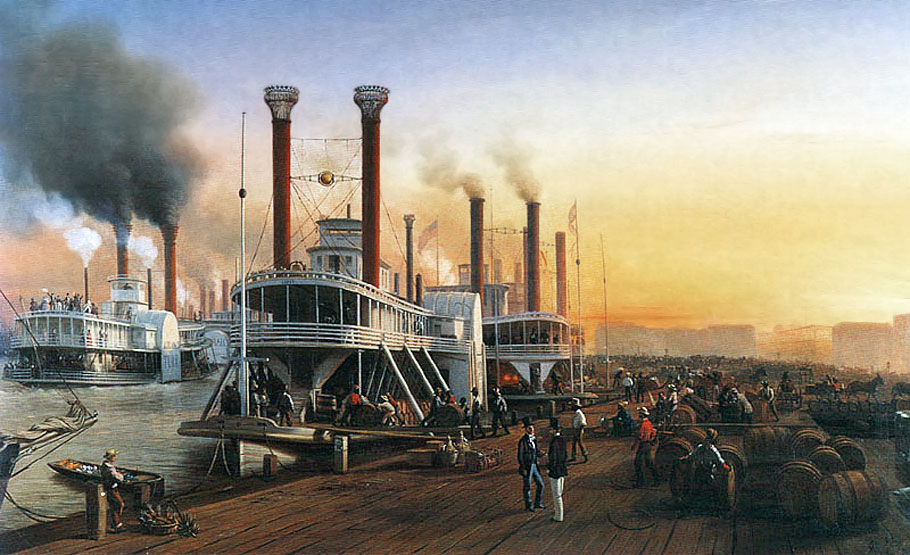
Giant Steamboats at New Orleans, 1853, painting by Hippolyte Sebron
source:  Wikimedia Common
s

Josiah Camp, my 3 Great Uncle, left his home in Georgia at the age of 21, heading west for a life of adventure.   This letter was written by Josiah to his brother Thomas Camp and sister-in-law Mary, about midway on his journey.

New Orleans, Saturday, 21st April 1860

My Dear Brother & Sister,

I this morning seat myself to let you know where I am & how I am a getting on.  Well as to health, I never felt better in my life & spirits are good… I have got this far rather better than I expected.  I have had no delay until now, reached this place yesterday morning at 8 o’clock & will not leave until 5 this evening.  I shall reach Jefferson in about one week if good luck…When it comes to changing boats, only 20 or 30 minutes to change in and 2 or 3 hundred passengers & a half a mile to go by omnibus.  You may be assured that it takes all a man can do.  I have got on this far without being left, but I have had to run a half a mile at a time.  Mr. Melton got left at Mobile by being slow & a good many more.  I went aboard a vessel yesterday & … they found me a bed & board.

If anyone should ask you about me, you can tell them I am a getting on finely.  I have not  been drunk nor had a card in my hand since I left, & you all know for yourselves as to what I done before I left Georgia. … If and when I get settled in the West & any [of my friends] ever should come near me, I shall do all in my power for their welfare & happiness.

I have seen a good deal since I saw you, but I cannot begin to describe half, and even if I could, it would hardly be worthwhile as you have a very good idea of the manner in which business is carried on in these large cities.  The streets are full of people and omnibuses, and they don’t poke along, but all go like they were a running a race.  If you were in Marietta & see a person going like they go here, you would be right often asking him what was the matter!  And, if you was to see one load and drive like they do here, you would first look for them to break down & then … to see them killed for you would think the horses were running away all the time.

… I have traveled about 1000 miles since I left you, but my heart is very closely connected with yours.  I often think of the pleasant hours spent with you, and it seemed as though we always got on as smooth as anybody could. … When I left you, I left some of my best friends.  When I get to thinking of some of the friends … of old Georgia and then think that I shall never have the pleasure of seeing some of them anymore, it has a kind of a sad affect upon the heart of one that values a true friend as highly as I do.

I am satisfied that there are places where I can make more [money], & that is the place for me as I have nothing but my labor to depend on.  As a matter or course, a man’s business pays the best where he is apt to be the best satisfied … especially a man of my age & standing.  If it was not [for] … some other things, I don’t know but I would stop in Louisiana this year as there is a man on this boat that says he would pay me well for my services, & he stands in need of someone.  He has a store and a plantation and says he would let me have my choice of places to stay so I am not uneasy about something to do if I have my health.  This man is going out in Texas after a son of his that is sick… He says he would be willing to pay my way out there and back if I would go with him & hire me for the year & pay me from the time we landed at Shreveport.

I want you to write Mother at once & tell her not to be uneasy about me for I think I can paddle my own canoe.  Tell her she need not grieve after me.

… Tell all to write & do the same yourselves & believe me to be [your] good fine friend and brother,

                                                Jos Camp

 Because of his travel in April and May of 1860, Josiah may have been omitted from the 1860 census.  By August, 1860, Josiah was situated in Pittsburg, Texas, from which he wrote more letters back to the family in Georgia.  His adventures were just beginning.

* This letter is a part of the "Camp Family Papers, 1858-1877" which are housed in the Manuscript, Archives, and Rare Book Library (MARBL) of Emory University in Decatur, Georgia.  The letters was transcribed using Transcript freeware.  Some of the spelling, punctuation, and syntax were corrected in this post for ease in reading.  ... is used to indicate portions of the letter which were omitted in the post.  [ ] indicates a word I have inserted for clarity.

Monday, February 3, 2014

Amanuensis Monday: Confederate Pension Application for Thomas Nelson


Pension affidavit, page 1 of 2, Thomas Nelson
source: Georgia's Virtual Vault

When Thomas Nelson first applied for an indigent veterans' pension, his request was denied.  About a year later, he reapplied, making the following sworn statement.  This 2-page document is part of the Confederate Pension Files, State of Georgia, accessed online through Georgia's Virtual Vault.(1)

Georgia, Bartow County
In person appeared before me, Thomas Nelson and for amendment to his former application, on oath says that he was left in charge of Pinkney Hasty and Billie Murphy, two comrades who were wounded in The Battle of Jonesboro GA fought Aug 31st 1864; that Major Jackson ordered him to take charge of said comrades and care for them until they got well or died.  In a few minutes afterward Major Jackson was killed; that he took charge of the wound men, carried them to a private house in the country; staid (sic) with them and waited on them about one month when they got so they could ride on the train and he sent them to the hospital in Augusta that by this time or rather before this time Gen. Hood was on his march back to Nashville; that he started on his way following Hood’s Army with the intention of rejoining his company; that when he reached Atlanta Major Proctor advised him to fall in with his command, as it would be imposs’le to reach his (Nelsons) command; that he told Major Proctor that if it was all right he would do so, and he then was put in charge of a commissary in Atlanta by Major Proctor.  This was as he now remember in October 1864.  In the meantime Gen W T Wofford came to Atlanta with his command and took charge of all the command that was stationed in Atlanta; that he remained in this command under Gen W T Wofford till the close of the war.  That he surrendered at Kingston, GA May 12th 1865.  Applicant states that all those who knew him who could testify to the foregoing facts are dead so far as he can learn.  Both of the wounded comrades with whom he was left have long since died; that applicant served faithfully in the army for three years with the exception of a furlow of eight days; that he is now old, poor, weak – no means of support – all gone but his old woman.  Has to live hard with no comforts but the presence of his old woman who is old and feeble but who shares his poverty and want.
Sworn to and subscribed before me. Sep 4th 1907
G W Hendricks Ordinary
Bartow County Ga
[signature] Thomas Nelson

This affidavit contained some interesting information
  • Although he had signed an oath in 1863  to no longer take up arms for the Confederate cause, Thomas indicated he was part of Company B, 34th Georgia Infantry for at least another year and did not surrender until 12 May 1865.
  • Pinkney Hasty and Billie Murphy, the soldiers he stated he cared for, were also members of Company B, 34th Georgia Infantry.(2)
  • Gen W T Wofford was William Tatum Wofford of the Georgia 18th.  "Wofford's Confederate soldiers were the last significant troops east of the Mississippi River to surrender to the union." Their surrender took place 12 May 1865 at Kingston, GA.(3)
Thomas' statement was apparently enough to secure his Confederate Pension and the subsequent Confederate Widow's Pension received for a number of years by Hannah Hillhouse Nelson.  

My favorite part, though, is Thomas' references to Hannah.  Thomas stated that he had "no means of support – all gone but his old woman (Hannah).  Has to live hard with no comforts but the presence of his old woman who is old and feeble but who shares his poverty and want."  Hard not to smile at these words.


(1)  "Confederate Pension Applications." Database and images.  Georgia's Virtual Vault.  Georgia Archives.  http:cdm.sos.sate.ga.us:2011/cdm/
(2) Henderson, Lillian.  Roster of Confederate Soldiers of Georgia , vol. 3. www.hathitrust.org.
(3) "W. T. Wofford", New Georgia Encyclopedia, http://www.georgiaencyclopedia.org.

Monday, November 4, 2013

Amanuensis Monday: Helping the Widow Padgett*

* The Civil War records I downloaded from fold3.com about my husband's Great Grandfather Jesse Padgett, provided a wealth of information about Jesse.  The records also included a number of papers pertaining to Jesse's widow and her efforts to secure a pension following his death.  Below I have transcribed two of the records involving Parthenia, the Widow Padgett.


Note from Confederate Records for Jesse Padgett
source: www.fold3.com

State of Georgia
Fulton Co
[no date]
I do hereby constitute and appoint Capt Thos E King my attorney to collect for me what is due to my deceased husband by Confederate States for services rendered and commutation for clothing and any pension that may be due me as his widow.
[signed] Partheny Padget X her mark
J. L. Wood [and] J Roswell King Witness


Letter from Confederate Records for Jesse Padgett
source: www.fold3.com

Office Ivy Woolen Mills
James Roswell King [and] Thomas E King
Roswell, Cobb Co., Ga, 10th Apr 1862

Mr. W A I Taylor, Auditor
Treasure Dept CSA 2nd Auditors Office
Richmond, VA

Dear Sir,

Enclose please find certificate marriage Parthany Padgett, widow of Jessee Padgett private Co H 7th Regt Ga Vol who enlisted as a recruit 22nd Aug 1861 and died at 2nd Ga Hospital Richmond Va 2nd Jany 62.  Also I send her power atty.  You will please send me certificate of amount due her as his widow and commutation for clothing and any dues that may be due her as I am under the impression that the pay of deceased soldiers was confirmed to their families.  I acknowleged rect of certificate for Mrs. Jno Gossett.  The claim of Mrs. Jas Burton which I have before you has not been attended to.  We rejoice with humility before God for the great victory over the vandal Yanks.  It makes me almost forget my wound.

Very truly yours
Thos E King, Capt
7th Regt Ga Vol.

Additional information pertaining to the note and letter:
  • The note names Thomas E King as her attorney to act on her behalf.  It is not dated but was probably written on or before the April 10th letter.
  • The letter seems to be the earliest correspondence seeking to obtain any death benefit due Parthenia Padgett by the Confederate States of America following the death of her husband Jesse Padgett.
  • Thomas E King was one of the owners of Ivy Woolen Mills, Roswell, GA.  The company was a manufacturer of the "Roswell Gray wool" used in the manufacturing of Confederate uniforms.(1)
  • Thomas E King was the captain of Company H, 7th Regiment, Georgia Infantry, Pvt.Jesse Padgett's unit at the time of his death, 2 Jan 1862.  Capt King was wounded at the Battle of 1st Manassas,  21 Jul 1861.(2)
  • Jno Gossett (John E Gossett), the 4th Sergeant of Co H, was wounded at the Battle of 1st Manassas and died from his wounds 14 Aug 1861.(2)
  • Jas Burton (James A Burton), private in Co H, was wounded at the Battle of 1st Manassas and died from his wounds 8 Aug 1861.(2)
For me it was interesting to see that the Confederate States already had a system in place in its early days for attending to pensions for their soldiers or their widows.  There is significance also in seeing that Capt Thomas King was the attorney seeking pensions for the widows of three soldiers from his company.  As I have hear before, a good officer always takes care of his troops.  Whether he was paid to do so or not isn't as important as seeing how Capt. King was continuing to care for his men and their families.

(1) Brown, Fred, et al.  The Riverkeeper's Guide to the Chattahoochee. University of Georgia Press, 1997. Digital images, accessed through Google Books.

(2) Henderson, Lillian.  Roster of Confederate Soldiers in Georgia, vol. 1.  Hapeville, GA : Longine & Porter, 1959-1964.  Digital images.  http//www.hathitrust.org : 2013.

Monday, June 3, 2013

Amanuensis Monday: Looking for Louie - The Letters


Photo by  Petar Milošević  via Wikimedia Commons
Several years ago,  I transcribed a number of letters that were found as the family was cleaning out the Nelson family home.  Most were letters between my husband's parents, but tucked among these were two letters written by Louie Love Padgett.  I want to share parts of them because each provides more insight into Louie's character and his life.

Letter #1 - letter only, no envelope or date on the letter.  This letter was written by Louie to his father, John Adel Padgett.
Emory University, Ga
Dear Daddy;
I should have written you before this time, but I have never in my life had as much work to do as I am having now, it seems. ... I am enrolled in the School of Theology and enjoy the work there fine.  But instead of teaching one class as I expected to do, I am teaching two.  That makes five hours a day in actual class room work.  The preparation of these lessons naturally takes a lot of time.  I am also playing some foot-ball, taking practically all my time for these and other things that fall to my lot.
I am enclosing a check for the five dollars that you so kindly loaned me.  Thank you very much for the assistance.  
Louie
We had always heard that Louie taught at Emory, possibly at the Candler School of Theology.  This letter provides some confirmation for this family story.  How I wish it had been dated.  This was also the first mention we had found about Louie, the athlete.  As mentioned in the previous post about his college years, most of Louie's activities focused on academic and ministry related organizations.  Once again, we learned about another facet of Louie's life.


- - - - - - - - - -

Letter #2 - envelope postmarked 15 February 1926, Tallahassee, Florida.  This letter is written on business stationary with "L. L. Padgett, Oakman, Ga, European Tours Under the Business Management of Temple Tours, Boston, Mass" printed across the top of the paper.  The letter was written by Louie to his younger sister Jennie.

Dear Jeannie,
... I'm real proud to know that you are teaching, and I am sure you will find it agreeable work in spite of some discouragement and vexations that are incident to all worth while undertakings.  You will have bright days of happiness and contentment when you are aware of achievement and progress in your work.  You will have days of dark discouragement when you fail to see the real results of your labor.  Those days are just like the other days -- only it is our failure to see it that makes them seem darker.  Dejection of the spirit in that way is only "growing pains" that lift us higher and enable us to step forward more confidently the next day.

My own work has not been all a bed of roses. ... Traveling is difficult and lonely ... but my health has continued good.  Now there is a touch of spring in the air -- birds sing in the morning -- violets are blooming in the field -- jonquils and other flowers lend their beauty to the lawns.  I'm glad I'm living and its a good world. ...

Your devoted brother,
 
Louie
I love the gentle tone of this letter.  What a comfort it must have been to young Jennie to receive encouragement and understanding from a big brother as she was teaching school at the age of 19.  I would really have appreciated such a letter during my first year as a teacher!

The other important bit of information in letter #2 comes with the stationary Louie used.  By 1926, two years following his return from China, Louie was associated with a tourist agency.  According to the 1926 Boston City Directory, Temple Tours "took more people from America to Europe in small personally conducted groups ... than any other tourist agency in the world".(1)  Was he organizing tours to France, across Europe, or even to China?  Maybe someday someone in the family will stumble upon  a travel brochure detailing one of Louie's tours.

Looking for information about Louie continues to be interesting as we find information in such a variety of resources.

(1) U.S. City Directories, 1821-1989; database and online images; Ancestry.com (http:www.ancestry.com : accessed 29 May 2013); citing The Boston Cirectory 1926 (Boston: Simpson & Murdock Company, 1926).

Monday, January 21, 2013

Amanuensis Monday: Miriam and Her "Variety Book"

Miriam F. Vaughan, ca 1900
Imagine being 17 and suddenly have to move over 700 miles, just because your father got a new job.  It isn't that unusual today, but in 1898, it was much less common.  Miriam Frances Vaughan was 17 years old when her father, my Great Grandfather Albert Bell Vaughan, left Canton, Georgia, to become the minister of the Baptist Church in Nacogdoches, Texas.  The family moved to Texas and lived in Nacogdoches from July 28, 1898, to Nov. 26, 1899, after which they returned to Georgia.  From Miriam's vantage point, it turned out to be interesting time.

During those 16 months in Nacogdoches, Miriam kept a diary of sorts, penning her first entry the morning after they arrived in Nacogdoches and her final entry being written their last night in Texas.  Perhaps the book had been given to her as a farewell gift by family or a Georgia friend.  Her "Variety Book" is filled with quotes from literature, song lyrics, pressed flowers carefully attached to pages, and details of daily life.  Scattered throughout the 200 page book were also sermon topics, lines from hymns, and scripture - after all she was the preacher's daughter.   For me, her small book gave a personal and interesting look at being a young lady in the late 1890s.

The 4x6 inch faux leather book was given to me about 14 years ago by an elderly cousin.  For years, I had kept it just sitting on a table with a few other family heirlooms.  Recently I took the time to transcribe the book, and by doing so I started getting to know my Great Aunt Miriam.

The first thing that was apparent was how well educated Miriam was.  Her vocabulary was extensive, and running my 36 page transcription through a spell checker showed only ONE word which she had spelled incorrectly!  Even more impressive were her personal reading lists written in several parts of her Variety book.  Miriam had attended college in Georgia prior to their move but did not while in Texas.  On her own, between late September and early July she read four plays by Shakespeare, Vanity Fair by Thackeray, David Copperfield, Lorna Doone, works by George Eliot, Oliver Wendell Holmes, and popular writers of the day, plus my favorite on her list, Little Women.  Miriam obviously loved to read, sometimes receiving books and magazines as gifts from others.

Being an 18 year-old, single female in 1898-1899 was quite different from life today.  Her social activities were almost always planned by ladies of the community - picnics, parties, watermelon cuttings, simple activities.   Perhaps because her mother was looking after seven younger children, Miriam also spent a lot of time "calling on" ladies of the church.  For other entertainment Miriam also wrote of seeing a traveling minstrel show that was in Nacogdoches, a theater production of Christopher Colt, Jr., a popular play of the time, and attending band concerts at the local college.

Whenever Miriam and any of the eligible young men of Nacogdoches kept company, they were always with others.  Even an invitation for a buggy ride was to a public area and sometimes accompanied by friends.   Since her father was the minister, It wasn't surprising to see the number of gentleman who asked to accompany her to church services.  One Sunday evening, a dinner invitation prevented her from being able to attend the evening church service.  Her entry for that night showed how torn she had been between having fun with friends and doing what she knew was expected of her.  The other suitable escort for social activities turned out to be her 16-year old brother who was apparently willing to exercise this task so he could talk with some of the other young ladies present.

Miriam seemed to have made friends easily in Texas and wrote often about spending time with a close group of girls.  Early on Miriam was invited to be a member of the newly formed Pierian Chataque Circle, a literary and social club for young ladies.  This same group of friends spent the night at each other's homes, wrote notes to each other, went for walks, laughed, shared "confidences" (Miriam's term), and yes, even had some spats, all complete with emotional highs and lows. Sound familiar?

Before carefully reading and transcribing the Variety book, Miriam had been a rather shadowy figure to me.  I never met her, had only heard of her as being the oldest sibling in my Grandmother Perkinson's family, and had only the one picture of her.  Now she is much more real to me, thanks to her Variety book.