Showing posts with label Myren. Show all posts

Wednesday, January 31, 2018

(Almost) Wordless Wednesday: Who ARE these people?


This picture is a real family treasure. That is, except for one thing. I don't know who everyone in the photograph is or even might be. I recognize my Great Grandmother Kari Syverdatter Myren (#3  front row) from the different pictures I have of her. As for the other eight ladies, I have no idea who they might be. 

On the back of the picture, my mother had carefully written the following note "Grandmother #3 Kari Myren, LaCrosse, WI". Looking at the remaining women, I do not recognize any of my Myren aunts (Kari's daughters) nor do I have any information in my research of Myren or Syverson/Syvers family living in LaCrosse, WI, in the 1930s. The 1930s time period is my guess based upon the fashions and Kari's death in 1938.

So, if anyone recognizes any of these women, I would love to hear from you. This mystery is almost enough to make me start labeling every photograph in our house with names, date, and place. In the meantime, perhaps I need to look more closely for any relatives who might have been in LaCrosse, Wisconsin, all those years ago. 
#Myrenancestors #whoarethesepeople #LaCrossWIgathering #mysteryphoto

Friday, July 8, 2016

Step By Step : The Naturalization of Peter Peterson Myren


Recently Lisa Alzo presented a most informative webinar concerning naturalization records.(1) In the webinar Lisa covered the steps involved for an immigrant to become a naturalized American citizen, starting with the filing of a Declaration of Intent and ending with the awarding of a Certificate of Naturalization. It was particularly helpful to see actual documents, examining the information presented on each, and noting that different states had slightly different documents used for the process.

However familiar I felt I was with the naturalization process, I knew I wanted to take a new look at some of my naturalized ancestors and relatives. Using the information Lisa presented, I wanted to revisit what I already knew about my Great Grandfather, Peter Peterson Myren. I also wanted to apply some of her research tips to see if I could learn more about Peter's path to citizenship.

One strategy suggested in the webinar was to develop a timeline of events in the naturalization process. All events that I have recorded in my Family Tree Maker software appear in chronological order, but it helped to set up a smaller, separate timeline to look at only those events related to Peter's immigration, residence, and naturalization.

My timeline included the following events. From Norwegian church records, I knew that Peter had notified that church of his plan to emigrate from Noway to America in 1870.(2) Having an approximate date of departure had enabled me to locate Peter and his brother John and their arrival at the port of Quebec in late June of 1870.(3) This 1870 date was confirmed in subsequent census documents. The 1900 US census recorded Peter as arriving in the US in 1870 and having been in the country for 30 years. This 1900 census also listed Peter as being a naturalized citizen. Information in the 1910 US census recorded Peter as having immigrated in 1878, a date I consider to be a transcription error as 1870 is the date shown in all other records I have found. The US census for 1920 also listed his arrival as being in 1870 and that he was naturalized in 1890.

My timeline confirmed that Peter had followed the established sequence of events, but I also wanted to see the documents associated with his becoming an American citizen. Several years ago, I had located Peter's naturalization record through the index available online through North Dakota State University Libraries. The information provided in the index - name, county of residence (Traill), and date of naturalization (May 1890) was specific enough that I ordered a copy of the record.

The one page record had three distinct parts. First was the signed statement by two witnesses that Peter Peterson Myren had lived in the United States for five years, lived in the state of North Dakota for one year, and that he was of good moral character. The second part of the record (shown below) was Peter's signed statement that he was renouncing all allegiance to the King of Norway and Sweden.


The third part of the record was the signed statement of a judge that "Peter Peterson Myren be, and he is hereby admitted to be A CITIZEN OF THE UNITED STATES", the caps being straight from the printed form. Rereading this section of the document caused me to focus on the handwritten statement that "said Peter Peterson Myren [was] the same person who took out his Intention Papers in the name of Peter Peterson before the Clerk of Circuit Court Eau Claire County, Wisconsin". After all, I had recently learned that the marriage of Peter and his wife Kari took place in Eau Claire County, Wisconsin, in 1880. I should not have been surprised to see that his first step toward citizenship had also started in Wisconsin.

FamilySearch.org provided me with the chance to find Peter's Declaration of Intention, sometimes referred to as First Papers. Their digitized Wisconsin, County Naturalization Records, 1807-1992 are not indexed, but they are easy to browse if you know the approximate date and county in which the Declaration was filed. From the Eau Claire County records, I selected the volume of Declaration of Intention 1871-1880 as most likely to contain Peter's declaration.(4) Thankfully, this volume contained an index which listed four Peter Petersons has having filed a declaration during that time period. Of the four records, two records listed a Peter Peterson born in Norway in 1848 and immigrating to the United States in 1870; this matched what I already knew about my Great Grandfather. The other two records had dates that eliminated them as possibilities for my Peter.

Looking back at the book's index for Peterson/Pederson, I noticed a listing for a John Petterson. His declaration indicated that he was born in Norway in 1843 and immigrated to the United States in July, 1870. This matched with what I already know of Peter's older brother John, especially as these two brothers had immigrated together. John's record was on page 83 of the book. One of the possible Peter records was on page 84. Plus John (page 83) and Peter (page 84) had both made their declarations on the same day, 7 Nov 1871. It was looking as if I had found my Peter's declaration.

I spent time looking back at the second possible Peter Peterson record. This second record showed a filing date of 5 Jul 1872. The signature also provided another thing to question. The record on page 148 was signed Peder Pederson, while my Peter is more frequently listed in church, immigration, census, final naturalization record, obituary as Peter Peterson / Myren. It was enough for me to feel that the declaration signed by Peter on page 84 was that of my Great Grandfather, Peter Peterson Myren.

Using a specific timeline helped me to see how and where my Great Grandfather had followed that path to citizenship. Immigration in 1870, filing a Declaration of Intention in 1871, and appearing before the court for his second papers, his actual citizenship papers, in 1890. In twenty years, Peter had made life changing decisions that lead to his becoming an American citizen. In just over twenty years, one of his sons would follow a similar path, leaving the United States and becoming a citizen of yet another country. But that's a story for another day.

Lessons Learned:

  • Reading all the information of a record can sometimes lead you to find new information.
  • A timeline can help to clarify the sequence of events.
  • Once again, Legacy through its free webinars, added to my knowledge of research tips and resources.

(1) Alzo, Lisa. "Navigating Naturalization Records"; accessed through Legacy Family Tree Webinars (free through 13 July 2016) http://familytreewebinars.com/download.php?webinar_id=380.
(2) Oppland Parish (Lesjaskog Lesja, Norway). Minister Book no. 9 (1854-1889), Espress Expatriate 1870, p. 289, entry 2, 24 Mar 1870; accessed through Digital Archives of Norway.
(3) Passenger Lists, 1865-1922, ships manifest for Mercator; accessed through Library and Archives of Canada.
(4) Wisconsin, County Naturalization Records, 1807-1992 Eau Claire > Declarations of intention 1871-1880, various pages; accessed through www.familysearch.org.

Friday, June 3, 2016

June - a Month for Wedding Discoveries, part 1


"The Wedding Morning"
by John Henry Frederick Bacon, via Wikimedia Commons

June is still considered to be a traditional month for weddings. It is a time filled with hopes, dreams, family, and the excitement that comes with entering a new stage of life. And for me this week, June has been the time I discovered two interesting marriage records. It was enough to make me do my version of a wedding happy dance.

Over the past few years, I have tried unsuccessfully to find the marriage record of my GreatGrandparents, Peter Petersen Myren and Kari Syversdatter. I have looked at numerous online databases and indices, studied various North Dakota records, all without success. I had even requested snippets of possible records only to discover before I purchased a copy of the record that the records were not for my ancestors. Even all the focus and attention I gave to my Norwegian roots during the Genealogy Do-Over had not been enough to help my find this marriage record.

A recent e-mail from Ancestry.com mentioned a hint pointing to a birth record for a Norwegian relative. The birth record was part of Ancestry's database of church records from the Evangelical Lutheran Church of America, records covering 1875-1940. In one of those Ah-Ha moments, I realized I had not checked this database of church records for the marriage of my GreatGrandparents. I had only been looking through the civil records of Wisconsin and North Dakota.

It took using several variations and spellings of Peter and Kari's names, but I was eventually rewarded when I found the marriage registration record shown below.


source: Ancestry.com

My notes, shown in color to the left of their entry, indicate that this really is my Peter and Kari's marriage registration. The names of family members agreed with what I knew of Peter and Kari's families, as did Peter's listed residence. The marriage date of 16 December 1880 verified the approximate time period in which I had suspected they were been married. Assuming all along that they had been marred in the Dakota Territory, their Wisconsin marriage showed that I was only about 400 miles off in my geographical calculation.

From that day in 1880, the couple lived together in North Dakota until Peter died in 1923; Kari passed away in 1938. Eight of their nine children grew up on Peter's Dakota homestead; one child died there in his infancy. Today the property is still owned by a family member. I'm so glad I finally find the true beginning of their story.

The marriage information I found for another relative presented a very different story, a story I will share late.

Lessons Learned:

  • Boundaries in the United States were sometimes fluid in the period before an area officially became a state. Names of areas also changed through the years. In your research it pays to look at the counties or even states around the area in which a family lived.
  • I am so appreciative of the record keeping of the Lutheran Church in America. Their records enabled me to find a long missing marriage record. These and similar church records greatly add to the information available to us if we search just through civil records.


Monday, July 20, 2015

Have You Heard the News* About Paul Myren's Accident?


"Neither snow nor rain nor heat nor gloom of night stays these couriers from the swift completion of their appointed rounds."(1) This unofficial motto of the US Postal Service covers a lot of conditions. But what about fire?

My Great Uncle Paul Severin Myren was a rural postal carrier in Traill County, North Dakota, for many years. A brief newspaper article told of his brush with a fire in which he was seriously burned. Apparently getting rid of weeds so that the mailboxes remained accessible was part of the job for a rural mail carrier in those days.

Pioneer Express, 17 Nov 1922(2)

Fortunately, this accident did not end Paul's long-time career with the post office. In fact, at the time of his accident, Paul was serving as President of the Rural Letter Carriers in North Dakota.(3)

Lessons Learned: That wonderful picture of Paul found at the beginning of my post was one I obtained some years ago, back before I realized how important it was to keep up with sources. The picture came from a local history book probably written in 1930-1940 in Traill County, North Dakota. Online I had come across an index to the book, saw Paul listed, and wrote to ask if someone could send me a copy of the picture. A look-up volunteer promptly honored my request. I'm just sorry that I cannot tell you the title or compiler of the book or anything about the photograph. Lesson: as soon as you find or receive information, attach a source to it. If only I had followed my own advice.

* Have You Heard the News is a series of posts about family information gleaned from copies of newspapers available through www.fold3.com, www.ancestry.com, and Chronicling America by the Library of Congress.

(1) "Postal Service Mission and 'Motto'", https://about.usps.com/who-we-are/postal-history/mission-motto.pdf.
(2) "State Summary", 17 Nov 1922, Pioneer Express, Pembina, ND; accessed through Library of Congress Chronicling America.
(3) "State Summary", 30 Sep 1921, Pioneer Express, Pembina, ND; accessed through Library of Congress Chronicling America.

Wednesday, May 13, 2015

Workday Wednesday : Farming *

Farming on the Myren homestead in North Dakota, early 1900s

Whether the crop was wheat in North Dakota or cotton in Georgia, farming has been a part of the life of many of my ancestors and relatives.

* This is one in a series of old family photos showing my ancestors at work.

Wednesday, April 29, 2015

Workday Wednesday : Looking at "The Way We Worked"(1)


"The Way We Worked"
Johnson City Public Library, Johnson City, TN

The Johnson City (TN) Public Library is currently hosting "The Way We Worked", a traveling exhibit developed by the Smithsonian Institute as part of their Museum on Main Street program. We are able to have the exhibit available locally through the sponsorship of the Tennessee Humanities Council. It was a fascinating exhibit to view, one I hope will be in your area someday.

Seeing "The Way We Worked" has also led me to look back at the variety of occupations about which I have written in some previous blogs. These include:

Gold Miner Samuel Hillhouse

Homesteader Peter Petersen Myren

Land Agent  Thomas Smiley

Minister  Albert Bell Vaughan

Musician Gertrude Andrews Myren

Painter Hans Syversen

Soldier Raleigh Spinks Camp

Surveyor Ernest Perkinson

Tax Collector (and Singing Teacher) Elijah Hillhouse

Teachers Charlotte Vaughan  and her sister Louise Vaughan

Tufted Spreadmaker  Nelson relatives

And finally, the post about the Citizens of Wildcat Cherokee County, Georgia

Over the next few weeks, I'll be sharing some photos of other relatives at work.

(1) "The Way We Worked", http://www.museumonmainstreet.org/theWayWeWorked/index.html.

Monday, April 13, 2015

Mappy Monday : Here Comes the Syversen Family, part 3

The Syversen Family
created using Wordle.net


Between 1870 and 1900, a number of members of the Syversen family immigrated from Lesja, Oppland, Norway, and settled in the United States. Following their move, family members usually took on a variety of surnames. The primary ones found through US and state census records or engraved on cemetery markers are shown above.

By 1900, the family members were scattered across the midwest and were known by a number of different surnames. Yet, they were still family. Below is a brief look at the Syversen family after they came to the United States.

Patriarch Syver Hansen kept the surname of Hansen. A few years after immigrating, he died in Jackson County, Wisconsin.

His oldest daughter Anne Syversdatter and her husband Haldor Ericksen remained in Norway, but all five of their sons immigrated to the US in the 1870s. The brothers at times lived near each other but eventually were scattered across the country.  Son Elias moved to Wabaunsee County, Kansas and was known as Elias Holvorson for many years. Their second son Syver moved to Umatilla County, Oregon. Lars went by the name of Louis Halverson after his move to Garvin County, Oklahoma. Their fourth son Mathias. known as Mat Halvorsen, lived in Morrow County, Oregon. Ole, their youngest son, ended up in California. Three versions of a surname, four different states, and that is just one part of the Syversen family.

Hans Syversen, the son whose immigration started this series of posts, eventually lived in Day County, South Dakota, and took the surname of Belle. His sons Hans, Ole, Anton, and Otto continued to reside in South Dakota but used the Belden surname, Belden being the name of the farm area where the family has resided in Norway. Anton was later known as Anthony Belden while his brother Otto was sometimes referred to as Oscar Belden.

Another daughter, Ronaug Syversdatter, married in Norway and later immigrated to the Trempealeau, Wisconsin area with her husband, Syver Johannansen.

Guro Syversdatter seems to have been the first family member to immigrate, coming to the Chicago area around 1870. After her marriage to Erick Pederson, the family lived in Jackson County, Wisconsin. Through the years, several family members would stay with Guro and Erick after they first arrived in the US.

The second son, Syver Syversen also lived in the Jackson County, Wisconsin area. Syver, however, was known as Siver Siem, Siem being the name of another farming area in Norway.

My Great Grandmother, Kari Syversdatter, immigrated to the US before 1881 and married my Geat Grandmother, Peter Petersen Myren, They homesteaded in North Dakota, and a descendant of theirs still owns the family farm. Two of Kari and Peter's daughters preferred to use the surname of Myron while the rest of their siblings, as well as the parents, chose to use the name Myren.


It has been interesting to follow the various paths taken by members of the Syversen family. As shown on the map above, by 1900 the siblings and cousins were scattered across the country. Each seemed to have a surname preference, and although many were farmers, they also followed a variety of career paths. My research in following the family has also led me to contacts with other family members living across the US today.

I chose to write this post without my usual citations, but trust me, they exist. Feel free to contact me if you are interested in the sources used for the information presented here.

A final thank you to Thomas MacEntee. His Genealogy Do-Over encouraged me to be more systematic in my research and in recording the information I located. Without these tweaks to my methodology, I probably never would have been able to write this post.

Now, I think I'll take a look at some of those Bright Shiny Objects I came across in this journey.

Monday, March 2, 2015

Fearless Females*: Photos of Kari Syversdatter


It takes a special kind of woman to leave her native land and family, come alone to the United States, and make a home in a new country, probably never seeing her family in Norway ever again.  My GreatGrandmother Kari Syversdatter, I'm such, was one such fearless woman.  Today I want to share a few pictures of Kari from my personal collection of photos.


Kari Syversdatter Myren, ca early 1890s

I've written several times in the past about Kari.  In one post, I explored information about Kari's name and the variations in both her given name and surname.  A later post about Kari related my continuing efforts to learn about Kari's immigration to the United States.  


Kari Syversdatter Myren, ca late 1890s

And this is my favorite photo of Kari.  My mother at about age 12 came sneaking up behind her grandmother to give her a hug, just as someone was getting ready to take the picture.  I love the playfulness I see in my preteen mother contrasting with the ever serious face of GreatGrandmother Kari.


Kari Syversdatter Myren and her granddaughter, ca mid-1920s

* Lisa Alzo of The Accidental Genealogist blog has presented Fearless Females: 31 Blogging Prompts to Celebrate Women's History Month.  Her prompts can be found here.

Thursday, December 11, 2014

Maybe I'll Keep Looking a Little More

"Metal Detecting" photo by Jose Luis Cernadas Iglesias from Coruña, España
via Wikimedia Commons

Just when I'm ready to give up, I continue to come across one more tidbit of information about my Myren ancestors in Norway.  It is just enough to keep me looking in hopes of finding still more about the family before I leave those digitized records accessed through the Digital Archives of Norway.

In the past week, I located the following records in the Digital Archives.  I used baptism record indexes from FamilySearch.com to locate the correct year in the scanned clergical records on the Digital Archives, then followed the chronological entries until I found the full record.  All three were found in the same record, Ministerialbok (Ministers' Book) #5 for Lesja Parish, Oppland, Norway.  It was worth finding the full record in order to gain as much information as possible on these three events.
  • Marriage record of my 3GreatUncle Jorgen Andersen to Guri Knudsdatter on 30 Oct 1834
  • Marriage record of my 3GreatUncle Amund Andersen to Ragnild Lansdatter on 1 Nov 1834
  • Confirmation record of my 3GreatAunt Marit Andersdatter on 10 Oct 1830
The record I was most excited to find was the death and burial record for my 3GreatGrandfather Anders Pettersen.(1)  Prior to finding this record, I had found him listed in the birth, confirmation, and marriage records of his children.  I also knew that he not listed in the 1865 census of Norway, one of the primary censuses available through the Digital Archives.This suggested that Anders (senior) had probably died before the 1865 census was enumerated.

Locating this death record as, once again, like looking for a needle in a haystack.  This time I selected a clergical record that covered the likely period in which his death would have occurred.   In this case, I started with the Lesja Klokkerbok (clerk's book) for 1842-1871, hoping Anders would have been alive in 1842.  I started looking at all the death records, beginning with 1832.  There in the 1844 records, I found the information I was seeking about my 3GreatGrandfather Anders Pettersen.

Death / Burial record for Anders Pettersen
Lesja Klokkerbok, 1832-1871

That one line for entry 2 provided me with the following information:
  • Anders Pettersen died on 22 Feb 1844.
  • He was buried on 11 Mar 1844 [in Lesja].
  • He was living in the Myren farm area at the time of his death.
  • He was 74 when he died (and therefore was born about 1770).
  • He died of old age (according to the ditto marks for entry 1).

A few days later, I was able to solve another Myren family mystery.  FamilySearch.org has a lot of searchable international detabases including five databases from Norway.  I have used these a number of times in order to have a starting point for locating the digitized records available through the Digital Archives of Norway.  

The mystery concerned birth and christening dates for my 3GreatGrandfather Peter Andersen Myren.  There were two entries for a birth/christening record for Peter Andersen, son of Anders Petersen and Marit Jorgensdatter.  One listed a birth date of 4 Feb 1798, the other a birth date of 12 Dec 1799.  I wanted to know which was the correct entry and also why there were two similar entries.

By going page by page through the Lesja Minister Book 3, I located three entries that seemed to tell the story of Peter Andersen.(2)  The first entry, outlined below in blue, was the Christening record for Peter Anderson, son of Anders Petersen of the Myren farm area and Marit Jorgensdatter, born 4 Feb 1798 and christened on 14 March 1798.  Witnesses to the christening included my 4 GGrandfather Peter Petersen of Myren and my 5 GreatAunt Sigri Petersdatter of Myren.


Christening Record for Peter Andersen, born 4 Feb 1798

The second entry below, also outlined in blue, was the burial record for a Peter Andersen of Myren farm.  The numbers 1 and 2 in the short entry are in the place where the age of the deceased was generally written in the burial record.  According to this Peter would have been a year and two months at the time of his death or burial.  Looking back at his christening record, young Peter would have been a year and three months old at the time.  For personal clarity, I'm now referring to the birth recorded above and this death record as being for "Peter 1" Andersen.

Burial Record for Peter Andersen of Myren, 19 May 1799

Apparently at the time of Peter 1's death, his mother Marit Jorgensdatter was pregnant with another child.  This child was born 12 Dec 1799, almost seven months following the dead of Peter 1.  This new baby was also named Peter.  Through my family research, I've found it was not that unusual in the 1800s to name a baby after an older sibling who had previous died; these seems to be the circumstance here.

This Peter, whom I'm calling "Peter 2", is the Peter Andersen who was my 2GreatGrandfather, the Peter who had three sons leave Norway and emigrate to America.  The birth and christening record for "Peter 2" is outlined below in green.  I wish I had a Norwegian magic wand I could wave to translate the words circled in orange.  The first word is "first born" but I have no idea what the second word it but wonder if it meant deceased, died, or something like that.  Among the witnesses at this christening were some familiar names, those of my 4GGrandfather Peter Petersen Myren and of his sister Sigri, also of Myren.  I finally had an answer for finding two different birth dates in the same FamilySearch database.


Christening Record for Peter Andersen, b 12 Dec 1799

It is the little things like finding these records that keep me studying those digitized Norwegian records with Google Translate open and my vocabulary chest sheets close at hand..  No telling what else I might find if I just keep looking long enough.


(1)  Oppland (Lesjaskog, Lesja, Norway), Klokkerbok no. 4 (1842-1871) , Dead and Buried 1842-1845, p. 80, entry 1844-2, Anders Pettersen Myren; digital images, Digital Archives of Norway: accessed 2 Dec 2014
(2) Oppland Parish (Lesja, Norway), Lesja Minister Book 3 (1777-1819), Chronological Lists, 1798-1800, Peter Anderson; digital images, Digital Archives of Norway: accessed 7 Dec 2014.

Thursday, December 4, 2014

Nana, why do you write stories about dead people?


Oakman-Ranger Methodist Church Cemetery
Oakman, Georgia (personal photo)

I was taking a break from the marathon of football games over Thanksgiving weekend.  Taking my laptop with me, I settled in the breakfast area, thinking I would do a little internet browsing or at least look over my various trees in Family Tree Maker.

After a few minutes one of my grandchildren popped in to see what I was up to.  She asked a simple question, one that continues to cause me to ponder, "Nana, why do you write stories about dead people?"  My answer to her was simple, so that she and others in the family would know about some of the people in our family.

As she sat in my lap, I opened my Nelson tree in Family Tree Maker and quickly guided her through looking at the tree, starting with her GreatGrandfather Nelson.  He died several years ago, but she still remembers him.  I explained that he grew up, met her GreatGrandmother, they married, and then they had a baby, her Grandfather, the one watching football in the next room.  Her Grandfather grew up, met me, we married, and then we had a baby, her father.  Her father grew up, met her mother, they married, and then they had her.  With each generation her smile grew bigger and bigger.  After a quick "Thanks, Nana", she ran off to check on the family and the football game.

But why do I write about dead people?  For a variety of reasons ...
  • I've heard stories all my life and what to know more about these stories and the people they involve.  It is one thing to know that your ancestors farmed a homestead in North Dakota.  It is another to look at maps to determine its exact location and to see Bureau of Land Management information about when and how the family obtained the homestead.
  • The research is making history much more personal as I see how ancestors are part of it.  Adolph Myren, my great uncle, because more to me than merely a World War I soldier pictured in his uniform.  Learning about his unit, where and when he served, and the time he was declared missing in action brought new insight into events of the first World War.
  • My writing is connecting me with other family members.  I've discovered some new cousins.  And with these connections, we've also established more communication, sharing photos, information, and even speculation about certain family members or events.
  • I want to help preserve the legacies left by our ancestors.  When a family clock gets passed on to the next generation, I want that person and other family members to know its history.  I also hope the new recipient will glimpse a little of the life of the individual who puchased it.
  • I enjoy the whole research process and want to share what I've learned.  After years of teaching the basics of research and the evaluation of resources, it just seems natural for me to sometimes write about where I locate family information.  Other times I find that just writing about the steps I've followed to answer a personal question helps me see more clearly where else I need to look for new information.

So, as I told my granddaughter last week, there are a lot of reasons I write stories about dead people.  The primary reason. for me personally, is summed up in this quote by the late Maya Angelou.(1)
"We need to haunt the house of history and listen anew to the ancestors' wisdom."
 (1)  "Inspirational Heritage and Legacy" Family Tree Quotes,  http://www.familytreequotes.com/categories/Inspirational-Heritage-and-Legacy.

Wednesday, November 19, 2014

Looking For a Needle In a Høystakk*


Traditional Norwegian Haystack
by Kjetil Lenes, via Wikimedia Commons

I'll admit it.  I have become spoiled with the relative ease in finding names of ancestors and relatives in US census records.  Now that I am continuing to search for more information about my Norwegian ancestors, I also decided to take another look at the materials in my Norway Research folder before I jumped into this.  I knew from previous efforts that it would be much more involved than searching for a US census record.

My folder has a number helpful resources I've gathered over the years.  I had written about them in a previous post but knew I needed to have them close at hand once again.  These resources included:
  • "Norse Code" by David A Fryxell, a digital download purchased from FamilyTree.com.  This contains a brief history with timeline for Norway, lists of helpful web sites, and basic descriptions of the different types of records kept by the Lutheran Church.
  • FamilySearch.org's "Norwegian Genealogical World List".  This plus Google Translate is a necessity when I "read" those church records written in Norwegian.
  • "Parish Register Examples, Norway", a pdf download from FamilySearch.org.  When you don't really read Norwegian, this helps to select the correct column in which to look for a person's name in one of the church registers.
  • Maps of Norway, downloaded from Digital Archives of Norway.  I especially rely on the map showing parish names, locations, and numbers.
From previous research I knew that my 3 GreatGrandparents were Anders Pettersen and Marit Jorgensdr and that they had lived in the Lesja area of Oppland, Norway.  To learn more about them and other family members meant returning to the scanned church records available on the Digital Archives of Norway.  Admittedly, it has taken me a while to locate just one record, the marriage record of my 3 GreatGrandparents Anders Pettersen and Marit Jorgensdr.(1)


Oppland Parish (Lesja, Norway), Lesja Minister Book 3 (1777-1819)

On page 494 of a minister's book, I found this record concerning Anders Pettersen, resident of the Myren farm, and Marit Jorgensdr.  It is outlined in green in the screen shot above.  Information outlined in red listed that they were registered on 13 Aug 1797.  The writing in blue is still a bit of a mystery.  One of the Norwegian words for engagement is "engasjement", the word written there, while one of the terms for wedding is "bryllup".  (That's why I keep the Norwegian Word List next to my laptop).  It looked as if this record might be for their engagement rather than of their marriage.

I continued to look through the rest of the records for 1797, looking for another record for Anders and Marit, one for their marriage.  No luck.  I also looked back through previous records in 1797 to see if there was a record for the posting of the banns.  Again no luck, except for finding a "trolovelse" record for them in June, 1797.  "Trolovelse" is Norwegian for betrothal.  So, perhaps the 13 Aug date was a marriage ceremony preceded by the public recording of their plan to marry recorded back in June 1797.  For now, I will be using the 13 Aug 1797 date as the probable date of their marriage, listing it in Family Tree Maker as "about 13 Aug 1797".

This possible fact involved strained eyes, a number of hours, and dog-eared resources, but it was worth it to possibly have found one small needle among many large haystacks [or høystakks as long as I'm floundering in Norwegian documents].

* haystack

(1)  Oppland Parish (Lesja, Norway), Lesja Minister Book 3 (1777-1819), "August Married 1797"; accessed through Digital Archives of Norway.

Tuesday, November 4, 2014

Tuesday's Tips : A New Way to Search For Records

My usual way to research a branch of my family tree is to follow one individual at a time as long as I can.  The "Until I Reach a Brick Wall" approach.  Reading some of Randy Seaver's recent posts had led me to consider using a different approach.  In his Genea-Musings blog Randy wrote of "mining" a specific database for family members.

I had been writing about the Camp family for some months, and I was now ready to revisit the Myren branch of my family.  Time to leave the South, Tidewater Virginia, and the Civil War and head to North Dakota and the life of Norwegian immigrants.  Trouble was, I wasn't sure just where or with whom I wanted to start.  I decided to follow Randy's advice and to try focusing on one specific database for Myren family information.

Previously I had used FindAGrave to record burial information for some of the Myren family members buried at Hillsboro Cemetery #1 in Hillsboro, North Dakota.  My search for Myrens listed 11 people buried at that cemetery.


Myrens buried in Hillsboro Cemetery #1, Hillsboro, ND
source:  FindAGrave.com

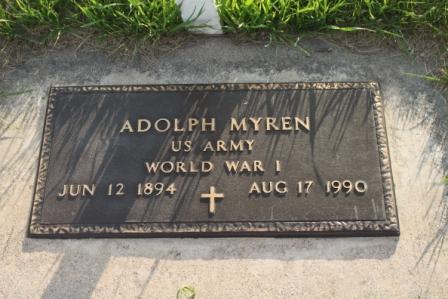
I recognized the listings for my GreatGrandparents Carrie (Kari) S Myren and Peter Peterson Myren and my  2Great Uncle Anders Myren.   Also listed were my Great Uncles Adolph, Carl P, and Paul S Myren as well as my Great Aunts Anna and Julia Myren.  

Seeing this listing, I made sure that I had recorded the birth and death dates from grave markers as well as cemetery information for each of these family members.  Citing each fact that I recorded in Family Tree Maker went quickly because I could make a copy of the citation for the first family member, then just edit in the correct data for the next family member.  I could copy the FindAGrave information for Adolph Myren then edit the name and dates in my citation for his sister Julia Myren's FindAGrave record.


Source Citations screen shot, Family Tree Maker 2014

Missing, however, were several family members who I thought would have be buried at this cemetery, my Great Aunts Pauline and Olga.  Also, I knew very little about Annie Myren and nothing about William Myren. 

Right away, I had a new To-Do List: (1) locate information related to the burials of Pauline and Olga and (2) learn more about Annie and William.  By focusing on these four names (Pauline, Olga, Annie, and William Myren), I was able to learn more about each of them in a relatively short time.  This time I used some of my usual search strategies - Ancestry.com, FamilySearch.com, Mocavo, and Genealogy Search Engine - as well as looking at census records and local histories available online.

In a little over an hour, I had found the following information about these relatives:
  • Pauline Myren, as an adult, preferred to spell her surname as Myron, a fact that had slipped my mind when initially searching for her burial location.  She too is buried in the same cemetery, Hillsboro Cemetery #1, as her parents and brothers.  Searching for information on Pauline was what lead me to find her request for a pen pal, the letter written by Pauline in 1911.
  • Olga Myren had married Adolph Rognlie.  Her FindAGrave memorial page lists her just as Olga Rognlie with no mention of Myren.  Olga Myren Rognlie is buried in Hillsboro Cemetery #1 but her husband Adolph Rognlie's burial place was listed as "unknown" while his place of death was noted as being Washington state.  Looking further into this is will probably be added to my To-Do List.
  • Annie Myren, identified through various census records, was the second wife of Anders Peterson Myren.  Anders' first wife, Oline Jorgensdatter Ateigen, was listed as buried in the Elmwood Cemetery of Hillsboro, ND.  By using both United States and North Dakota state census records found on Ancestry.com, I was able to follow Annie Myren as she continued to live in Hillsboro, ND until her death in 1949. 
  • William C Myren was one of the four children born to Anders Myren and his second wife Annie.

I also decided to pass on some information to others researching the Myren family by requesting that the FindAGrave memorial pages for my GreatGrandparents, Peter Myren and Kari Siem Myren, include the links to the FindAGrave information of their children.  Some of my editing requests were done within a few days.  Others of my requests are still waiting to be posted.

Lessons learned:  Thanks to Randy Seavers' suggestion, I plan to search within one database or type or record as part of my research strategies with a family.  This experience with FindAGrave showed me how it provided a family overview and then showed some areas where I needed to look for new or additional information.

Sunday, October 26, 2014

Looking for a Pen Pal


The Farmers Voice, 15 July 1911.

At the age of 13 my Great Aunt Pauline Myren wrote a letter to the children's page of The Farmers Voice.  She was hoping to find a pen pal or at least to receive some letters or postcards from other readers.  Here is her letter.(1)
    
     This is the first time I have written to the Farmers Voice, nor have I seen any letters from this part of the country, altho I have been a reader of the Voice almost a year.  I like the boys' and girls' page extremely well.  I am 13 years old, will be 14 on the 19th of January, 1912.  Who else has 14?  I am now a freshman of the Hillsboro high school.  I graduated from the eighth grade June 1st, 1911.  I like to go to school fine and dandy, altho I am glad when we have a vacation.  Daddy has a farm of 160 acres.  He had 3 cows, 8 horses, and quite a number of chickens.  We stay in town during the winter months, but we usually stay on the farm in summer until the last of August when we pack up and get ready for school.  Our farm is 3 1/2 miles from town.  Our town has a population of about 1,800.  There are many nice residences in the town.  I almost always see, when looking over the girls' and boys' page letters from Illinois.  There are a large number of Illinois people but we welcome them and also more.  I would like to receive some postcards, other views, or comics, from the Farmers Voice readers.  I will answer all I get.
                                                                                  Pauline Myren, Hillsboro, ND                      

Pauline's letter was printed in the July 15, 1911 issue of The Farmers Voice.  Finding this letter was one of those serendipitous things, but what a little treasure it is.  Once again googling a relative's name and location lead me to an unexpected resource.  I'm sure I had a huge grin on my face as I read that letter for the first time.

I knew the location of the the Myren family farm on their homestead near Hillsboro, North Dakota and had visited the farm as a child.  It was interesting to read about the farm from Pauline's perspective, plus her description of the livestock on the farm adds a lot to my picture of life on the farm.

My mother had spoken of how her grandparents (Pauline's parents) maintained two houses in North Dakota.  One was in the town of Hillsboro where the family lived during the school year so that the children could attend school.  Over the years, the family occasionally had some of the single, female teachers boarding with them for the year.  Their other house was located several miles out from Hillsboro on the family's 160 acre homestead.  The homestead house was where the family lived d
uring the summer so they could all work on the farm, just as Pauline related in her letter.  In the heritage scrapbook I made some years ago are photos of both of their homes.

Myren home on the family homestead, Trail County, North Dakota

Myren family home in the town of Hillsboro, ND

I don't know how many letters Aunt Pauline received after her request in The Farmers Voice.  Lots, I hope.  After all, Pauline was a career postal employee and worked in the Hillsboro Post Office, and a brother Paul Myren was a long time letter carrier.

(1) "For the Boys and Girls."  The Farmer's Voice, 15 July 1911.  Online archives.    http://idnc.library.illinois.edu/cgi-bin/illinois?a=d&d=FFV19110715.2.49

Monday, July 21, 2014

Military Monday: Adolph Myren


Pvt Adolph Myren, World War I
photo from personal collection

The story of Adolph Myren, my Great Uncle, is much like that of many young American men during the years of World War I.  I grew up hearing how Uncle Adolph had served in the first World War, seeing the photo above in the family picture box as I was growing up.  His story, however, comes in bits and pieces for his service record was most likely among those destroyed in the 1973 fire at the National Archives Record Center in St. Louis, Missouri.

Adolph Myren was the son of Norwegian immigrants who became Dakota homesteaders and American citizens.  In June of 1917, Adolph registered for the draft in his hometown of Hillsboro, North Dakota.  The physical description listed on his registration card - tall, slender, blue eyes, and [light] brown hair - speaks of his Scandinavian heritage.


World War I Draft Registration Card
source: Ancestry.com

A detailed record of Adolph Myren's military service is found in Ancestry's "US Adjutant General Records", pictured below.  Initially he was a member of the North Dakota National Guard, enlisting about three months after his registration for the draft.  Adolph, along with other state national guard members, later became part of the regular American military forces serving in World War I.


source: US Adjutant General Records, 1631-1976
Ancestry.com

Adolph was reported as Missing in Action while he was serving in France.  His name appeared in the list published in the Official US Bulletin of 23 Sep 1918.(1)  It would appear that Adolph was missing following the Battle of St.Mihiel which occurred 12-16 Sep 1918.(2)  Since the fighting at Meuse-Argonne took place between 26 Sep-11 Nov 1918, Adolph was apparently able to rejoin his unit within a relatively short time.

Following the conclusion of the war, Adolph Myren returned to his home in North Dakota.  He was a farmer for the rest of his life. never married.  Adolph lived until his mid-90s, always standing tall and straight just as he did done many years before in his military photograph.

photo by Alexis Yokom
FindAGrave memorial #92116119

(1) Official US Bulletin, Issues 402-451. Washington, DC, US Government Printing Office, 1918, accessed through Google Books.
(2) "US Army Campaigns, World War I." http://www.history.army.mil/html/reference/army_flag/wwi.html.

Tuesday, December 3, 2013

Advent Calendar of Christmas Memories* December 3 - Christmas Music

The Trapp Family Book of Christmas Songs
selected and arranged by Franz Wasner and illustrated by Agathe Trapp
Pantheon Books, c1950 

My Grandmother, Gertrude Andrews Myren, was an accomplished musician.  She was also a fan of the Trapp Family singers, having seen then perform.  Years ago, my mother and I spied this book, The Trapp Family Book of Christmas Songs.  Mother and I knew it would be the perfect Christmas gift for Grandmother, and it was.  Now the book has been passed on to me and is one of the first of my Christmas things to be put in place each year.

The book opens with an introduction by Maria Auguste Trapp in which she described the various types of Christmas music associated with different cultures throughout the ages.  The beautiful illustrations throughout the book were woodcuts done by Agathe Trapp.

What makes this book such a special part of Christmas for me, beyond its association with my Grandmother, is the variety of carols it includes - Latin, traditional English and German carols, American folk carols, as well as music from Austria, Poland, and other countries. The book is truly a reminder that Christmas does not belong to any one culture, it is for all people to celebrate.

Besides, where else besides this book could I find all the verses of "O Tannenbaum!" in German?

*The Advent Calendar of Christmas memories (ACCM) allows you to share your family's holiday history twenty-four different ways during December!  Learn more at http://adventcalendar.geneabloggers.com.

Thursday, October 24, 2013

Treasure Chest Thursday: The Locket

Gertrude Thankful Andrews
photo in personal collection
According to family stories, this is a photo of my grandmother Gertrude Thankful Andrews taken approximately 1909 at the time of her engagement to my grandfather Michael Arthur Myren.  Mike Myren had given the locket to Gertrude as an engagement present, and following their marriage Gertrude had it engraved with her new initials "GM".

Later my grandmother gave the locket to my mother.  It was kept in a small box in my mother's chest of drawers and brought out to wear only on Sundays or special occasions.  Then, some years ago, my mother give the locket to me, telling me the story behind the locket and giving me the old photograph.

Through the years, I had noticed some dings on the locket but thought they had come from being knocked around for 100 years.  It turned out the the dings were actually bite marks on the locket, made by my mother when she was teething and being carried around by my Gramma!  Each teething mark on the front, shown by the red circles below, has a corresponding mark on the back of the locket.


"Chomp, chomp, chomp"
The other day I bravely used a jewelry screwdriver to open the locket, something I had never done before.  Inside the locket was a faded picture of my father.  What a special surprise to realize that my mother had years ago added this photograph to the locket.

Someday the locket will probably be passed on to one of my grandchildren.  Along with the locket will also go the photograph as well as the story of how it served as a teething ring for their great grandmother.  This is also one more family heirloom that I am recording in my small "Family Treasures" scrapbook so that all of the family can share in this story.