Showing posts with label Norway. Show all posts

Wednesday, April 8, 2015

Coming to America: The Syversen Family, part 2


Lesja Church, Oppland, Norway
photo by Henny Stokseth, Wikimedia Commons

I've been on the immigration trail of my Great Grandmother Kari Syversdatter Myren for the past several years, trying to see how she left the village of Lesja in Oppland, Norway and came to North Dakota.  Previously I had described some of my efforts in a post written in March, 2013. After my relative ease in finding how her brother Hans Syversen came from Norway to the US, I hoped to be more successful in learning about Kari. I would use the steps that had worked so successfully with Hans.

1. Use the Norwegian census records for 1865, 1875, and 1885 to establish the last census year in which the family or individual was recorded as living in Norway. (Digital Archives of Norway). Also, check US Federal census records to see when the family is recorded in the US.


Kari was listed as living with her parents, Syver Hansen and Marit Olsdatter, in both the 1865 and 1875 census of Norway but not in the 1885 census. The first census which records Kari as living in the US is the 1885 Dakota Territory Census.(1) In this 1885 census Kari, now married to Peter Peterson Myren, was listed as the mother of two children, ages 3 and 1, both of whom were listed as being born in the Dakota Territory. This sets Kari's migration bracket as being between 1875 and 1882.


2. Check local parish records to see if the family or person is listed as a "Removal", the column heading used for individuals notifying the church of their intent to move out of the area or to emigrate. (DAofN)


Several months ago I was looking for something else in the Lesja Parish records and stumbled upon the Migration Record for Kari.(2)


At the time I first found this record, I made a note in Family Tree Maker about the other person, Marie Hansdatter of Belden Farm, who was planning to leave Lesja the same time as Kari. I wondered who Marie was, a neighbor, friend, relative. As I started planning to write this post and was considering resources to mention, I had one of those "duh" moments. Marie Hansdatter, born in 1858, living on Belden Farm is in all likelihood the "missing daughter"t of Kari's brother Hans Syversen and also Kari's niece,  It now looked as if these two girls might be planning to travel together to America, leaving Norway on 25 April 1878. Surely two women traveling together should be easier to track than one person traveling alone.

The Digital Archives of Norway has digitized a number of records related to immigration. In their "Emigrants From Oslo 1867-1930", I found a record that might belong to Kari.(3) The database provided the following information about a Kari Hansen, a possible name for Kari since her father was Syver Hansen. Here is the information provided about Kari; my comments about the information are written in red. These are the reasons I say it might be for my Kari rather than being certain.
  • Names:  Kari Hansen possible name
  • Gender:  female
  • Age:  24  Kari's age in 1858 would have been 25
  • Residence:  Oier Oier is a parish located in an area close to Lesja, Oppland
  • Position:  a Girl term usually means a servant girl who isn't part of the family
  • Date of emigration:  23 June 1878
  • Port of departure:  Oslo
  • Destination:  White Hall Wisconsin Kari's older sister Guro had immigrated to American about 9-10 years earlier and resided near this town in the 1880 US Federal Census
  • [Ship] Line:  Hero This ship only took passengers from Oslo to Liverpool, after that the person had to travel to the east coast of England to board a ship to travel to America
  • Freight cost:  paid sometimes this indicated that the person emigrating held a prepaid ticket from Oslo to their final destination, in this case, Wisconsin
"Emigrants From Oslo" is a database, not a digitized record which I could browse for myself. No matter which search terms I used, I was never able to find a similar record for Kari's niece and possible traveling companion, Marie Hansdatter. Nor did I ever find listings for Hans Syversen's family as they had prepared to leave in July of 1878 as seen in a previous post.

3. Study US Federal Census records to see the year recorded for immigration, number of years in the US, or information on naturalization. (Ancestry.com)


In the 1900 US Federal Census, Kari Syversdatter Myren was reported as coming to the US in 1880 and being in the US for 20 years. According to the 1910 US Federal Census, Kari had immigrated to the United States in 1879. The 1920 US Census recorded Kari as coming to the US in 1878 and being naturalized in 1890, the same time as her husband Peter Petersen Myren. The census of 1930 also provided the same 1878 date for immigration. So, in a number of different census records, Kari is recorded as coming to the US between 1878 and 1880.


4. Search for the family or individual in immigration databases and ships' passengers lists.  Use sites such as Ancestry.comFamilySearch.orgLibrary and Archives of CanadaThe Ships List,  Castle Garden for immigration 1820-1892, Ellis Island, or Steve Morse's One-Step Search.

This step kept me busy recording "no record found" on my research spreadsheet. I searched for both Kari and her niece Marie Hansdatter without success. I used NorwayHeritage's databases to make a list of possible ships on which Kari might have sailed with a later April 1878 departure date. Some docked at New York, others in Philadelphia, or Quebec. Then over several days, I searched more than 25 ships' passenger lists accessed through Ancestry.com and was not able to find either girl listed as a passenger. Not giving up, I tried searching a list of passenger lists for ships departing England in late July of 1878, the time listed in the Emigrants From Oslo database. Still no success.


For those ships docking at Quebec, I searched the immigration databases found on the Library and Archives of Canada website. Next I tried searching in the Castle Garden database. Again, no records using either website.

Kari Syversdatter's date and means of arrival in the United States continues to be a mystery. It is obvious that she left Norway. Obvious that she lived for over 40 years in North Dakota. There is just that gap between leaving Norway and residing in North Dakota that continues to be so elusive. When I compare my efforts concerning Kari with those on behalf of her brother Hans, it has seemed much easier to track a male through the immigration process.

But wait, there's more ...

(1) 1885 Dakota State Census, Traill County, [population schedule], Hillsboro Township, p. 5, dwelling 428, family 440, for Petter Petterson [and family]; North Dakota State University Archives, Fargo, [microfilm # unknown].
(2) Oppland (Lesja, Norway), Parish Register (Official) 8, 1854-1880, Migration Records 1878, p 587; Digital Archives of Norway.
(3) Emigrants From Oslo 1867-1930, "Kari Hansen"; accessed Digital Archives of Norway.

Monday, March 30, 2015

Coming to America: The Syversen Family, part 1


SS Germanic, White Star Line
source: John S. Johnston [Public domain], via Wikimedia Commons

The other day I really seemed to be on a roll. In a relatively short time, I located the passenger list showing my 2Great Uncle Hans Syverson and his family arriving at the Port of New York on 17 Aug 1878 aboard the SS Germanic.(1)    Some of the research involved records accessed through the Digital Archives of Norway (DAofN). I accessed other records through Ancestry.com.

My successful plan for finding Hans Syversen's immigration records used the following steps.

1. Use the Norwegian census records for 1865, 1875, and 1885 to establish the last census year in which the family or individual was recorded as living in Norway. (DAofN). Also, check US Federal census records to see when the family is recorded in the US.


Hans and his family were recorded in both the 1865 census for Norway and the 1875 census for Norway but not in the 1885 census. Both 1865 and 1875 records showed the family living on the Belden South Farm in Lesja Parish of Oppland. According to the 1880 US census, the Hans Syversen family was living in Linden, Brown County, Minnesota. This gave me a timeframe of between 1875 and 1880 for the family's emigration period.


2. Check local parish records to see if the family or person is listed as a "Removal", the column heading used for individuals notifying the church of their intent to move out of the area or to emigrate. (DAofN)


Oppland, Lesja Parish, Register #8, Migration Records, 1878-1879, p 589
Digital Archives of Norway

After looking at the Migration Records for 1875-1877, I found this page listing Hans and his family.  The family had notified the church of their plan to leave 17 July 1878 for America.   All of the family, Hans Syverson of Belden Farm, his wife Marit Paulsdatter, and their children Toline, Sofia, Marit, Hans, Ole, and Anton were planning to emigrate to America.

3. Study US Federal Census records to see the year recorded for immigration, number of years in the US, or information on naturalization. (Ancestry.com)

According to the 1900 US Federal Census, Hans immigrated to the US in 1878 and had been in the United States 22 years. This agreed with the parish record shown above. For the son Hans, however, different information. In the 1910 census, son Hans indicated he had immigrated in 1889 while the 1920 census gave 1876 as the year he arrived in the US. In the 1915 South Dakota census, son Hans said he came in 1875 and had been in the US for 40 years.  Hans (the father) had the date of 1878 that corresponded with the parish date of 1878. His son Hans, for unknown reasons, had various dates ranging from 1876 to 1889. I chose to consider 1878 as the probable date the family emigrated since the father Hans had provided that date in 1900, a time closer to the actual event than the later years in which his son Hans gave emigration information.


4. Search for the family or individual in immigration databases and ships' passengers lists.  Use sites such as Ancestry.com, FamilySearch.orgLibrary and Archives of Canada, The Ships List,  Castle Garden for immigration 1820-1892, Ellis Island, or Steve Morse's One-Step Search.

This part of my research took a number of tries. With our immigrant ancestors, we are viewing passengers lists sometimes written by someone writing in English based on information spoken in another language so the variation in the spelling of names can necessitate additional searches for information. Add to the passenger list information, the fact that it has been transcribed or edited by yet others who may not be familiar with names from other countries.

Another variable in my search was estimating the arrival date for the family. I found a series of excellent articles about the process of emigration from Norway and conditions found in the steamers that crossed the Atlantic to America on the Norway Heritage website.  The articles mentioned that Norwegian immigrants primarily sailed from Norway to Hull in Yorkshire, England or other several other English ports. From the English port, the emigrants would travel by rail across England to the port of Liverpool to begin their trip across the Atlantic. The trip might take as long as a month based on making the connection to cross England and board the transatlantic steamer. If Hans had indicated to the Lesja Parish church that he and the family planned to leave on 17 July 1878, I hoped to find him arriving in American sometime in August of 1878.

A third variable concerned how his name might be listed on a passenger list - Hans Syverson, Hans Syverson Belden, Hans Belle as he was listed in the 1880 US census, or perhaps some variation I had not anticipated. Through trial and error and much adjusting of the "Broad to Exact" sliders on Ancestry's search boxes, I finally found the family of H S Belle listed as arriving at the Port of New York on 17 Aug 1878, exactly one month after the family departed from Norway.

I was not certain at first this was MY Hans Syverson of Belden farm. I looked back at both the 1875 Norway Census and the parish Migration Record to compare the Norwegian family listings with the one on the New York passenger list. One huge difference was seeing the entire family listed on the passenger list as being from Sweden instead of Norway. The family members' names and information were generally more accurate. Below is my transcription of the passenger list with corrections made in (red).

#154    H S Belle    age 44   male    farmer    Sweden (Norway)
#155    Mar (Marit) Belle    age 43    female    wife    Sweden (Norway)
NOTE: daughter Marie was listed as leaving on the parish Migration Record, but she was not on the passenger list.  Checking into this is definitely on my To-Do List.
#156    John Belle    age 17    male    laborer    Sweden    (Here was a big difference - no John was ever recorded as being a member of the family. However, there was a daughter Toline Belle, age 17 in 1878, who is also listed in the 1865, 1875 and 1880 censuses.)
#157    Sofia Belle    age 14    female    spinster
#158    Maret (Marit) Belle   age 11    male (female)    child    Sweden (Norway)
#159    Hans Belle    age 9    male   child    Sweden (Norway)
#159    Ole Belle    age 5    male    child    Sweden (Norway)
#160    Anton Belle    age 3    male    child    Sweden (Norway)

Comparing this passenger list with information I already knew about the family, I was confident I had found the passenger list for my 2Great Uncle Hans Syversen and his family. According to SteveMorse.org, all passengers arriving in New York in 1878 would have been processed through Castle Garden so I also looked for the family using the Castle Garden database. On the Castle Garden website, I wasn't as successful in finding a listing for the family's arrival. Their website provides a template of information on individual passengers rather than digitized records that can be browsed. I never keyed in the right set of search terms to actually find the Syversen family records.


I had found the information in a few hours and without a lot of difficulties, thanks to the sliders on Ancestry.com's search screen.  I thought I had established a winning sequence of research steps for tracing my Norwegian relatives on their travels to America.  I couldn't wait to try it out on other relatives who I knew had immigrated to the US in the late 1800s.

To be continued ...

(1) "New York Passenger Lists, 1820-1957", SS Germanic, arrival Port of New York 17 Aug 1878; accessed Ancestry.com; citing National Archives M237, roll 414.

Thursday, March 12, 2015

Genealogy Do-Over : Who Lived Where, The 1838 Norwegian Matrikul or Land Register

After spending a number of weeks plowing and plodding through the digitized parish registers for Lesja, Oppland, Norway found on the Digital Archives of Norway, I finally got brave enough to peruse some other records found in the Archives.  I decided to look at the digitized records for the 1838 Land Register.  This register ended up providing me with new information about some of my ancestors and relatives.


1838 Land Register for Lesja Parish, Oppland, Norway; source: Digital Archives of Norway

As soon as I started to look at the pages, it was clear that my first order of business was to translate the various column headings so it was easier to see what information was actually available here.  Using both Google Translate and my Germanic Alphabet Chart, I was able to come up with a loose translation for the column headings.  Basically the columns are

  1. Farm Number
  2. Name of Farm
  3. Name of Farm Section or Division
  4. Occupant of Section
  5. Amount of land registered
  6. Tax or Debt Information

My previous look at parish records and the 1801, 1865, and 1875 Norway census records provided clues as to whom might be residing on a specific farm in 1838.  It was helpful to read John Follesdal's article on background information about Norwegian farms for a better understanding of how important the Land Register of 1838 was to the country as a whole and to the individual farmers.  Another aid in understanding the register was the Norway Glossary on FamilySearch.org which defined a number of terms related to property ownership and farming.

Pulling things together, I was able to find the following information from 1838 concerning some of my ancestors and relatives.

My 2GreatGrandfather Petter Andersen resided on farm 36 on the section recorded as Myren North.  At the time of the 1838 registry, the amount of his farm land had apparently not yet been recorded but the tax on it was listed as 2 ort and 13 skillings.  Below Petter's name is another Andersen, Isak Andersen, registered as living on the Myren South section.  Interestingly, although it might seem logical that two brothers would divide a section of a large farm, I have not yet come across any relative named Isak / Isaac Andersen in my research, so Isak Andersen is a question mark for me at this time.


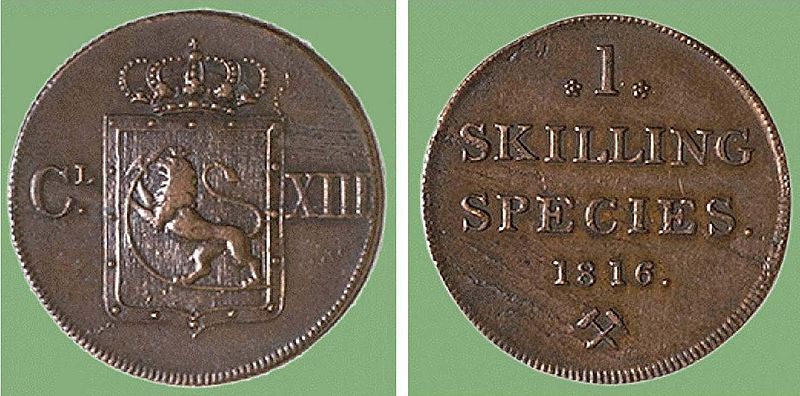
Further down the list on farm 49, the Mosenden Farm, was information about my 3GreatGrandfather Joen Olsen.  Joen and his family lived on the Mosenden North section.  His property had already been registered as being 7 units in area and having a tax of 3 ort and 13 skillings,  So far I haven't been able to determine the value of skylddalers, orts, and skillings in today's US currency, but I was able to find the picture below.

Norwegian Skilling, source: Wikipedia Commons

I also found another 2GGrandfather, Syver Hansen, recorded as the farmer for the south portion of the Bellen / Belden / Belle farm.  According to a family history, this farm had passed to Syver from his father Hans Syversen at the time of Syver's marriage in 1830. Quite a wedding present, and one I would like to be able to document.

A 4th Great Uncle, Hans Jorgensen, was recorded as the primary tenant of the Little Bjøkne section of Bjøkne farm.  Also living on Bjøkne farm on the Upper Bjøkne section was another 4th Great Uncle, Hans Bjørnersen.  Again, descendants of these two continued to live on these farm sections through the 1875 census.

The Overlien South section of the Overlien farm was home for yet another 4th Great Uncle, Syver Syversen.  His farm was taxed at a rate of 1 skylddaler, 2 ort, and 14 skilling.

I felt like doing the Genealogist's Happy Dance as I "read" over the property register.  Without the focused research of the past two months, I would not have recognized names of ancestors, relatives, farm names and sections.  And I would not have stayed so focused without the encouragement of Thomas MacEntee's Genealogy Do-Over.

Now if I plot the various farm locations on Google Map, I can see where people lived and perhaps better understand some of the relationships between the two Norwegian branches of my family tree.  Maybe I should take a look at the Real Estate Registers available on the Archives site to learn more about those living on the farms into the early 20th century.  And someday, I need to get my hands on a copy (or photocopy) of the Bydgebok for Lesja, a book tracing the history and land ownership in the Lesja Parish which was home to virtually all of my Norwegian relatives.  I might then do more of the Cluster Research that is a part of Genealogy Do-Over Week 9.  There is always something new just around the bend.

Tuesday, February 24, 2015

Tuesday's Tips: Norwegian Research Aids Coming to My Rescue


Norwegian Society for Sea Rescue
photo by Torvol at Norwegian (bokmål) Wikipedia, via Wikimedia Commons


As I continue knee-deep in the Norwegian Parish Registers, I've added two more "must haves" to my research toolbox.  Both have proved to be real lifesavers as I research my ancestors.

source: Family Tree Magazine

Because these parish records are written in Norwegian and in a variety of handwritings, the Germanic Alphabet Chartfrom Family Tree Magazine has proved so helpful in deciphering those written records.  The Fraktur style of writing is used in the printed column headings of a number of 19th century records while the old handwriting styles section of the chart helps in distinguishing between letters that strongly resemble each other.  I probably need to laminate my chart because it is already showing wear from being used so much.

Must have # two is a resource that stays open on my laptop whenever I am researching records from the Digital Archives of Norway.  This time Family Search has come to my rescue with its Calendar for Moveable Feast Days.  The Parish Registers are church documents, written by the minister or church clerk and frequently have a reference to a specific event of the liturgical year as the date for baptisms, marriages, or burials.  Before I stumbled upon this resources, I spent time googling to find the date for Trinity Sunday in 1803 then locating a calendar to determine the 7th Sunday past Trinity in that year.  Now I just select the year, ex. 1803, and scan down to find that the 7th Sunday past Trinity was 24 July 1803, easily read in English.  There are similar calendars available through the Family Search Wiki for other countries in addition to the calendar for Norway.

If you are researching records written in other languages, I hope that similar resources will help you, too.

Wednesday, January 28, 2015

Wk#4GenealogyDoOver : Getting From Here to There With My Research

Red River Gorge Rock Wall by By Jarek Tuszynski via Wikimedia Commons

Participating in the Genealogy Do-Over had made me so much more aware of my research strategies.  I've written previously about I've started being more methodical in tracking my research.  Now, as I continue to plow through digitized church records from Norway, I'm seeing that I'm following a path as I look for information about my ancestors.

My 2GreatGrandmother Marit Oldsdatter, according to the family history booklet I have, was born 26 Jan 1810 and died 23 Dec 1890.  Here are the steps I've followed to learn the names of her parents, siblings, and grandparents, steps I'm now using as I research other ancestors.  


  1. Using records on the Digital Archives of Norway, l found the parish record of Marit's birth.  The great thing about these records is that they (usually) provide the birth date, baptism date, names of parents, farm residence of father and mother, and names of witnesses to the baptism, usually other family members.
  2. After finding Marit's birth / baptism record, I knew her parents were Ole Jacobsen and Ronnoug Bjornersdatter.  Next I searched in FamilySearch.org's Norwegian records for any children born to these two parents.  This provided me with the names and birth dates of Marit's siblings, Jacob, Bjorner, Mary, Hans, Anna, and another Marit/Mari.
  3. Time to go back to the Digital Archives of Norway to find the digitized record for the birth / baptism of each of the siblings.  There is no substitute for being able to study the original record.  Having been a volunteer transcriber, I know that any transcription stands the chance of having an error recorded.  Seeing the actual record myself provides a second set of eyes on the document.
  4. Once I knew the birth order of the children, I started looking for the marriage record for Marit's parents.  Again, the original marriage record provides a lot of additional information.  Depending upon the year, the Norwegian marriage records can contain the marriage date, names and ages of the bride and groom, their farm residences, names of their fathers, names of bondsmen (who just might be other relatives), and possibly information about a previous marriage of either party.  Stuff that is definitely worth looking for.  Admittedly, finding the marriage record requires some speculation on my part.  My standard search plan is to look in the parish marriage records for 0-5 years prior to the birth of the couples' eldest child.  In the case of Marit, the oldest child, born in 1810, I found the record for her parents' marriage in the 1809 parish marriage records.
  5. After the marriage information of Marit's parents was located and recorded, I then started to look for the family in a census record.   Records for the 1801, 1865, and 1875 censuses are searchable through the Digital Archives of Norway.  If I've fortunate enough to find the family listed in one of these census records, I also can see, just as with US census records, who is living in the household, their ages, marital status, and occupation as well as basic information concerning their residence or farm.  In my search of the 1801 census I found Marit's father Ole Jacobsen, age 19, living with his parents and siblings on the family farm.  Marit's mother, Ronnoug Bjornersdatter, age 16, was living on a nearby farm working as a servant girl.
  6. Finding the family in a census record also provides an approximate birth date for any family members listed.  I loop back to Step 3 and search in a three year period for previously missing Birth / Baptism records.  This means searching the parish records for 1786-1788 for a Birth / Baptism record of a child listed as being age 14 in the 1801 census.  And this works just about every time.
  7. Death / Burial records are the last part of my current search strategy.  Finding them turns out to be much more of a "needle in a haystack" approach.  I start by searching the death records following the latest information I have for an individual, i.e. date of marriage, birth of last child, census record.  This "new" information becomes my starting point.  The first few times I tried this, I kept wondering WHY am I looking at so many records and how will I know it is the right record.  Bless those Lutheran clerics who recorded the farm residence so often along with the first name and surname of an ancestor.  If I can decipher the cleric's handwriting, I can then use Google Translate to determine the cause of death.  Once I found the death / burial record, I was also provided with the age at the time of death, enabling me to loop back to look for their birth / baptism record.    And so my plan continues.
As I watched pictures of the recent scaling of Yosemite National Park's Dawn Wall, I marveled at how much planning went into each inch of elevation gained by the two climbers.  I saw times when they had to drop back and try another route.  

The steps above are my planned route for researching my Norwegian ancestors.  Sometimes I get to where I want to be in a short time.  Other times I have to drop back and try something else, expand the years I search, head over to FamilySearch.org or check out any shaky leaves on Ancestry to see if there are hints I can follow up on or try to verify.  It is all part of getting from here to there.  It is also worth the effort.

Now, time to apply these steps to learning more about my three other 2GreatGrandparents from Norway.

Wednesday, January 21, 2015

Wk#3GenealogyDoOver: Tracking My Research

"Deer Mouse Tracks in the Snow"
by Jomegat.Jomegat, from Wikimedia Commons


Thomas MacEntee's Genealogy Do-Over is proving to be just the encouragement I needed to tweak some of my research habits.  Take "Tracking Research", one of the topics for this week.  Previously I had been fairly meticulous about recording where I found reliable information about a family member.  Not so, however, about where I had looked and not found anything of note.  Participating in the GD-O has changed that.

Some time back I had come up with a simple version of my Research Log as a Google Sheet to use during the GD-O time.  I showed a screen shot of it in a previous post.  Soon after I started using it, I added another column, Completed.  There is just something so satisfying about noting that a series of research tries finally has lead to success.  

Today, this is what my Research Log looks like as I am using it to learn more about my 4GreatGrandparents, Syver Syverson and Kari Gudbrandsdatter.  I'm finding that this Research Log is helping me stay more focused in my research.  


Prior to starting the Do-Over, I only knew that my 4GreatGrandparents were both alive at the time of the 1801 Norway Census.  Now I've started to use the Topic column as a To-Do List, indicating that I wanted to find Birth/Baptism, Marriage, and Death/Burial records for Syver and Kari.  Some of the information I have recently found through the record images available through the Digital Archives of Norway.  The items indicated in red show the things I still need to be seeking.  And that green box "DAofN Parish Register 4", that's where I will be starting to look for Kari's Death/Burial record once I finish writing this post.

Besides providing a focus for my research, tracking my research on this Research Log has proved helpful in other ways.  The Resource Used column lets me see where all I have looked for similar information about other family members.  I've also used the Date column several times to look for the name of a resource I remembered using at a specific time.  Now all my efforts to learn more about how my 2GreatUncle Siver Syverson came from Norway to Wisconsin has provided me with a list of places to look for records for other immigrant ancestors and relatives.

Sources of Emigration Records


Finally, I've discovered a great, unexpected benefit from using my Research Log so judiciously.  For the information I still have not been able to locate for a specific relative, I can do a quick copy of the topics and all six columns concerning that from the Research Log Google Sheet.  I then can paste it as a research note in Family Tree Maker so I can see sometime in the future where I have looked should I want to take another stab at locating an elusive record.

As Elizabeth McCracken said "if someone caught me when I was in the throes of tracking something elusive I would have told them: but it's out there.  I can feel it".(1)  And now I have the record to show my search for it.

(1)  "Elizabeth McCracken: Quotes".  www.Goodreads.com

Tuesday, January 6, 2015

Wk#1GenealogyDoOver : What I REALLY Need to Get Started

"The Road", uploaded by Geralt to pixabay

Following Thomas MacEntee's suggestions for week 1, it didn't take very long to take a quick look through the pile of papers next to my laptop.  I removed the few pertaining to my Norwegian research and put all the rest on the top shelf on a nearby bookcase.  Out of sight and (hopefully) out of mind, at least until a later time.

Now there are just a few things sitting on my desk, things I know I will use frequently:
  • The privately published Overli-Belle-Siem family history booklet - This booklet contains so many names, places, and dates that I hesitate to put it away.  I want to quickly verify information from those family group sheets.
  • "Norwegian Genealogical Word List" from FamilySearch.org - necessary for translating information when I'm looking at digitized Norwegian records
  • "Norway Occupations" from FamilySearch.org - ditto
  • "Parish Register Examples Norway" from FamilySearch.org - Just as US census records contain different information in different years, Norwegian parish registers changed the specific information recorded between 1814 and 1877.  Knowing which column has parents' names recorded makes it easier when I visually scan records.
  • Folder containing maps of Norway, Oppland, and Lesje, the home of many of my Norwegian ancestors; printouts of farm names and numbers
As I was on FamilySearch.org getting the links for the resources listed above, I found myself being distracted by some of those "bright, shiny things" Thomas MacEntee spoke about.  In this case, I saw links to pictures of parish churches and family farms in Norway.  Talk about something bright and shiny!  I allowed myself a few seconds to quickly look at each group of photos, then made a note (with the two links) in my Genealogy-To-Do list so I can return to the photos for a closer look at a later date.

I've also started to clarify what I do hope to accomplish over the coming weeks.  The Overli-Belle-Siem family history booklet is filled with information, but there are very few sources for the information found on the family group sheets.  I want to focus my research on finding sources for birth, marriage, immigration, and death records for my direct ancestors.

Finally, in an effort to stay focused on my research, I plan to have the following open on my laptop whenever I sit down to work:
  • Family Tree Maker with my Perkinson Family Tree open
  • My Genealogy To-Do List on Google Drive
  • My Research Log on Google Drive (see below) so I can easily see what resources I have used in searching for the same type of information for other relatives as well as noting where I've looked for my current ancestor
  • Downloaded edition of Evidence Explained so I can correctly cite my sources
  • StickyNote app so I know where I stopped last time and have a place to note where I'm ending things in the current session

I think I'm about ready to get started.

Thursday, January 1, 2015

Wk#1GenealogyDoOver : Getting Ready to Get Started

Do-Over Button from Geneabloggers.com

Nothing like a new year to spur me on to clearing up some messes.  Now I'm going to be looking a little differently at my genealogical research, especially the two Norwegian branches of my family tree.  Parts of it are a mess.

Thomas MacEntree's Genealogy Do-Over looks like it will provide the motivation and support for me to tackle some of my Norwegian "issues".  I especially like the four points he suggests we focus on in our Genealogy Do-Overs.

  • Capture everything and save for later.  For me this includes the reminder to actually take that close look at my saved material, then either save or delete it, based upon what I actually find there.
  • Build a good research toolbox and keep adding to it.  My list of support materials, web sites, and articles is growing because I continue to stumble onto new resources.  I need to add them to my blog's toolbox so I can share with others, just as others have shared with me.
  • Create to-do lists.  It is amazing how two days of a stomach bug or those wonderful holiday visits can cause me to forget exactly which trail I had been in the midst of following.  I need to do a better job with my computer "sticky notes" and with recording things in my research log.
  • Pay no attention to that bright and shiny object.  Focus, girl!  Focus!

Several days ago, I got a head start (sorry, Thomas) by trying to get some consistency in the way I have names recorded for these Norwegian ancestors in my Family Tree Maker software.  Because of the patronymic naming system, so many of these ancestors did not have consistent surnames until after they immigrated to America.  Some of what I've done in FTM is arbitrary, but it has already helped me locate names in my database by keeping siblings' names together in my A-Z list of names.  

  • Son of a man named Syver/Siver/Sivert is now recorded as Syverson (not Sivertson, Siverson, Syversen, etc.)
  • Daughter of a named named Syver/Siver/Sivert is now recorded as Syversdatter (not Syvertdtr, Siverdaughter, or any of the other combinations I have found.)
  • Because I am examining records from the Digital Archives of Norway from as far back as the mid 1700s, there is a wide variety in the spelling of names in birth, confirmation, marriage, and death records.  As I find another version of the name I am adding it to the FTM database, but keeping only the Syverson / Syversdatter name as the "preferred" or primary name.
  • Because some records and databases automatically add the name of the farm residence to a person's name, this gives yet another name for a number of my ancestors.  Another personal arbitrary decision has been to add these farm names as a "Residence" in FTM.  That way it will be easier to select the appropriate parish register to browse through.
  • For those ancestors changing their name after coming to America, I'm adding their Americanized name as yet another name in FTM.
Today's project as been to look back at one of my saved resources, a self published family history of the Syverson / Hanson / Belle, Siem family.  This 100 page booklet is a treasure, essentially a number of family group sheets, hand drawn family trees, and brief narratives about some family members.  I am so thankful that my mother finally met the cousin who wrote it back in 1980 and who gifted her with the copy I now have.  Although the information it contains is not sourced, it is filled with dates, names of spouses and children, and names of family farms.

Already I have found that I had previously incorrectly recorded several dates into FTM.  Other information I had entered into FTM but had not cited the family history booklet as its source.  And taking the time to read the narrative passages provided so many small bits of information - someone died of whopping cough, a father gave the family farm to a son at his marriage, and who immigrated to America with whom.  All things I had previously missed.

Now I feel I'm ready to get started.  I'm excited about being more focused in my work and hopefully that I'll learn more of our family story.  What caused so many to leave Norway and come to America in a 15 year time span?  How could they afford to bring those large families of 7-10 individuals?  How did they decide where to live?  Maybe I've already starting on my To-Do List.


Thursday, December 11, 2014

Maybe I'll Keep Looking a Little More

"Metal Detecting" photo by Jose Luis Cernadas Iglesias from Coruña, España
via Wikimedia Commons

Just when I'm ready to give up, I continue to come across one more tidbit of information about my Myren ancestors in Norway.  It is just enough to keep me looking in hopes of finding still more about the family before I leave those digitized records accessed through the Digital Archives of Norway.

In the past week, I located the following records in the Digital Archives.  I used baptism record indexes from FamilySearch.com to locate the correct year in the scanned clergical records on the Digital Archives, then followed the chronological entries until I found the full record.  All three were found in the same record, Ministerialbok (Ministers' Book) #5 for Lesja Parish, Oppland, Norway.  It was worth finding the full record in order to gain as much information as possible on these three events.
  • Marriage record of my 3GreatUncle Jorgen Andersen to Guri Knudsdatter on 30 Oct 1834
  • Marriage record of my 3GreatUncle Amund Andersen to Ragnild Lansdatter on 1 Nov 1834
  • Confirmation record of my 3GreatAunt Marit Andersdatter on 10 Oct 1830
The record I was most excited to find was the death and burial record for my 3GreatGrandfather Anders Pettersen.(1)  Prior to finding this record, I had found him listed in the birth, confirmation, and marriage records of his children.  I also knew that he not listed in the 1865 census of Norway, one of the primary censuses available through the Digital Archives.This suggested that Anders (senior) had probably died before the 1865 census was enumerated.

Locating this death record as, once again, like looking for a needle in a haystack.  This time I selected a clergical record that covered the likely period in which his death would have occurred.   In this case, I started with the Lesja Klokkerbok (clerk's book) for 1842-1871, hoping Anders would have been alive in 1842.  I started looking at all the death records, beginning with 1832.  There in the 1844 records, I found the information I was seeking about my 3GreatGrandfather Anders Pettersen.

Death / Burial record for Anders Pettersen
Lesja Klokkerbok, 1832-1871

That one line for entry 2 provided me with the following information:
  • Anders Pettersen died on 22 Feb 1844.
  • He was buried on 11 Mar 1844 [in Lesja].
  • He was living in the Myren farm area at the time of his death.
  • He was 74 when he died (and therefore was born about 1770).
  • He died of old age (according to the ditto marks for entry 1).

A few days later, I was able to solve another Myren family mystery.  FamilySearch.org has a lot of searchable international detabases including five databases from Norway.  I have used these a number of times in order to have a starting point for locating the digitized records available through the Digital Archives of Norway.  

The mystery concerned birth and christening dates for my 3GreatGrandfather Peter Andersen Myren.  There were two entries for a birth/christening record for Peter Andersen, son of Anders Petersen and Marit Jorgensdatter.  One listed a birth date of 4 Feb 1798, the other a birth date of 12 Dec 1799.  I wanted to know which was the correct entry and also why there were two similar entries.

By going page by page through the Lesja Minister Book 3, I located three entries that seemed to tell the story of Peter Andersen.(2)  The first entry, outlined below in blue, was the Christening record for Peter Anderson, son of Anders Petersen of the Myren farm area and Marit Jorgensdatter, born 4 Feb 1798 and christened on 14 March 1798.  Witnesses to the christening included my 4 GGrandfather Peter Petersen of Myren and my 5 GreatAunt Sigri Petersdatter of Myren.


Christening Record for Peter Andersen, born 4 Feb 1798

The second entry below, also outlined in blue, was the burial record for a Peter Andersen of Myren farm.  The numbers 1 and 2 in the short entry are in the place where the age of the deceased was generally written in the burial record.  According to this Peter would have been a year and two months at the time of his death or burial.  Looking back at his christening record, young Peter would have been a year and three months old at the time.  For personal clarity, I'm now referring to the birth recorded above and this death record as being for "Peter 1" Andersen.

Burial Record for Peter Andersen of Myren, 19 May 1799

Apparently at the time of Peter 1's death, his mother Marit Jorgensdatter was pregnant with another child.  This child was born 12 Dec 1799, almost seven months following the dead of Peter 1.  This new baby was also named Peter.  Through my family research, I've found it was not that unusual in the 1800s to name a baby after an older sibling who had previous died; these seems to be the circumstance here.

This Peter, whom I'm calling "Peter 2", is the Peter Andersen who was my 2GreatGrandfather, the Peter who had three sons leave Norway and emigrate to America.  The birth and christening record for "Peter 2" is outlined below in green.  I wish I had a Norwegian magic wand I could wave to translate the words circled in orange.  The first word is "first born" but I have no idea what the second word it but wonder if it meant deceased, died, or something like that.  Among the witnesses at this christening were some familiar names, those of my 4GGrandfather Peter Petersen Myren and of his sister Sigri, also of Myren.  I finally had an answer for finding two different birth dates in the same FamilySearch database.


Christening Record for Peter Andersen, b 12 Dec 1799

It is the little things like finding these records that keep me studying those digitized Norwegian records with Google Translate open and my vocabulary chest sheets close at hand..  No telling what else I might find if I just keep looking long enough.


(1)  Oppland (Lesjaskog, Lesja, Norway), Klokkerbok no. 4 (1842-1871) , Dead and Buried 1842-1845, p. 80, entry 1844-2, Anders Pettersen Myren; digital images, Digital Archives of Norway: accessed 2 Dec 2014
(2) Oppland Parish (Lesja, Norway), Lesja Minister Book 3 (1777-1819), Chronological Lists, 1798-1800, Peter Anderson; digital images, Digital Archives of Norway: accessed 7 Dec 2014.

Wednesday, November 19, 2014

Looking For a Needle In a Høystakk*


Traditional Norwegian Haystack
by Kjetil Lenes, via Wikimedia Commons

I'll admit it.  I have become spoiled with the relative ease in finding names of ancestors and relatives in US census records.  Now that I am continuing to search for more information about my Norwegian ancestors, I also decided to take another look at the materials in my Norway Research folder before I jumped into this.  I knew from previous efforts that it would be much more involved than searching for a US census record.

My folder has a number helpful resources I've gathered over the years.  I had written about them in a previous post but knew I needed to have them close at hand once again.  These resources included:
  • "Norse Code" by David A Fryxell, a digital download purchased from FamilyTree.com.  This contains a brief history with timeline for Norway, lists of helpful web sites, and basic descriptions of the different types of records kept by the Lutheran Church.
  • FamilySearch.org's "Norwegian Genealogical World List".  This plus Google Translate is a necessity when I "read" those church records written in Norwegian.
  • "Parish Register Examples, Norway", a pdf download from FamilySearch.org.  When you don't really read Norwegian, this helps to select the correct column in which to look for a person's name in one of the church registers.
  • Maps of Norway, downloaded from Digital Archives of Norway.  I especially rely on the map showing parish names, locations, and numbers.
From previous research I knew that my 3 GreatGrandparents were Anders Pettersen and Marit Jorgensdr and that they had lived in the Lesja area of Oppland, Norway.  To learn more about them and other family members meant returning to the scanned church records available on the Digital Archives of Norway.  Admittedly, it has taken me a while to locate just one record, the marriage record of my 3 GreatGrandparents Anders Pettersen and Marit Jorgensdr.(1)


Oppland Parish (Lesja, Norway), Lesja Minister Book 3 (1777-1819)

On page 494 of a minister's book, I found this record concerning Anders Pettersen, resident of the Myren farm, and Marit Jorgensdr.  It is outlined in green in the screen shot above.  Information outlined in red listed that they were registered on 13 Aug 1797.  The writing in blue is still a bit of a mystery.  One of the Norwegian words for engagement is "engasjement", the word written there, while one of the terms for wedding is "bryllup".  (That's why I keep the Norwegian Word List next to my laptop).  It looked as if this record might be for their engagement rather than of their marriage.

I continued to look through the rest of the records for 1797, looking for another record for Anders and Marit, one for their marriage.  No luck.  I also looked back through previous records in 1797 to see if there was a record for the posting of the banns.  Again no luck, except for finding a "trolovelse" record for them in June, 1797.  "Trolovelse" is Norwegian for betrothal.  So, perhaps the 13 Aug date was a marriage ceremony preceded by the public recording of their plan to marry recorded back in June 1797.  For now, I will be using the 13 Aug 1797 date as the probable date of their marriage, listing it in Family Tree Maker as "about 13 Aug 1797".

This possible fact involved strained eyes, a number of hours, and dog-eared resources, but it was worth it to possibly have found one small needle among many large haystacks [or høystakks as long as I'm floundering in Norwegian documents].

* haystack

(1)  Oppland Parish (Lesja, Norway), Lesja Minister Book 3 (1777-1819), "August Married 1797"; accessed through Digital Archives of Norway.

Monday, March 18, 2013

Mystery Monday : Where's Kari?


photo by Steve Justonly on flickr
Ever since I found the path my Great Grandfather Peter Peterson Myren followed from Norway to North Dakota, I've been anxious to see how my Great Grandmother Kari Belle Myren arrived also.  I thought it would be so simple, just use the same search strategies and web sites that had worked with Peter.   Here is the link to Peter's story and the sites that were so helpful in learning about him.

It was simple to bracket a time for Kari's emigration from Norway.  She was present on her dad's farm in the 1875 Census of Norway.  According to information recorded on the 1900 and 1910 US Federal Census records, Kari immigrated to the United States in 1878 or 1880.  Final known date was the birth of her first son, Paul Myren, 1881 in North Dakota.  You'd think within a six year time period I should be able to find something helpful.  Welcome to the story of my current brick wall.  

For starters, I checked all the parish record books available on The Digital Archives of Norway using all the various name combinations, hoping to find that Kari had registered her intent to emigrate with the parish church.  I found absolutely nothing.  I had even less success using the Emigrants section of The Digital Archives of Norway.  Strike one.

Next plan was trying to figure out if Kari arrived in the US through Castle Garden, Ellis Island, or via landing first in Canada, again using the same web sites that had been so helpful with Peter.  Again nothing, even using wild card searches like "s*ver*" to search for any version of her original last name.  Strike two, nothing through these three web sites.

Then I decided to try looking for the emigration of any other family members.  The Overli-Belle-Siem book provided some information about Kari's father, Syver Hanson Belle Siem.  Her father came to American in 1882 together with wife Marit, his son Sivert, daughter-in-law Marit and grandson Sigurd after the Siem farm in Norway was sold.  Syver Hanson Belle (as he was now know) and his group joined another daughter Gunda and her family already living in Wisconsin.  Unfortunately the book has no mention of Kari's immigration.  Strike three.

At this point, I'd struck out, but I now focused on her older sister, Gunda, wondering if I could find Kari staying with Gunda at any time.  By 1880 Gunda was married to Erick Pedersen and was living in Jackson County, Wisconsin, but the census had no mention of a sister, sister-in-law, or anyone named Kari living with them or even nearby.

My Great Grandfather Peter is listed as a single farmer in the 1880 US Federal Census for Traill County, North Dakota, and their marriage apparently occurred shortly after the census .  The search through the entire 1880 census for Traill County, North Dakota,  revealed only Peter in that area, but no Kari.

That's my story for now.  My research record was lots of information as to where I didn't find anything.  I won't forget about Kari, I'll keep looking, and hopefully someday I will find her.  Until then, I'll remember this quote mentioned in Genealogy in Time Magazine.
"I have not failed.  I've just found ten thousand ways that won't work." --- Thomas Edison