Showing posts with label Bookshelf. Show all posts

Friday, July 13, 2018

Remembering Our Ancestors


Sometimes we accidentally stumble onto something special. That was certainly the case with this book, Passed and Present by Allison Gilbert. Frankly, I checked it out relating more to memories of my late husband, but I found a lot of ideas that connected with sharing memories of anyone we cherish. I wanted to share a few ideas Gilbert presented that spoke to me as unique or interesting, or special ways to remember our ancestors.

For starters, the book is filled with a number of ways to use items that has belonged to others but in new and more usable ways. Why not make a "Family Fossil" (Gilbert's term) as a way to display old buttons, pendants, ID badges, etc. by casting small items in clear plastic resin for new use as a paperweight. Another suggestion was to present jewelry, tools, other memorabilia in a shadow box, together  with a picture of the ancestor. Or cover a picture frame with old keys once belonging to a special person. Her repurposing projects range from easy and child-friendly to advanced or for skilled crafters, some referring to professional services for completion. I appreciated the wide variety of suggestions and the artwork by Jennifer Orkin Lewis presented in the book's list of "Forget Me Nots".

Other suggestions are more personal such as simple Random Acts of Kindness done in memory of an ancestor, things like baking cookies for someone as a memory of baking with your grandmother or a family hike to pick up litter along a favorite trail. Allison Gilbert also suggests that sometimes passing something on to others is the best use for an item, far better than the item gathering dust on a shelf or being stuck away in a drawer. During a recent family visit, complete with accompanying the grands for a tour of the attic, one of my grandchildren kept looking at a wooden gavel made by her great grandfather. Others had seen it on previous trips, but no one had been very interested in the gavel before.  After seeing my granddaughter's smile when I shared the story about the gavel, I knew it was the right time to pass it on to her. And so I did.

Technology can help family connect in ways when geography might otherwise be a hindrance. Posting old family photos to a Facebook family group page on Throwback Thursday can share special memories in a way that might interest even those not specifically involved in genealogy. Or, the author suggests, this might be a good time to digitize family recipes hand written by loved ones and use these treasured recipes to create a family cookbook.

The book left me with a number of ideas to consider as special ways to remember my husband as well as to remember other ancestors. Besides arts and crafts projects, Gilbert also has a section of ways to remember others on holidays as well as a collection of memorializing traditions from other cultures. I spent several weeks reading (and rereading) the ideas presented in the book, photocopying a few pages, even getting a friendly email overdue notice from my library, but it was time well spent.

Passed and Present: Keeping Memories of Loved Ones Alive by Allison Gilbert is filled with great ideas, all the while being sensitive to the emotional impact of dealing with family treasures and the personal possessions of loved ones. Perhaps this book will give you some ideas on meaningful ways to share your family treasures and help keep those memories alive.

Monday, October 31, 2016

What To Do What To Do, What To Do?


Grandmother's Hankies, personal photo


They can be that proverbial two-edged sword. Family heirlooms. We are delighted to have these special items that once belonged to an ancestor or relative, especially those things which provide some special insight into their lives. But then, all too frequently in my case, these items stay stored in a drawer or box. And I continue to wonder what to do with them.

Last week during a visit to our local library, I may have found a few suggestions as to what to do with some of these heirlooms. As I was walking through the craft section of the library, I spied several books dealing with crafting family history and memorabilia. I added them to my check-out pile and then spent an afternoon looking through the books and considering some new possibilities.

Memorabilia Quits by Rita Weiss had some new takes on ways to use family items in a quilt.(1) In addition to the often seen T-shirt quilt and quilts made with family photos printed onto cloth, there were photos of a lovely quilt made with squares featuring "Grandma's Hankies". This made me think of the box in an attic trunk filled with handkerchiefs passed down from my Grandmother to my mother and now to me. All are still in excellent condition, lace and printed design still there; after all, these were used primarily in the Sunday purse when those ladies when to church. A smaller project might be making several pillows using some of the handkerchiefs, together with initials or a monogram. Or ... 

Judi Kauffman had a very interesting book, Memory Crafting Beyond the Scrapbook, which featured a number of smaller projects.(2) One quick project was a "Memory Tray", just a simple wooden tray with photos or cards displayed beneath a piece of glass. That might be a possibility for using some of my mother's handwritten recipe cards or a way to display Christmas photo cards received from family members. Another small project was a "Keepsake Envelope". This was essentially an envelope sewn from satin, lined with a soft material, designed for storing a piece of jewelry, an award, a baby bonnet, etc, together with a card describing the provenance or history of the item. This would certainly be a special way to protect and commemorate the medals my mother-in-law received as a college student in the late 1920s.

I've been an avid scrapbooker for years so I added several books on the topic to my stack to checkout. I especially enjoyed looking through Scrapbooking Your Family History by Laura Best.(3) One of my first scrapbooks was a family heritage book. I know how much time was involved in completing it so I especially liked seeing a number of smaller scrapbook projects in Best's book. For starters, she had a "Family History Jar". The jar contained a number of questions, each written on a strip of paper, together with a notebook for recording the answers. It would be a great conversation starter at family gatherings. She also reminded scrapbookers to provide a key identifying all those family members in group pictures. I loved the idea of a scrapbook page picturing a child along with photos of the person(s) for whom the child was named. Another simple idea was making one scrapbook page on a specific theme or person to hang in a 12x12 inch frame. This could be a page of photos from Christmas or other family gatherings to hang at holiday times, a collection of photos of a grandparent through the years, pictures of various houses where a family had lived, so many possibilities for an easy way to display a little family history.

Lisa Bearnson and Becky Higgins coauthored an interesting book, Our Family Scrapbooks. It deals, of course, with large, heritage scrapbooks, but the book also presents some great small scrapbook ideas.(4) One of the simplest books was a "Family Faces" scrapbook, just a single photo of a relative on one page of an small photo album with the person's name or a short sentence about him/her on the opposite page. This is a great idea for young children whose relatives may be scattered around the country. Another small scrapbook was the "One Memory at a Time" book. This was a perfect way to use some of those interesting old photos like my grandfather working on the family farm or my father in a baseball uniform. This small scrapbook called for a 4x6 inch photo album, one picture on the left and a short descriptive paragraph about the photo on the right page. Finally Lisa and Becky used a similar idea for documenting family heirlooms, again having a photo of an item on one page and brief information about the item on the opposite page. This would be a way for me to provide information about Thomas Nelson's clock, my Grandmother's metronome, or my mother-in-law's college medals.

Several years ago, I started my Pinterest board Celebrating Family as a way to keep and share other projects related to family history. Once again, a trip to my local library stirred my creativity. Now I have more ideas about things that I could do as a way to celebrate and share some of our family stories with others.

Lessons Learned:

  • Our local libraries are filled with so many interesting books and materials.
  • Think outside the box. An craft or creative idea found in one source might be tweeked or expanded a little and become a great means for sharing our family stories or history.

(1) Weiss, Rita and Linda Causee. Memorabilia Quilts: Fabulous Project With Keepsakes and Collectibles. New York: Sterling Publishing Co, Inc. 2007.
(2) Kaufman Judi. Memory Crafting Beyond the Scrapbook: 130 Projects to Sew, Stitch, and Craft. Iola WI: Krause Publications, 1999.
(3) Best, Laura, Scrapbooking Your Family History. New York: Sterling Publishing, 2005.
(4) Bearnson, Lisa and Becky Higgins. Our Family Scrapbooks. Primedia, Inc., 2005.

Monday, August 25, 2014

Learning More About the Civilian Conservation Corps


CCC Medallion placed on picnic shelter,
Fort Mountain State Park, Chatsworth, Georgia

It was the early 1930s.  The United States was still in the midst of a depression.  So many were unable to find work.  President Franklin Roosevelt, as part of the New Deal, proposed the Civilian Conservation Corps as a means of providing work to thousands of able bodied young men.  One of those young men was my father, Oscar Dean Perkinson.

Being in the Civilian Conservation Corps (CCC) was one of many things my father had mentioned in passing.  It was one of those things I didn't really think about until years after his death.  Since then, I've learned more about the role of the CCC and, more importantly to me, my father's part in it.

A few years ago I came across a fascinating web site, The James F. Justin Civilian Conservation Corps Museum.  The web site provided information about the history of the CCC, the quasi-military structure of the organization, and lists of CCC camps around the country.  And, where and how to locate the government records for someone who had served in the CCC.

The records, available from the National Records Service in St. Louis, were free and arrived within a few weeks of my request for them.  The five pages of my father's individual record provided some basic information.(1)  Some was surprising, some I had always known, including:
  • In all the typed CCC records my father's birthday is listed as July 1, 1908.  However, he was born in 1907.  Roosevelt's plan in setting up the Civilian Conservation Corps was to provide employment for young men ages 18-25 who had been unemployed for some time.(2)  When my father enrolled in the CCC at Ft. McClellan, Alabama on 6 Jun 1933, he was a month away from his 26th birthday which would have made him ineligible for the initial program.  Why the incorrect birth year was repeatedly recorded, I'll probably never know, but it was an interesting tidbit to find.
  • The pay for young men in the CCC was essentially a dollar a day, $30 a month.  My dad's records indicate that his mandatory allotment of $25 per month went to his mother, netting him $5 each month of his 12 month enlistment in the CCC.
  •  My father served in Company 488 which was stationed at Ellijay, Georgia. Eureka!
  • His work with the CCC was as a head telephone / telegraph lineman, a job similar to work he had previously performed stringing telephone lines and work he later did with the electrical company.
  • The entrance and exit physicals done of my father indicated that he had 20/20 vision with no mention of his wearing glasses.  Every picture I have even seen of my father from his teens on show him wearing glasses.  Interesting, especially since his exit physical was so specific that it mentioned a scar on one of his fingers.  Perhaps the primary focus of the physicals was to determine if he were a healthy young man, willing and able to do physical labor.
In an effort to learn more about CCC Company 488, I found several photos of their camp on the web site of The Georgia Archives Virtual Vault.  The pictures of the camp located in Ellijay, Gilmer County, Georgia, showed a number of canvas tents serving as dormitories and several large wooden buildings which were probably the mess hall and other common use areas.

A few months later I purchased a book about the Civilian Conversation Corps in Georgia written by Connie M Huddleston.  The book is part of the Images of America series about which I have previously written.  This book was true to form, filled with interesting photos from the 1930s showing the CCC at work in Georgia.  Huddleston's book also indicated that CCC Company 488 had been involved in the building of Fort Mountain State Park near Chatsworth, Georgia.

Last year we visited the CCC Museum at Vogel State Park in Georgia.  The museum's collection of photos, uniforms, and dioramas provided a lot of information about how the CCC was involved in the development of state parks within Georgia and other states.


CCC Museum, Vogel State Park, Blairsville, GA
personal photo

Fast forward to a recent trip we made to Georgia.  One beautiful day we decided to head toward the North Georgia mountains for a picnic.  Randomly, we decided to visit Fort Mountain State Park.  About half way to Fort Mountain, I remembered that was the park Company 488 had worked to build.  Good choice.

At the Visitor's Center at Fort Mountain State Park, I told the park attendant of my interest in the CCC and its work at Fort Mountain.  Although there are no exhibits about the CCC there, the park attendant did mention that a number of things built by the CCC are still in use at the park today.  Picnic shelters.  Rock lined trails and paths.  A rock fire tower.  It was easy to plan the rest of our time at Fort Mountain.  I even have the pictures to prove it.

Picnic shelter build about 1933-34 by the CCC
Fort Mountain State Park, Chatsworth, Georgia

Interior of the picnic shelter with original stone fireplace


Stone walking path from the picnic area leading up toward the fire tower

Fort Mountain Fire Tower (currently being cleaned and repaired)

No, I never found my father's initials carved anywhere on a picnic shelter or written in the concrete on a walking path, but our picnic at Fort Mountain State Park make the work of the Civilian Conservation Corps much more real to me.  

Since our picnic, my interest in the CCC has been rekindled.  The other day I came across Ancestry.com's collection of "Happy Days", the weekly newspaper of and for the CCC.  Looking at the issues provides a real snapshot of the everyday work of the CCC, camp life, and the young men who were part of this progrtam.  The newspapers are filled with stories of building parks, fighting fires, controlling floods, doing meaningful work, and protecting public lands around the country.  The legacy of the CCC is something we still enjoy today.

(1)  Individual Record - Civilian Conservation Corps for Dean Perkinson, Perkinson Family Files; privately held by Mary Perkinson Nelson.  Photocopies (5 pages) obtained from The National Personnel Record Center, Sep 2012
(2)  Huddleston, Connie M. Georgia's Civilian Conservation Corps. Images of America Series. Charleston, SC: Arcadia Publishing, c2009.

Thursday, February 20, 2014

Those Places Thursday: Boones Creek, Tennessee


 Boones Creek Historical Trust.  Bountiful Boones Creek, c 2008.


Boones Creek can sometimes be hard to find on a Tennessee map.  The brief entry in Wikipedia primarily provides the GPS coordinates along with a few sentences about this area just north of Johnson City, Tennessee.  But it is an area steeped in history, as one might expect of a place named after Daniel Boone, the frontier explorer.

Recently I spied this book at our local library and ended up buying a copy.  The book, published by the Boones Creek Historical Trust, presents the histories of 45 houses and buildings in the area.  Some of the houses are still inhabited by relatives of the original owners, some by newcomers attracted to a picturesque old home, while others stand empty and show the effects of time.  I've lived in this area for over 30 years and have driven past many of the old homes pictured in this book.  The problem was I never knew the story behind some of these old relics. Thanks to Bountiful Boones Creek I know so much more about the history of this part of East Tennessee and some of its founding families, along with some new recipes to try.


The Bowers / Kirkpatrick House, p 14

Whenever I head over to the interstate I drive past this old, boarded up house.  I would frequently speculate about its history or wonder about those who had lived there.  Now I know that it is the Bowers/ Kirkpatrick House as well as something about its past on land which can be traced back to a Revolutionary War grant.

Each two-page spread in the book features one of 45 homes or buildings.  The spread includes a brief history of the building as well as information about previous, and in some cases, present owners.  Topping off the spread are a few recipes submitted by family members or those associated with the Boones Creek Historical Trust.

The Bowers / Kirkpatrick House, p 15

The book will be a focus of springtime drives in the area since the book also includes a map with the houses and buildings noted.  I'll also look at homes where friends have lived or buildings where I sometimes shop with a new eye, knowing more of the history of these places.

I appreciate the efforts of the Boones Creek Historical Trust of Gray, Tennessee in publishing this book.  What a great way for a local historical or genealogical society to share information about homes, families and the area.  After all, homes, like people, have their stories, stories that are celebrated so wonderfully in this book.

Thursday, September 19, 2013

Good Bye to a Good Book

"Book on Monitor" by Anna Call
OpenClipArt.org

Today was a sad day, time to "return" my digital download of The John Pickens Family.  Over the past two weeks, I have browsed its pages daily, taken lots of notes, and learned so much about my husband's family.  As I mentioned previously, this book is a notch above many family histories I have looked at.  Now, I have a dilemma.  Do I want to spend the money to purchase my own copy, perhaps ask for a copy as a gift from my husband, or just move on?  Decisions, decisions.  Meanwhile, I'll continue to be thankful that the digital download was available.

Thursday, September 12, 2013

Researching the Pickens Family


Now that I have the digital download of The John Pickens Family,  I have had time to skim through the entire book and look at the information it contains.  The book represents years of research by a number of people and is a good example of how to compile an interesting, readable, and usable family history book.  The work is definitely a notch above a number of others I have seem.  Below are some of the reasons I was delighted to be able to read this book.

The book was first published in 1951 using information compiled by Nellie Pickens Anderson.  Later in 1981 Elizabeth Cowan Snead Shue and Lloyd C. Shue added supplemental information, an index, and family tree charts in the combined (1951 and 1981) edition.  Both Cowan and Shue / Shue repeatedly credit the other family members and researchers who had contributed information to the book.  The book comes across as a collaborative effort.

Throughout Anderson’s book, she provided the sources of her facts, census records, land records, church records, with details so specific that I could go to the Blount County Tennessee Courthouse or the Tennessee State Archives in Nashville and request the exact record she referenced.  In addition, she also provides information on the provenance of important family items, such as the Pickens family bible and the metal buttons probably remaining from the broadcloth coat John Pickens wore in the Revolutionary War.  Interesting stuff to know.

Early in the original edition, Anderson listed the lineage key she used throughout the book.   Once she finished providing basic information about the meaning of the name and migrations of the family to America, she started using her key as she wrote about members of the John Pickens family.  Her key made it easy to skim through to locate information on specific generations.  Most family history books are written using this key, but her listing was appreciated.

          A B C D           children of John and Letitia Hannah Pickens
          I II III IV V          grand children “
          a b c d e          great grandchildren “
          1 2 3 4 5          great great grandchildren “
          (a) (b) (c)         great great great grandchildren “
          (1) (2) (3)         great great great great grandchildren “
          i ii iii iv v            great great great great great grandchildren ”
          a- b- c- b-         great great great great great great grandchildren “

Anderson’s style was to begin each biographical section in the following manner "C John Pickens, 3rd child of John & Letitia, b Dec 25, 1788, VA ?; 43 at time of father’s will, buried at Eusebia.”(1)  Then the ensuing paragraphs provided additional information along with sources about that individual.  In a family where the same names kept appearing in different generations, her method made it clear which individual was being discussed.

The library media specialist in me really appreciated the index added in 1981 by Shue / Shue.  With several other family and local history books, I've found myself writing a personal index to a book, just to make my use of it easier.

The 1981 supplement in the combined edition contained both corrections to the original edition and new information about contemporary family members.  I remembered receiving a questionnaire in the late 1970s asking for information about our family to include in the supplement.  I had forgotten about that until I saw my sisters-in-law and I listed as contributors to the 1981 supplement!  This collaborative method is one more thing I appreciated about this family history book.  After all, our family history does not belong to just one of us, it needs to be shared, revised, even extended as associated individuals learn and contribute new information.

Thanks to Nellie, Elizabeth, Lloyd and the countless others through the years for all you have added to the knowledge about my husband’s 4th Great Grandfather.

(1) Anderson, Nellie Pickens, Elizabeth Cowan Snead Shue, and Lloyd C. Shue, The John Pickens Family, combined edition. Baltimore, MD: Gateway Press, 1981, p. 53.  Boston Public Library, Boston, Massachusetts, accessed 7 Sep 2013 through OpenLibrary.org.

Tuesday, August 6, 2013

Tuesday's Tip : Check Out The Hathi Trust Digital Library


When researching your family history, one can never have too many trusted places to look for information.  If you haven't visited this site before, I urge you to visit the HathiTrust Digital Library at www.hathitrust.org.  It just may become one of your favorite sites.

For starters, as the website indicates on the opening screen, "HathiTrust is a partnership of academic & research institutions, offering a collection of millions of titles digitized from libraries around the world."  The partnership has digitized over 10.7 million volumes, many of which are available for viewing in their entirety online  The partnership itself is impressive - major universities, The Library of Congress, The New York Public Library, and others of similar stature.(1)

I became a fan of HathiTrust while looking for the complete Roster of the Confederate Soldiers of Georgia, all five volumes, when I was researching my Second Great Grand Uncle Samuel Howard Dean.  Some sources had parts of a few pages from specific volumes, but I wanted to find all five volumes so that I could refer to it for a number of my relatives as well as my husband's.  All five volumes were digitized and available to download or else to read online through HathiTrust.  I was surprised to see so many other genealogy / historical resources available considering the academic nature of the library's partnerships.

Since then, I have found myself returning to HathiTrust and finding other digital resources from an out-of-print genealogy of a 2GGrandparent (The Genealogy of the Benson--Latimer ... Families by Mary Benson Maxwell) to a listing of lumber yards in Manitoba which showed my grandfather as a purchasing agent for one of them.  Both of these were available in full view online with digital images of the original pages and even the covers.  The "search within" box helped me quickly find my information, even in a lengthy book.  For resources with limited, search-only view, you have the opportunity to migrate to OCLC World Cat to see which libraries have that resource available.  This makes it easy to consider using an interlibrary loan or to plan a visit to specific library to use that resource.

I'm using HathiTrust enough that I have established a free, "friend account".  A friend account brings with it the ability to create personal collections of digital resources.  My collection currently holds the five volumes of the Roster of the Confederate Soldiers of Georgia as well as Mary Benson Maxwell's Genealogy of the Benson--Latimer ... Families, resources I know I will be using in the future.  One special benefit of setting up a collection is the ability to search within my entire collection for a name, location, or event.  This has been particularly helpful in searching for names in the thousands of pages of the Roster of ... Soldiers volumes.  Even without the friend account, I could still have this searching ability, just one volume as a time. 


Screen capture of my Genealogy Resources collection
www.hathitrust.org
There are a number of great sites for digitized print resources including Google Books, HeritageQuest, and Internet Archive, but HathiTrust is my new favorite.  It has a large number of full view resources, ease in searching for information within a specific work, the ability to sync with World Cat to locate print copies of a resource, and a user friendly collections feature.  It all combines to make HathiTrust a prime resource for me.

(1)  HathiTrust. "Home Page." Database and images. HathiTrust. http://www.hathitrust.org : 2013.

Thursday, June 27, 2013

Unleashing My iPad

Lisa Louise Cooke.  Turn Your iPad into a Genealogy Powerhouse.  
c2012, www.lisalouisecooke.com.

Most of the genealogy books at my public library are for in-library use only.  I was glad to see Lisa Louise Cooke's book, Turn Your iPad into a Genealogy Powerhouse, on the shelf recently and available for check-out.  This book had actually been on my gift hint list for a while so I was happy to finally read it.

We've had an iPad for over a year and a half, plus another tablet computer, so I was pretty familiar with a lot of the tips she covers in her book.  I liked the way she organized tablet apps by category - file sharing, genealogy, note taking, organization apps, plus many others, so I just skimmed through parts of the book.  But, as with any good read, I learned some new tricks.

I've been using Evernote for several years, primarily for note taking when watching webinars and for making to-do-lists.  It took reading Cooke's comments about adding iPad photos into Evernote for me to realize that my tablet computer can function as a scanner.  No more hunting change for the copier or trying to find its location in an unfamiliar research facility!  (Note: just remember to ask permission first before taking photos of document pages.)  Once I add the photos into Evernote, they are easy to tag, put in a folder, or transfer to other software.

My other favorite section was her comments on apps that let you view videos which need Adobe Flash Play.  Its inability to use Adobe Flash is about the only negative I see in our iPad so we are currently looking at the options she suggests as work around apps for this problem. One is a free app, the others are reasonably priced for what they purport to do.

Whether you are an experienced table computer user or a newbie, Lisa Louise Cooke's book is filled with helpful hints about apps and ways to use your tablet in your genealogy research.  The book was definitely well worth the time to read and the notes I took.  Check it out yourself.

Thursday, June 13, 2013

Treasure Chest Thursday - Southern Cooking


Back before there was Southern Living magazine or Paula Dean and the Food Network, if you were a good cook in the South, you probably had a copy of Southern Cooking by Mrs. S. R. Dull sitting close at hand.  As blogger Scott Thompson says, her cookbook, first published in 1928, "is still defined by current culinary connoisseurs as the Bible of southern cooking".(1)  As you look through its pages, it is easy to see why James Beard Award winning chef Sean Brock refers to Southern Cooking as one of the top ten vintage cookbooks on southern cooking.(2)

For my mother, born and raised in Canada, Mrs. Dull was pretty much a necessity as she tried to learn the basics of southern cooking.  I'm not sure exactly when mother got her copy of "Mrs. Dull", as the cookbook was referred to in our house.  The front end paper has the name and address of an aunt who may have given her personal copy to mother after my parents married in 1942.  I just know that Mrs. Dull was always in our home as I grew up and is now in mine.  Some of the pages are soiled with food splatters, often directions in recipes are underlined, and several recipes cut from The Atlanta Constitution are tucked between pages of the cookbook.  Mrs. Dull was definitely my mother's go-to cookbook. 

To learn more about Mrs. Dull's life and how she came to write her cookbook, you might read Scott Thompson's brief biography of Harriet Stanley Dull whom he dubbed "The Queen of Southern Cooking".  The Orlando Sentinel also has a reprint of an article Jim Auchmutey wrote in 1999 for The Atlanta Journal-Constitution relating how she came to write her cookbook and its place in Southern cuisine.  Years ago I downloaded a copy of that same Auchmutey article and stuck inside my copy of Mrs. Dull.


Probably my favorite recipe from Mrs. Dull is her recipe for Lemon Cheese Filling (not her Lemon Filling No. 1 or the Lemon Filling No. 2 recipe).  This Lemon Cheese Filling combined with Mrs. Dull's recipe for Seven Minute Icing (recipe doubled to use the two egg whites left from the filling recipe) and a white cake was something my mother sometimes made whenever my husband and I were at home.  Today that same cake is often the cake he requests for his birthday.  Thanks, Mrs. Dull.

(1)  Thompson, Scott. "Henrietta Stanley Dull, The Queen of Southern Cooking." Scott Thompson. The Women of our Lives, Lauren County, Georgia, 7 Aug 2009. http://womenofourliveslaurenscounty.blogspot.com/2009/08/henrietta-stanley-dull.html : 2013.
(2)  Street, Erin Shaw. "Top 10: Sean Brock Shares The Greatest Southern Cookbooks You've Never Read." 16 Aug 2012. Southern Process Corporation, Southern Livinghttp://thedailysouth.southernliving.com/2012/08/16/southern-cookbooks : 2013.

Thursday, June 6, 2013

Treasure Chest Thursday - The Girl's Own Annual

The Girl's Own Annual, 1924
Growing up there was one book in the bookcase that was always a special treat to thumb through, my mother's 1924 edition of The Girl's Own Annual.  In those days, I had little interest in things of the past except for this book.  I even remember asking my mother as a teen if I could someday have that book.  She remembered that request and gave it to me about 20 years ago.  I'm so glad she did.

The Girl's Own Annual, edited by Flora Klickmann, was a British publication that was also popular in Canada where my mother was raised.  The annual was a bound volume, often sold as a Christmas present, featuring the previous year's monthly issues of The Girl's Own Paper and Woman's Magazine.  Looking at the pages presents an image of the proper English woman as it combined serial stories, cooking and household tips, fashion, and crafts with information about British nobility.  From the research I did to learn more about the publication, it was apparently as popular in Mother's day as Seventeen was for me.

According to the online catalog of the Women, Writing, and Reading Exhibition held at the University of Alberta in 2007, The Girl's Own Paper was started in 1880 by the Religious Tract Society whose
aim was to combat the "pernicious" influence of penny dreadfuls, cheap romances, and other forms of mass-market print.  The magazine sought to shape the moral and domestic life of its readership at a time when the figure of the modern new Women  was beginning to threaten cherished Victorian ideals of woman hood. (1)
There are a number of serious collectors of this series of books.  On eBay or antique book web sites copies of individual books can sell for up to $100.  The University of Pittsburgh has 34 volumes of The Girl's Own Annual in their Elizabeth Nesbitt Collection of Juvenile Literature.(2)  One photographer has a series of photos of covers of The Annual and The Paper from the 1880s into the 1930s posted on flickr.   There are even a number of pins on Pinterest related to The Girl's Own Annual and The Paper.  It is easy to see why so many collect and enjoy this series of vintage books.

Step back in time and explore some pages from The Girl's Own Annual of 1924.


Often complete directions for sewing or making items were included in the articles.

Some of the serialized stories went on and on for several years.

The fashions were always my favorite sections to look at.

Who knew there were so many ways to mash potatoes?

Now, I'm going back to read about Queen Mary's Dollhouse.  I once saw it on display at Windsor Castle so this article will be even more special.


(1)  Kirsten MacLeod et al, Women Writing and Reading (for the University of Alberta, 2007); digital images, CRC Studio (http://www.crcstudio.org/conf_exhibit/Pages/viewtext.php?s=search&tid=69&route=basicsearch.php&sterms=girl\'s%20own%20annual&s=browse : 2013.
(2)  "The Girl's Own Annual (Girl's Own Paper)."  University of Pittsburgh, University Library. (http://pittcat.pitt.edu/) : 2013.

Thursday, May 16, 2013

Hey, America, Your Roots Are Showing


Megan Smolenyak2 had written an interesting book, filled with tidbits of celebrity genealogy and solid research techniques.  The cover grabbed my attention as I was at the library recently, and I found myself looking for small blocks of time in which I could read a chapter of two.

Each chapter focuses on a different genealogical question.  I ended up with two favorite chapters, ones I continue to think about.  The book's first chapter deals with Smolenyak2's work as a forensic genealogist with the US Army.  CSI fan that I am, I remembered an episode in which a genealogist provided helpful information in the solving of a case, but Smolenyak2's work was different.  In the book she related her experiences locating the probable next of kin for soldiers whose remains had been returned to our country.  Her accounts were both thorough and touching as she wrote of this final service to our military and covered an aspect of genealogical research of which I was unaware.

What if George Washington had been crowned King of America rather than elected President?  This was the topic of my other favorite chapter.  Apparently there were those in revolutionary times who wanted to retain a monarchy in America with Washington was our king.  Smolenyak2 explores this idea, referencing the various successors named by other genealogists.  After briefly documenting her research, Smolenyak2 named her candidate for Washington's present day descendant as our "king".  It was a fascinating area of speculation about our country's history.

Through all her interesting chapters, several key points continued to come through.
  • Think outside the box when you are faced with a brick wall.
  • Everything is not answered on the internet.
  • DNA testing is an important tool in genealogy research.
  • Sometimes we find information in the most surprising places.
  • Have solid research to back up your conclusions. 
When you read Hey, America, Your Roots Are Showing I'm sure you'll have your own favorite chapters.  In addition, you'll also learn the reason behind the "2" in her name.

Thursday, January 17, 2013

Those Places Thursday: Images of ... Woodstock

I am a huge fan of the Images of America series of books by Arcadia Publishers.  If you aren't familiar with this series, it highlights local and regional history, primarily featuring old photographs with informative captions, usually written by someone with local ties.  Their website lists over 8000 titles in this series.

A while back I added to my Images of America collection when I purchased the book about my father's hometown of Woodstock, Georgia.  I thought it would be a nice souvenir of spending some time at the Visitor's Center in Woodstock, but it turned out to be so much more.  
Whitemore, Felicia S.  Woodstock 1860-1970.  Images of America.  Charleston,  SC: Arcadia Publishers, 2009.
For starters, the front cover featured a photo of Dean's Store which was owned by a cousin also pictured on the cover.  Inside the book I found several pictures of the church where my Great Grandfather A. B. Vaughan had been the minister for many years and a shot of the elementary school where my Grandmother Perkinson had taught.  There were also more pictures inside Dean's Store where I remember my Grandfather Perkinson taking me for a Coke during family outings to Woodstock.  Finally I found photographs of the old family home and as well as houses belonging to various cousins.  All places I remembered visiting as a child.  

As I browsed through the book, I started spying names that were scattered on branches of my family tree, so I slowed down and when back to reading every caption.  I found invaluable snippets of information about cousins through the captions.  Later, because the books in this series are not indexed, I made my own index of family names and locations in the book.  This has made it easier to locate information using the index I've tucked into the back of the book.

My favorite moment came as I studied a picture of "Woodstock Residents at President Wilson's Inauguration, March 4, 1913".  There in the backseat of a sightseeing car was my Grandfather Perkinson!  The caption went on to relate how "the driver made a wrong turn and got in front of the presidential inauguration parade and could not turn off the road because of exits filled with spectators.  The four guys from Woodstock and other spectators in the car led the parade unexpectedly."(1)  Love this story!  Plus Google Books just happened to include a picture of page 110 in their preview of the book.

What I thought would be just a souvenir turned out to be a helpful resource in my research.  Sure, I had memories of people and places in Woodstock, Georgia, but this book turned out to be a real gem.  Maybe you will have a similar experience reading one of their books about a town or area that is part of your family's story.

(1) Felicia S. Whitemore. Woodstock 1860-1970. Images of America. (Charleston, South Carolina: Arcadia, 2009), 110.

Thursday, December 27, 2012

The Weekend Genealogist

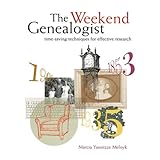
Recently I stopped by our public library to pick up a book and took a few minutes to browse in the Tennessee Room, our library's genealogy collection.  In the display of new materials, one book caught my eye,The Weekend Genealogist: Timesaving Techniques For Effective Research by Marcia Yannizze Melnyk.  The title sounded interesting, and I ended up skimming through the entire book, kicking myself that I only had an old grocery list with me for taking a few notes on some of her practical tips.

Once home, I transcribed my notes, paying close attention to one part that really spoke to me.  Melnyk had a very informational section about preparing to visit and utilize a research library, including a list of materials she carried in her research tote.  Eureka!  Based on her ideas, I've putting together a research tote to keep in my car.  Right now I'm using one of the many tote bags I accumulated through years of teaching.  My tote has my favorite writing paper (a blank legal pad), several pens and pencils, a bookmark that can also double as a ruler as I skim charts and lists, sticky notes for pages I want to copy, a list of my research goals or questions to help me focus, and some blank index cards just in case.  

When I've been out of town doing research, I've meticulously carried things like this in my laptop bag, but now they will be with me everyday, placed underneath those other totes I carry into the grocery store each week.  With my research tote, a small magnifying sheet stowed in my wallet, and my cell phone camera, I'll be ready for whatever I find.

I'm glad I spent some time looking at Marcia Yannize Melnyk's The Weekend Genealogist.    Her book has a lot of helpful suggestions, all designed for helping us make the most of small or limited blocks of time available to research our families.  It can be especially helpful to beginning family historians to see ways in which to work a little at a time and not be overwhelmed by the enormity of the task at hand.  The research tote idea was just one of the many ideas she had so we can plan our work and work our plan.

(The book is available for purchase at Amazon.com as well as other bookstores.  The cover image is from Amazon.com.)