Showing posts with label Civil War. Show all posts

Saturday, July 29, 2017

It Never Hurts to Go Looking: Civil War Records

"Binoculars"; source Pixabay

Last week I finally updated to Family Tree Maker 2017. The process went smoothly, and I was anxious to try out some of its new features. I also started reading with renewed interest Russ Worthington's blog posts on FTM2017, especially his post on Color Coding and Civil War Soldiers. This post inspired me to follow his steps in a search for Civil War records for my Second Great Grandfathers. Here is how my search went.

Although past versions of Family Tree Maker had the ability to filter the index of persons in a tree, I had not found it to be particularly helpful. I just seemed to generate a long list of names for a specific time period. Now, with the color coding of my ancestral lines, after using the filters Russ had suggested, I still had a long list of names of possible Civil War soldiers, but I also had the color coding dots to help me quickly locate just those direct ancestors who might have military records for the Civil War.

I quickly had a short list of eight names, four for whom I had already located Civil War records from a variety of resources and four for whom I had no military information. Interestingly, two were from Georgia, likely Confederate soldiers or sympathizers; the other two were from Pennsylvania, most likely with information to be found in Union records. Because of  ancestors from just two states, I ended up searching for the two individuals from a state in each state database or source rather than searching through a variety of records for just one person at a time.

As I searched, I noted my negative research in the Notes section of the Person Workspace for that ancestor. Below are the notes of my search for my 2nd Great Grandfather William Wallace Andrews of Crawford County, Pennsylvania. My sources and results are indicated with blue. This has become my standard format for a simple research log since particapating in the Genealogy Do-Over several years ago. If I later find other Ancestry databases, I will add it to the Ancestry list in the Notes. If I come across a totally different source, I just add " // " after fold3 then add the source and name of the new database. If I find information in a record, I will change "no record" to "information found in ... record".


It turned out that none of the four direct ancestors in question had any military records, but now I had a research log to indicate that I had searched for records of their military involvement. In addition, the whole process didn't stop me from seeing other family names listed in some of the Georgia records. The surprise for me was learning more about William S Vaughan, the son of my 2nd Great Grandfather Albert Bell Vaughan, Sr. Through the same records in which I found nothing about his father Albert, I learned that William had enlisted in the Confederate Army at the age of 15.(1) At Andersonville in 1864 William contracted measles and became blind in one eye. Later William received an allowance from the state of Georgia to compensate him for his loss of sight. Apparently William was able to return home to Pike County, Georgia for he was listed in the 1864 Census for Reorganizing the Georgia Militia where it was noted that he had an exemption (to any further service) due to his eyes.(2) No more military service for William.

This search period gave me the opportunity to see how the color coding and filters in Family Tree Maker 2017 can help me focus on a specific group of individuals in my research. It also let me see that the Notes field of the Person Workspace in FTM2017 remains a useful place to keep an individual's research log. Finally, using the same geographical databases to search for different people provided to be an efficient strategy, one I'll use again in future research.

Thanks to Russ Worthington's post, I was able to give FTM2017 a good work out and to learn some new information. After all, it never hurts to be looking for new strategies or techniques in researching our ancestors and their families.

#andrewsgenealogy #civilwargenealogy #familytreemaker2017 #georgiagenealogy #pennsylvaniagenealogy #researchtips #vaughangenealogy

1. Compiled Service Records of Confederate Soldiers Who Served in Organizations From the State of Georgia, packet for William S Vaughan, accessed www.fold3.com.
2. Cornell, Nancy J. 1864 Census for Re-Organizing the Georgia Militia; accessed Ancestry.com.

Monday, February 29, 2016

Military Monday - Learning More About Capt William Nelson


A recent e-mail from a nephew contained the photo above, taken during a visit to a local historical center, and an important question: "Are we related?" After all, there are several William Nelsons in my husband's family tree. I had just finished with a big project and was looking for something different on which to focus. Learning more about Capt William Nelson seemed like a good place to start.


Using the information from the photo, I was able to find some additional military information about William Norborne Nelson on Fold3.com. At the age of 30 Nelson had enlisted as a captain in Company C of the Second Virginia Infantry, mustering in at Harpers Ferry, West Virginia in April of 1861. During the battle of First Manassas, 21 July 1861, he was wounded and was away from his unit from a number of months due to the wound he received. Finally, his health lead to his being discharged from the Confederate army on 18 May 1862.

Googling I found mention of Captain Nelson in Virginia at War, 1861 by William Davis. One snippet of information about Capt Nelson mentioned that Company C was known as the “Nelson Rifles”. The book also related that Nelson was wounded so severely in the left breast that he was never really able to return to active duty. That further explained his short period of military service.

Later, checking US census records from 1860-1900, I saw that Nelson had returned home to Clarke County, Virginia, where he was a farmer for the rest of his life.

FindAGrave provided photos of the two markers memorializing Captain Nelson. His memorial page also listed the names of his parents, siblings, wife, and two of his children.

Then, I stumbled upon something I had not ever found in any of my previous research - a poem written in honor of someone I was researching. Francis Orray Ticknor wrote "The Virginians of the Valley" in memory of William Norborne Nelson and the other Confederate soldiers who had fought at Manassas.(1)

I ended up starting a separate family tree in Family Tree Maker based on the information I had found about William Norborne Nelson. This gave me a way to keep up with the information I found using various resources. 

But, in answer to my nephew's question, no, William Norborne Nelson was not a relative of our family. I was not able to find any connection between this William Nelson and all of my husband's family scattered across North Georgia. 

My research wasn't wasted, however,  because I was able to exchange several e-mails with my nephew as we shared information and our interest in Capt Nelson. We both marveled at Nelson's recovery from a chest wound during a time period when medical practice coupled with poor battlefield sanitation would usually have lead to a soldier's death, not to his recovery. Being a retired military officer, my nephew contributed how William Nelson was most likely the company commander of the Nelson Rifles since the company bore his name. So what if William Norborne wasn't our Nelson family's relative; he was still an interesting individual to research.

Lessons learned: 

  • Never be surprised at the various places in which you can find information about someone.
  • Even it is turns out not to be a relative, you can still enjoy the hunt and the story.

(1) Ticknor, Francis Orray. The Poems of Francis Orray Ticknor. Neale, 1911; accessed on Google Books, Feb 2016.

Wednesday, November 11, 2015

Veterans Day 2015 - Ways to Remember Our Veterans

Iwo Jima Momument, Marine Corps Base Quantico
personal photograph

On Veterans Day in the United States, there are numerous ways people choose to honor and remember the veterans who have served in the military of our country. Parades. Flag lined streets. School assembly programs. Special gestures extended to today's veterans.

Blogging also provides additional ways for many of us to remember and honor our military ancestors. During the past year, I had four such posts, each written for a different reason.

A recent visit to the Resaca Confederate Cemetery in Georgia reminded me of the sacrifices made by many unknown soldiers who fought of both sides during the Civil War. The story of how this cemetery came to be is also the story of how one person can make a difference in keeping individuals and events from fading from our memory.

It was exciting to look into the life of the young Revolutionary War spy, John Howard, while trying to verify a family story. Learning that a 15-year old was a real spy might just be the hook to grab the attention of some of the younger members of our family and help them see history through the life of a relative.

I still find myself thinking about the life of a Confederate soldier and relative, Samuel G Slade. Learning more about his military service, his injuries, and his later life was a reminder that there are too frequently personal battles fought long after the war is over. Today's headlines about Post Traumatic Stress Disorder or long waits for veterans  to receive proper medical care were foreshadowed by what Samuel Slade and countless others went through in their day.

My fourth post concerned one of the Camp Family Letters housed in the Manuscript and Rare Book Library of Emory University near Atlanta, Georgia.  The letter of Thomas Camp to his wife is one more reminder that our veterans are also someone's spouse, parent,sibling, or child. Our veterans are not only soldiers, they may also be part of our family. They are our friends and our neighbors.

To all of veterans today, thank you for your service to our country. For our ancestors who served, we will remember your actions, your efforts, and your place in our country's history.


Thursday, September 24, 2015

Those Places Thursday : Resaca Confederate Cemetery


The Resaca Confederate Cemetery is not like the huge military cemeteries I had visited before. Hundreds or thousands of white crosses placed in straight lines. Names or numbers on each cross or marker. Instead, this cemetery is a small, quiet place located just a few miles off I-75 in Georgia about midway between Atlanta and Chattanooga. There is no sign at the exit to let passersby even be aware of its existence. It is also the place where I found a story, just not one I had expected to find.

During a recent trip to Georgia, my husband and I made a short visit to the cemetery. It was a familiar place to my husband; after all, he had told me about his walking around the cemetery grounds to gather information for a high school project years ago. Plus, a brother-in-law had mentioned that their grandmother had relatives buried there. A beautiful day provided us with a good opportunity to visit the Resaca Confederate Cemetery.


The cemetery itself is small and covers less than three acres. The picture above shows almost all of the cemetery's property. Resaca Confederate Cemetery contains less than 600 graves, a combination of short upright markers, flat ground level markers, and a few more ornate monuments. Fewer than 150 are marked with a name, initials, or any personal information. The remainder of the graves, 424 of them, have only simple markers to the unknown Confederate soldiers who were buried there.(1)  Today small Confederate flags or single artificial flowers decorate most of the graves of the unknowns.


Signs on the archway to the cemetery and inside the cemetery tell the story of what may have been the first confederate cemetery in the country. The cemetery is located on property that once belonged to the Green family. Following the Battle of Resaca, the family returned to their home and found that some of the soldiers killed in the battle had been buried on their family property. One of the family's daughters, Mary J Green, helped by a sister, buried two more soldiers there. Later Mary Green, with the assistance of others, moved the make-shift burials into a flower garden near their home. Green then started a move to honor these soldiers with a proper burial in an actual cemetery. Her efforts involved letter writing and fund raising, all with the goal of establishing an official cemetery for the soldiers buried on the family property. In 1866, Mary's father, Col. Green, gave her two and a half acres to be used for a cemetery. The property became where the bodies were finally laid to rest in an orderly arrangement in an actual cemetery. The cemetery was officially dedicated on 25 Oct 1866.(2)

Posted on the information board at the entrance to the cemetery are lists of the known soldiers buried there. I took pictures of the lists and once back home, tried to see if I could find the names of any of my husband's relatives. FindAGrave has 141 interments listed for the cemetery, a few more names than are posted at the cemetery, but no names listed were those of relatives.

I searched through the Roster of the Confederate Soldiers of Georgia, 1861-1865 which I have in my Civil War Collection on HaithiTrust. I was able to use their "find in text" feature to look for "Resaca" information. The roster provided information concerning soldiers wounded in the Battle of Resaca, those transferred to the field hospital in the Resaca, and some listed as being buried at Resaca. Although I did find a few new names listed in the rosters as having been buried at Resaca, I was not able to find any relative's name using that resource. Perhaps the relatives who may be buried at the Resaca Confederate Cemetery are among the 424 unknown soldiers.

This genealogy trip did not lead me to any new family links. What I did find, however, was the story of Mary J Green. Her desire to honor the dead and provide a proper burial for them shows how one person's efforts can make a difference for many others. That's a story worth celebrating.

(1) "Resaca Confederate Cemetery", http://www.rootsweb.ancestry.com.
(2) "Honoring the Fallen", The Civil War in Georgia, http://www.gacivilwar.org/story/green-sisters-resaca-confederate-cemetery.

Wednesday, August 19, 2015

Sometimes Life is Just Hard ...

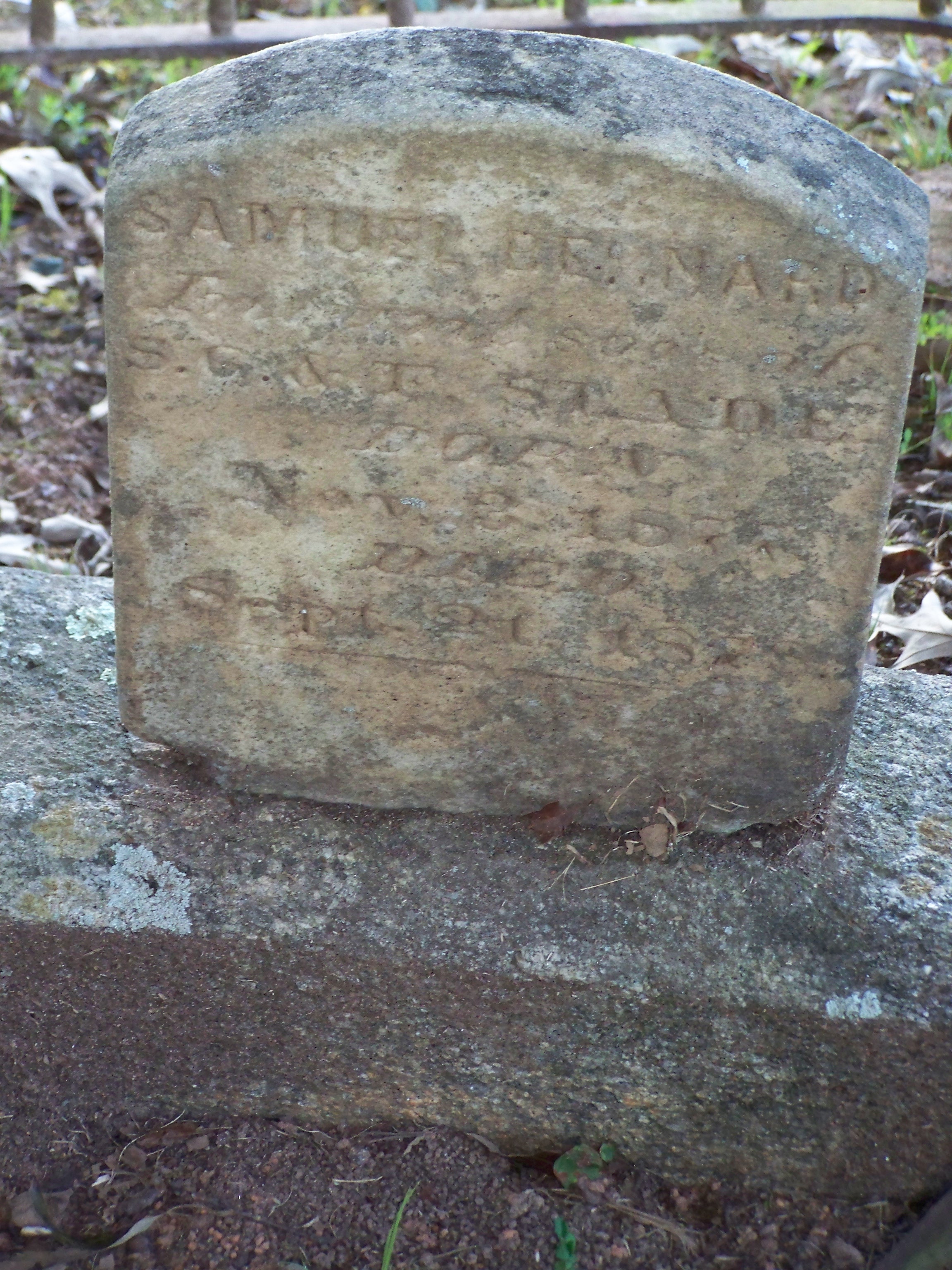
Samuel Bernard Slade, infant son of S G and F C Slade,
findagrave memorial #119440666; photo by Lisa G

Some relatives are just plain fun to research; they draw you by their interesting lives or exciting adventures. Sometimes, though, a relative will grab my attention for other reasons. Samuel G Slade, my third great uncle, is one of the later. I first came across him while searching for military records for the Georgia Slades. Each new thing I learned about Samuel G and his hard life kept me digging to learn more about him.

Samuel G was the youngest of the 11 children of my third Great Grandparents, Samuel Slade and Chloe Harrison. He was born and raised in central Georgia. At the age of 19, Samuel G and his bride Mary C Smith were living with his parents at the time of the 1860 census. It looked like a bright future for the young couple. However, according to information on the Slade Genealogy website, Mary Smith Slade died early in their marriage, and the couple did not have any children.

In July 1861, Samuel G joined other men from Pike County, Georgia, when he enlisted to serve in Company A, 13th Georgia Volunteer Infantry, CSA.(1)  During the Battle of Monocracy in July of 1864, Samuel's leg was wounded such that it had to be amputated below the knee. After his capture by Union forces at the Battle of Monocracy, he was sent to the Military Prison at Hampton, Virginia, then involved in a prisoner exchange later that summer.(2) By February of 1865, now back with the 13th Georgia, Samuel was placed on extended medical furlough.

Samuel G Slade, record of diagnosis, 22 Aug 1864 (2)
Apparently Samuel G was in Georgia long enough to marry Fannie Coker in January of 1865.(3) By the 1870 census, Samuel G and Fannie had three children with two more born in the 1870s. Things seemed to be looking up for Samuel G and Fannie.

The couple's seemingly peaceful life started a downward slide in September of 1878 when their year-year-old son, Samuel B, died.(4)  Several unsourced online family trees mention that a second son also died during that period. Then, about a year later, Fannie Coker Slade passed away due to a fever.(5) In November of 1879, Samuel G was a widower, left to raise four children, all under the age of 13.

Samuel G Slade, application for payment for limb

Although Samuel G's leg had been amputated during the Civil War, he had not received an artificial limb or military pension from the government. About a month after his wife's death. Samuel G applied to the state of Georgia for a $75 payment for a leg.(6) Samuel G's file contains only this application and one supporting form attesting to his condition. Nothing more. His file was in all likelihood closed soon after it had been opened. In February of 1880, Samuel G Slade died. The cause of death listed on the 1880 Federal Mortality Schedule was suicide.(4)  Not yet 40 years of age, Samuel G had lost two wives and at least one young child, as well as having a lasting disability from his war injury; apparently he must have felt that life was just too hard to continue.

The impact of these events has caused me to spend some time researching the lives of Samuel G's four surviving children. They were first cousins, three times removed, not close enough to ordinarily be a high research priority, but as a mother and a teacher I've found myself wanting to know more about them. What would life hold for these children who had known such upheaval in their lives, losing a brother (or two), their mother, and their father, all in less than a two-year time span?

Thankfully, there were some bright spots in the adult lives of the Slade children. Within a few months of their father's death, all four children were living with the James W Means family in Pike County.(7) They were listed in the 1880 census as Mr. Means' wards so apparently they were all together, in a home with food and, hopefully, care and attention. This also probably meant that neither 14-year-old Ella or 12-year-old J C Slade was put in the position of having to raise the younger siblings while themselves still children.

One of the Slade boys became a teacher, a school board trustee, and even served as the county Sheriff. Another Slade brother went in the lumber business. Both of the sisters married and had families of their own. Life did go on for the Slade children, sometimes for the better. At times, life is just hard for an individual or within a family. And sometimes a spark or concerned individuals can help people not just endure but perhaps even thrive.

(1) Henderson, Lillian, Roster of the Confederate Soldiers of Georgia, vol. 2, Hapeville, GA: Longrine & Porter, 1959-1964; accessed through www.haithitrust.org.
(2) "Compiled Service Records of Confederate Soldiers Who Served in Organizations From the State of Georgia", packet for Samuel G / S G Slade; accessed through www.fold3.com.
(3) Slade-Harrison Family Bible, transcription and provenance posted on www.sladegenealogy.net.
(4) "Samuel Bernard Slade", FindAGrave memorial #119440666; citing Ebenezer United Methodist Church Cemetery, Lamar County, Georgia; memorial page and photo by Lisa G provide information.
(5) 1880 Federal Mortality Schedule, Georgia, Pike County, District 551; accessed through Ancestry.com.
(6) Georgia. Confederate Pension Applications, Georgia Confederate Pension Office RG 58-1-1, "Samuel G Slade". accessed through Georgia Virtual Vault.
(7) 1880 Federal Census, Georgia, Pike County, Zebulon; accessed through Ancestry.com.

Thursday, December 25, 2014

The Camp Family Letters : Christmas, 1862

"A Husband and Wife Separated By the War, 1862", Thomas Nast
source: Wikipedia commons

For a Confederate soldier, Christmas was about like any other day.  Thoughts always turned to family back home.

Camp near Dalton, Georgia

Dec 25, 1862

My Dear Mary,

[Your letter] came to hand on 21st … much satisfaction [to have] a letter from you … I am destitute of words that can express them, and if I could see you, I could not tell them to you.  I wish it was in my power to be with you in Christmas times, but I cannot.  I feel like I was ready to protect you at all times and under any circumstances.  That is one of my first duties … to protect the ones that are near and dear to me.  And when the time comes that my dear ones cannot be protected at home, I feel that it will be my duty to go and attend to them myself.  And how long before that time will come, I cannot tell.  As to the end of this war I cannot see.  You and our children are all that I need to protect.  ...

I am very sorry to hear of so much sickness in your settlement [among] the settlers [and] friends].  ….. very anxious to hear from you …. I’m sorry but don’t be uneasy.  ...  Keep on the watch all the time.  Keep everything close.

... Write how much more money you will have to have.  I have drawn three month wages, $40, and will draw again the first of January.  ...  I will close for the present.  May God bless us is my prayer.  Write soon.

This is on Yankee paper.


T L Camp


* This letter is part of the "Camp Family Papers, 1858-1877" which are housed in the Manuscript, Archives, and Rare Book Library (MARBL) of Emory University in Decatur, Georgia.  The letter was transcribed using Transcript freeware.  Some of the spelling, punctuation, and syntax were corrected in this post for ease in reading.  ... is used to indicate portions of the letter which were omitted in the post.  [ ] indicates a word or information I have inserted for clarity.

Monday, November 10, 2014

Veterans Day, 2014: Remembering the Past


Field of Poppies, Tower of London
By Ian Pegg (Own work) [CC0], via Wikimedia Commons

Tower of London 2014
By Scarretero (Own work) [CC-BY-SA-3.0 (http://creativecommons.org/licenses/by-sa/3.0)]
via Wikimedia Commons

This past week, I have seen several images which pointed my thoughts toward the observance of Veterans Day.  The first were pictures I saw of the poppy memorial at the Tower of London.  The monument, which is titled "Blood Swept Lands and Seas of Red", contains 888,246 ceramic red poppies that have been placed in the moat area of the Tower of London.  Each poppy commemorates the death of a soldier of the British Commonwealth during World War I.(1)   The monument in its simplicity makes a powerful statement.

A very different image was the snapshot of a military cemetery which I found in a family photo album.  The handwritten note on the back indicates it was taken on Okinawa in 1945.  My father served with the US Army and was stationed on Okinawa in the final year of World War II.  This photo was something he brought back from his time spent on Okinawa.  Try as I might, I have not been able to enlarge it enough to clearly read the symbols and inscription on the crosses.  All that is clear is that it is the burial place of apparently hundreds of soldiers killed in World War II.  

Okinawa 1945
photo from personal collection

Today Veterans Day is celebrated in a number of ways.  For many it is a federal holiday, for others it means parades or patriotic programs in schools.  But for all of us it should be a day to recognize, honor, and commemorate our country's military.  As the US Department of Veterans Affairs reminds us on their web site ...

The ... observance of Veterans Day ... not only preserves the historical significance of the date [Armistice Day], but helps focus attention on the important purpose of Veterans Day:  A celebration to honor America's veterans for their patriotism, love of country, and willingness to serve and sacrifice for the common good.
On this day I especially want to remember these veterans about whom I have written during the past year.
(1) "888,246 Poppies Pour Like Blood From the Tower of London to Remember the Fallen Soldiers of WWI",  http://www.earthporm.com, Nov 2014.

Monday, June 23, 2014

Tying Up Some Loose Ends ...

"String or Nothing" by Andrea Kirkby
source: flickr


As I have been rereading my transcriptions of the Camp Family Letters*, I have come across several that have pointed me to additional family research.  Sometimes it is a reference to a person, other times to an event or a place, all needing further research to clarify.  Here are a few of those questions I have been able to answer.

Who is Lewis Camp?  Who is Uncle Joe?

Knoxville, Tenn
26th April 1862

My Dear Brother & Sister [Thomas and Mary Ragsdale Camp],
..... You have doubtless learned ere this that Lewis Camp and James Langley are both dead.  Lewis died Tuesday evening and his body started home Thursday morning.  Two hours after the corpse left, Uncle Joe got here, but he had to wait there until Friday morning.  On Friday morning James Langley died very unexpectedly, and Uncle Joe concluded to remain until this morning and carry his corpse with him  So he left this morning .....

Raleigh Camp

Lewis Camp was the first cousin of Raleigh Camp, the son of Raleigh's uncle Josiah Washington Camp and Louisa Cooper Camp.  According to the Roster of Confederate Soldiers of Georgia, vol. 4, Lewis had enlisted in Company A of the 40th Georgia Infantry on 10 Mar 1862.  His death came six weeks later, 22 Apr 1862.  Lewis' military records on fold3.com showed that when his father Josiah Camp later applied for a survivor's pension, Josiah stated that had Lewis died with no wife or child to survive him.

The Uncle Joe to whom Raleigh referred was Lewis' father, Josiah Camp.  This paragraph amazed me with the quickness in which news seemed to be transmitted, probably by telegraph.  Josiah Camp died in Tennessee on 22 April.  His father must have left right away in order to arrive from Georgia on 24 April in hopes of bringing Lewis' body back to Georgia.

James Langley was also a member of Company A, 40th Georgia.  For Uncle Joe to carry his corpse back to Georgia suggested that James was perhaps a family friend or neighbor.


Lewis S. Camp, Confederate Records
source: fold3.com

Who are all these people?


15 Apr 1866
Georgia, DeKalb County

Dear Daughter [Mary Ragsdale Camp],
..... Old Jim was down at Sheffield last week.  Bud and Sue were well.  Sue said she would get through grammar this week and that she has found she could learn anything she wanted to by studying and that he was receiving the prize.  Nellie has improved her reading ago right well.  Sissie says tell Fannie she has spelled [better].
..... Lou is in a great trouble now about getting her fixups for the wedding.  I do not know what she has told you about it.  The time is set, the tenth of May.  If she has not wrote to you, wait until you hear from her about it.....

Your affectionate mother,
J C Ragsdale [Jemima Caroline Ragsdale]

I still have no idea who Jim, Bud, Sue, Nellie, and Sissie might be.  I've tried several different strategies, looking at the siblings of Jemima Caroline Born Ragsdale and of her husband Elijah Newton Ragsdale as well as looking at their children, their children's spouses, and the few grandchildren I have previously been able to name.  Identifying all these people will probably wait for another time.

Fannie was a family nickname for the second daughter of Thomas Camp and Mary Catherine Ragsdale Camp, Francis Estelle Camp.  At the time of this letter, Fannie was seven and was attending school.  It sounds as if a grandmother was trying to encourage a granddaughter in her school work.

The paragraph about the anxious bride got my attention.  Lou is Louisa Jane Ragsdale, the sister of Mary Catherine Ragsdale.  The wedding information turned out to be easy to locate.  The Georgia Virtual Vault has a large number of digitized county marriage records, and I was able to find the record for this marriage in the DeKalb County records for 1866.  Lou married Isaac Newton Scott on 10 May 1866.  Two weeks before your wedding, who wouldn't have a few nerves?

DeKalb County Marriage Book, 1856-1872, Book B
source:  Georgia Virtual Vault

What was the Lamar House?

Knoxville, Tenn
Nov. 27th, 1866

My Dear Sister [Mary Ragsdale Camp],
..... I don’t now that I have anything to write that will interest you though last week was rather a week of events at the Lamar House [Louisa tells about a man arrested for stealing money and a watch from someone staying at Lamar House].....  On Thursday night the Yankees had a ball, and on Saturday Mr. and Mrs. Frances, two of our boarders, returned..... [Capt. Bell, a person living at the hotel] went to take tea with some of his relatives Sunday evening and brought a little teacake back with he.  He went in the office and give it to Newt .....

Your sister
Lou Scott

From the these events and others described in Lou's letter, it is possible that Lou's husband Newton Scott was working at the hotel, particularly with the reference to Capt. Bell coming into the office to see Newt.  A check of Ancestry's collection of digitized city directories did not provide any additional information as no Knoxville city directory was published from 1861-1868 and the 1869 Knoxville directory did not list either a Newton Scott or an Isaac Scott residing there.  The 1870 federal census listed Newt and Lou as living back in Georgia with Newt recorded as being a farmer.

A history of Knoxville' Bijou Theater and the Knox Heritage website both provide interesting tidbits about the history of this building constructed in 1817.  Reading about the building's history as a private residence, hotel, hospital during the Civil War, and later as a theater has peeked my interest in going there when I'm next in Knoxville.

Lamar House / Bijou Theater, Knoxville, Tennessee
source: www.knoxheritage.org
One further note, in this letter Lou mentions receiving a letter from Bud.  Could this be the same Bud to whom Jemima Born Ragsdale referred in the previous letter to Mary Ragsdale Camp?  

Maybe there are a few more loose ends to tend to.  

Lessons learned:  It is worth spending time to learn more about people, places, and events associated with our family.  It is another part of their story.

* These letters are part of the "Camp Family Papers, 1858-1877" which are housed in the Manuscript, Archives, and Rare Book Library (MARBL) of Emory University in Decatur, Georgia.  The letters was transcribed using Transcript freeware.  Some of the spelling, punctuation, and syntax were corrected in this post for ease in reading.  ... is used to indicate portions of the letter which were omitted in the post.  [ ] indicates a word or information I have inserted for clarity.

Monday, June 16, 2014

Mystery Monday: So That's How it Happened!

photo source : A Journal of the American Civil War, vol. five, no. 1.

Raleigh Camp taught at the Georgia Military Institute.  He served as a Captain in the 7th Texas Infantry, CSA.  Later Camp become a Major in the 40th Georgia Infantry, CSA.  These three basic facts had been part of the story for my 3Great Uncle, Raleigh Spinks Camp, but I had questions as I tried to connect these events.  Hence, my mystery.  And the answer came through a variety of resources.

Raleigh Camp was a graduate of the Georgia Military Institute.  Following his graduation he taught math at the Institute and was a charter member of the school's chapter of Sigma Alpha Epsilon fraternity.(1)

On 15 Dec 1859, Raleigh married Miss Laura Clifford Jones of Liberty County, Georgia.  Soon the young couple moved to Gilmer, Texas where Raleigh set up his law practice.  According to the 1860 census Raleigh and Laura have two bachelor lawyers and a young physician boarding with them in Gilmer, Texas.  Why Raleigh decided to practice law in Texas is still a bit of a mystery although there were several Camp relatives living in that area of Texas in the 1860s and earlier.

From reading the Camp Family Papers of Emory University, Raleigh Camp initially hoped for peace as the slavery issue began to divide the North and the South.(2)  By 2 Oct 1861, Raleigh was supporting the Confederate cause, joining the 7th Regiment of the Texas Infantry, and being elected Captain of Company B.(3)  The 7th Texas became part of the Army of Tennessee and saw action at the fall of Fort Donalson in Tennessee.  Raleigh, however, had been furloughed due to illness and was apparently with family in Georgia at the time the rest of the 7th Texas was captured by Union forces.  Among those captured was his younger brother Josiah Gresham Camp about whom I had written in a a previous post.  This meant that in February of 1862 Capt. Raleigh Camp had been separated from his regiment.


Letter to Gov. Joe Brown from Raleigh S Camp
source: Ancestry.com (4)

It look reading a letter Raleigh Camp had written to Governor Joe Brown of Georgia to understand his move to the 40th Georgia Infantry.(4)  In the letter dated 18 Feb 1862, Raleigh made two important points.  First, he spoke of being unable to return to the remnants of his troops now in Kentucky due to medical reasons.  Then Raleigh offered to be an instructor in military tactics at one of the training camps for the additional companies being raised in Georgia to fight for the Confederacy.

Things moved quickly following this letter.  Within a month, by 19 March 1862, Raleigh has been transferred from the 7th Texas to the 40th Georgia Infantry.  Two days later, he was elected Major in the regiment.(5)

Raleigh Camp remained with the 40th Georgia, serving as its Acting Inspector General as well as in other staff positions.(6)  Along with thousands of other Confederate soldiers, Raleigh was captured at the Battle of Vicksburg and later paroled.  Later, Raleigh would write of his experiences in the Battle of Vicksburg in his personal memoir What I Know, I Know, and I Dare Express It.(7)

From reading family letters to examining military records on fold3.com and additional records on Ancestry.com to books accessed online as well as held in my hand, a lot of resources played a part in connecting the Georgia - Texas - Georgia dots.  Sometimes, we find an answer in one wonderful resource.  Other times, as with Raleigh Spinks Camp, it takes a variety of resources across time to get to that A-Ha moment.  

Now, if I could just learn why Raleigh and his wife Laura headed to Texas rather than settling somewhere in Georgia ...

(1) Nash, Howard.  Sixth General Catalogue of Sigma Alpha Epsilon (1904); accessed through Google Books.
(2) "Camp Family Papers, 1858-1877"; Manuscript, Archives, and Rare Book Library (MARBL) of Emory University in Decatur, Georgia. 
(3) "R S Camp", Compiled Service Records of Confederate Soldiers Who Served from Organizations in the State of Texas, accessed fold3.com 
(4) "R S Camp to Joseph E Brown, 18 Feb 1862",  Georgia Civil War Correspondence, 1847-1865, www.ancestry.com
(5) "R S Camp", Compiled Service Records of Confederate Soldiers Who Served from Organizations in the State of Georgia, accessed fold3.com 
(6) Henderson, Lillian.  Roster of the Confederate Soldiers of Georgia, v.4. Hapeville, GA : Longrine & Porter, 1959-1864. 
(7) "Major Raleigh S Camp's History of the 40th Georgia Infantry in the Vicksburg Campaign", A Journal of the American Civil War, vol. five, no. 1.

Monday, June 2, 2014

Military Monday : The Camp Letters * - What a Soldier Needs ...

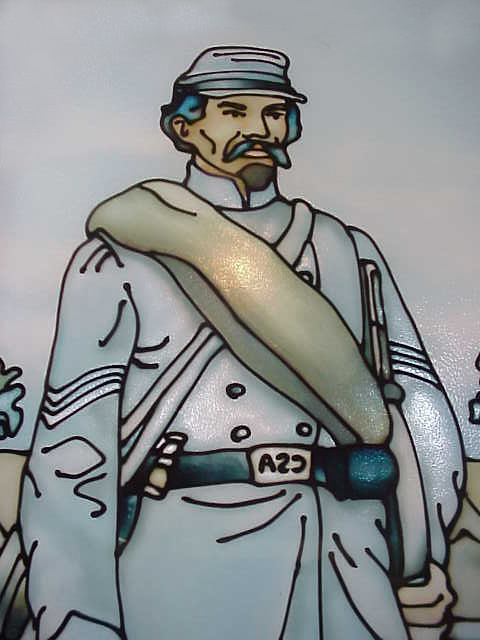
"Stained Glass of a Confederate Soldier of the American Civil War at Bardstown, Kentucky"
photo by Mary Harrsch posted on flickr

When we think of our country's soldiers today, we think of them as all clothed with the same uniforms, fed and living in standardized barracks.  That wasn’t always the case for Confederate soldiers such as my 2GreatGrandfather, Thomas Lumpkin Camp.  Excerpts from some of the letters he wrote to his wife Mary reveal his need for personal items, clothing, and food.


Camp near Dalton, Georgia
Dec. 25, 1862

My Dear Mary,
….. You need not send me any yarn shirt as the winter will soon be over.  If you can sell it, you can do so.  Send me some socks when Dave comes ….. 
 _ _ _ _ _ _ _ _ _ _ _ _ _ _ _ _ _ _ _ _ _

Camp near Loudon, Tenn
Oct the 29th, 1863

My Dear Mary,
 ….. I have not heard any thing from my blanket, and I never expect to.  I think Dave will get home after [a] while; you can send me my blanket by him and one pair of socks and that will do me some time until spring.  If we should take winters [here] I may want a green shirt and drawers. 
_ _ _ _ _ _ _ _ _ _ _ _ _ _ _ _ _ _ _ _ _ _ 

Camp near Chattanooga
Nov. 22nd, 1863

My Dear Mary,
….. I want a pair of half soles for my shoes.  If this should come to hand before R. T. Harlson starts back, [I need] one yarn shirt and a pair of socks.
_ _ _ _ _ _ _ _ _ _ _ _ _ _ _ _ _ _ _ _ _ _ 
  
Camp 40th Georgia Regiment
April 14th, 1864

My Dear Mary,
….. I want you to send me one of them old pocket books by Dave or Mr. Goodson at the first chance, ….. one of the two, I want to have it fixed.
 _ _ _ _ _ _ _ _ _ _ _ _ _ _ _ _ _ _ _ __ _

Camp 40th Georgia
May the 20th, 1864

My Dear Mary,
….. .  I will say to you that I am needing some fronts ..... so if you can make me any you can do so if you have any cotton cloth that will do.  If you can not, get jeans.  I much rather have jeans ….. I want you to make me a nice suit this summer if the Yankees do not break you up.
_ _ _ _ _ _ _ _ _ _ _ _ _ _ _ _ _ _ _ _ _ _ 

Camp near Cave Spring [Georgia]
Oct the 10th, 1864

My Dear Mary,
….. This is a fine country and as fine crops as I ever saw in my life.  We will [gather] as long as there are as many potatoes as what is in this country.  I have been living better for the last week that I have since I have been in the War.  On last Friday night I came by Sister’s, and she loaded me with chicken and bread, on the way came by Uncle Burrell Camp’s, and he filled his saddlebag with bread and potatoes and his bucket with as good butter as you ever saw.  So we are living alright now.

Socks, jeans, food, just a few of the necessities to make life as a soldier a little more bearable.


* These letters are part of the "Camp Family Papers, 1858-1877" which are housed in the Manuscript, Archives, and Rare Book Library (MARBL) of Emory University in Decatur, Georgia.  The letters was transcribed using Transcript freeware.  Some of the spelling, punctuation, and syntax were corrected in this post for ease in reading.  ... is used to indicate portions of the letter which were omitted in the post.  [ ] indicates a word or information I have inserted for clarity.

Monday, May 26, 2014

Amanuensis Monday : The Camp Family Papers: Soldier, Husband, Father, Friend

Camp Letter 29, Thomas Camp to Mary Camp (1)

Soldier, husband, father, friend.  On 10 March 1864, a Confederate soldier wrote this short letter to his wife Mary.  In it his words showed many facets of the man who was my second GreatGrandfather, Thomas Lumpkin Camp.

Thomas Camp the Soldier

Camp 40th Georgia
March 10, 1864
Hoods Corps, Stuarts Division, Stovall Brigade

My Dearest Mary,

…...  We are having fine weather now for our military duty.  I have not been on any guard duty since I have got back.  We have got 30 men in our company.  Capt. Mc has not got back yet; he is at Kingston Hospital.  Lt. Murphy left the day before I got here.  He left here sick.  He is at Matterson, Georgia so John and myself is running the concern. ….. I have one consolation and that is this war can not last always.  There is an end to it though I may never live to see it.  Let me live long or die soon.  I am going to try to do my duty the best I can.

[As in so many of his letters, Thomas was apparently free to write about the location of the troops, the battles, and various military personalities.  No redaction here.]


Thomas Camp the Husband

….. Did you get my letter of the 5th?  I sent you $50.  If you have not sent the things I wrote for and Anderson thinks there is danger in sending them, you can pay the money to your father.  I will pay Dave this $20 but if you have sent them, it is alright.  I received your letter of 7th; ….. [the mail] is coming right through.  As I said, if your father should need his money, you can let me know, and I will send it to you at once. ….. .  I will send you $20 in this letter.  I know it is a bad way to send money.  You can pay it to your father, don’t keep it on hand.

….. You must take good care of yourself if you should take the measles.  This is a very good time of the year to have them.  You must recollect that when you think you are well, then the danger comes.  I hope you will not take them until I can be at home, but when will that be?  I have no hopes of getting home not before next winter.  If I should come, I will.  That seems like a long time to have to stay away from those that are so dear to me.


Thomas Camp the Father

….. I am glad you have the chance to send Lou to school.  I hope you will be able to send her all the year.  Try to encourage her all you can.  Try to get her to love to go. ….. May God be with us in all our trials and troubles and keep us from evil.  Write soon and give my love to all.
[Lou was Louise, the oldest of Thomas and Mary’s children.  At six, she was able to start attending school.  These few sentences are especially dear for me for I know the tradition of teachers among Thomas’ descendants.  Some of these teachers include six of Thomas’ granddaughters, at least two of his great granddaughters, and one greatgreat granddaughter.  I think Thomas would have been pleased to know of the family through the years who apparently loved to go to school.]


Thomas Camp the Friend

….. Dave is not very well, nothing serious, he was cold.  Lt. John says he is after the gal that bakes the cakes.
[Were this sentence written today, it would definitely end with a smiley face emoticon!]


Lesson Learned:  Once again I am grateful that Mary Ragsdale Camp kept these letters and that a great granddaughter later donated them to Emory University.  Each letter I read provides a little more information about these relatives as well as insight into their lives.  There are several additional Camp family letters among my family archives.  I need to look seriously at them and see if there might be a better place for them to reside than in my file box.

(1) This letter is a part of the "Camp Family Papers, 1858-1877" which are housed in the Manuscript, Archives, and Rare Book Library (MARBL) of Emory University in Decatur, Georgia.  The letters was transcribed using Transcript freeware.  Some of the spelling, punctuation, and syntax were corrected in this post for ease in reading.  ... is used to indicate portions of the letter which were omitted in the post.  [ ] indicates a word or information I have inserted for clarity.

Monday, May 19, 2014

Amanuensis Monday: The Camp Letters* -- Thoughts on War

"Writing a Letter" By Petar MiloÅ¡ević (Own work)
[CC-BY-SA-3.0  (http://creativecommons.org/licenses/by-sa/3.0)], via Wikimedia Commons
Raleigh Spinks Camp was a learned man, a teacher, and a Confederate officer.  Among the collection of Camp Family Papers were a number of letters written by Raleigh to his mother Penelope Willingham Camp (my third GreatGrandmother), to Thomas and Mary Ragsdale Camp (my second GreatGrandparents), and to other members of the Camp family.  In these excerpts of letters to family members, Raleigh did not hesitate to express his opinions and his emotions related to the possibility of war and later concerning the Civil War itself.*

Gilmer, Texas
January 1, 1861

My Dear Mother,

... I really have no news to write you.  Times are hard. money scarce and much talk about fighting, but even in the midst of all these, I hope for a more bright and better day in the future when money will be more plentiful, corn cheaper & peace either in or out of the Union.  These was considerable talk some time ago about Secession, but I now believe that Union sentiment will prevail ...

Raleigh

* * * * * * * * * * * * * * * * * * * * * * * * * * * * *

Gilmer, Texas
March 25, 1861

My Dear Brother,

... Times are here like everywhere else, pretty hard.  We are sometimes excited about war and sometimes we are not.  You have doubtlessly heard that Texas is out of the Union, but we had to work [to] get it as there are in Northwestern Texas many Abolitionists, and then our Governor, Sam Houston, was a strong Union man, but the battle is fought, and the victory won thus far.  As to what Mr. Lincoln will do, I cannot tell, only that I feel certain that he will fail to coerce the southern states, should he try it.  I hope for the sake of peace, he will not ...

Raleigh

* * * * * * * * * * * * * * * * * * * * * * * * * * * * *

On 2 Oct 1861, Raleigh Spinks Camp became a member of the Confederate troops being raised in Texas and was named Captain of Company B of the 7th Texas Infantry.  In less than a year, Capt. Camp was released from the 7th Texas Infantry when he transferred to the 40th Georgia Infantry.  Through his years with the 40th Georgia, Raleigh continued to write home to his family back in Georgia.


Camp near Big Creek Gap
45 miles from Knoxville, Tenn
1st June 1862

My Dear Sister,

... There are some Yanks on the other side of the mountain, and we sometimes hear that they are coming over to see us.  We are ready to give them a warm reception, I for one want them to try it.  I want to see a fight, not that I am reckless of life at all, but I want to bear my part in the bloody contest.  If tis my fate to fall, let me share it in common with thousands of my countrymen engaged in our great and glorious struggle for independence and the Rights of Man.

... We must meet the Enemy as he is strong and powerful, and it will require all our strength to do so.  Now is the time I am very anxious to hear from Richmond.  The battle there must be a great one, one upon which depends a great deal.  Should our Army stand and drive back the enemy there, then I think they [the Enemy] will begin to think the war a bad bargain, and it might lead to peace.  Should we be routed, then a long war will follow.  As to subjugation, I repel the charge.  I cannot think of such a thing.  I will go barefoot in these mountains, dress with a sheep shin, and eat parched corn for years before I will submit.

... O may God not forsake us in our deep distress and grant us grace sufficient for all our trials.


Yours truly and affectionately,

R S Camp

* * * * * * * * * * * * * * * * * * * * * * * * *

Tazewell [Tenn], 10 Sept 1862

Dear Sisters,

… I am 10 miles from the [Confederate] Army which [is] lying before the [Cumberland] Gap.  Yet how long they will remain there, there is no telling.  The Yankees are not starved out yet, nor do I know when they will be.  I am of the opinion that they are a hard set to starve, but then some deserters from them say that they have but little to eat.  If this be so, they must run or fight us soon.  The last news from some days past is encouraging indeed, enough to convince any sensible man that the North will never whip the South.  It seems they ought to be satisfied that Virginia is a hot place for them.  I think that Kentucky is to be a great battleground, and I will be there as soon as the Gap is cleared.  

O, my dear sisters, these are trying times indeed, and when they will end, God only knows.  If they still wage it upon we, we will continue to fight with them.  Our soldiers are fighting for liberty, home, and our loved ones and never will they cease to fight …

Raleigh

One man's thoughts,  Expressed about one war.  Like those expressed by so many on both sides of the fighting in numerous wars.

* These letters are a part of the "Camp Family Papers, 1858-1877" which are housed in the Manuscript, Archives, and Rare Book Library (MARBL) of Emory University in Decatur, Georgia.  The letters was transcribed using Transcript freeware.  Some of the spelling, punctuation, and syntax were corrected in this post for ease in reading.  ... is used to indicate portions of the letter which were omitted in the post.  [ ] indicates a word or information I have inserted for clarity.