Showing posts with label Analyze Information. Show all posts

Thursday, January 12, 2017

Leaving 2016 Behind, Moving on in 2017


 Dismiss 
2016-17 by Philip Barrington, source: Open Clip Art


It's that time of year. Time to look back and see how many additional ancestors I have been able to identify sufficiently to feel confident in adding them to my family tree. That is something I had done each January for the past three years after reading Randy Seaver's blog post and watching Crista Cowan's YouTube video.

My method has stayed the same and has been the subject of a previous blog post.  As always, I continue to be grateful that I can simply generate an Ahnentafel Report of my direct ancestors by using my genealogy software, Family Tree Maker. Here is what my report for 2016 looked like.


DateGenerationRelationship# in generation# identified% identified2016 increase
1/6/20171Self11100%
2Parents22100%
3Grandparents44100%
4Great Grandparents88100%
52 Great Grandparents1616100%
63 Great Grandparents323197%
74 Great Grandparents645891%2
85 Great Grandparents1286148%4
96 Great Grandparents2563815%?
107 Great Grandparents512398%10
118 Great Grandparents1024364%36
129 Great Grandparents2048251%25
1310 GreatGrandparents40961212
1411 GreatGrandparents819288
1512 GreatGrandparents16,38488
1613 GreatGrandparents32,76822
1714 GreatGrandparents65,53622
Totals
35147% *109
* Percentage of those identified in Generations 1-10

I realize that some of the totals in my table may seem strange. For starters I have no increase in known ancestors for Generation 9 because I obviously had a typo in my previous year's report. It is possible to remove or change a relationship or two based on new research, but I know that I certainly did not lose almost 30 ancestors in that one generation during the year! I would probably still be shaking my head in bewilderment if that had actually happened.

In the report for 2016, I also stopped trying to determine the percentage of ancestors identified after Generation 12. The percentages were just too small to have any significance. Instead, I will continue to just look at the increase in numbers over the previous year's report.

Similarly, I decided to use those ancestors in Generations 2-10 as my basis for determining the percentage of ancestors I have now identified. Identifying ancestors in Generations 11-17 or beyond is just a unexpected bonus in my research.

But it isn't just a numbers game. The report prompts me to try to analyze where I found information, strategies that worked, and questions that still linger.

By using the Will and Probate Records available through Ancestry.com as well as browsing similar records on FamilySearch.org, I was able to identify with some degree of confidence a number of ancestors in generations 11-17. By studying names of beneficiaries listed in a will and comparing them with known children, siblings, and/or spouses, I succeeded in pushing my family tree back additional generations through information found through these will and probate records.

Looking back, I knew that during this year a lot of my personal research had focused on ancestors who had lived in New England. Bless the clergy and town clerks of those areas who had maintained such detailed records of births, marriages, and deaths from the mid-1650s and forward. These records, combined with will and probate records, kept me dancing around. Sometimes going one step back, then a few steps sideways, backwards and forward a lot, but eventually these records helped me identify more of my Massachusetts ancestors.

For me there is real value in doing this report each year. It isn't just about the total number of ancestors I have identified, although it is nice to document. It is more about seeing where and how I was able to learn about these new people in my family tree. And yes, it continues to bother me that I still cannot find the name of the wife of my 3 Great Grandfather William Vaughan. But it also convinces me that there are additional resources I haven't used, strategies I haven't tried, more hints to prove - or disprove. All part of trying to learn more about my ancestors.

Lessons Learned in 2016
  • I spent enough time studying wills and probate records that I actually got where I could understand the terminology and learned more about how our the legal system functioned in earlier times. These records also spoke volumes as to the nature of slavery as well the legal status of  women in the past. This prompted me to write several posts about the slave records I found in wills, posts that are now linked with the Slave Name Roll Project developed by Schalene Dagutis.
  • Ancestry's indexed Will and Probate Records were easy to use, but I frequently found additional information by browsing the unindexed will and probate records on FamilySearch.org. Browsing page by page, section by section continues to provide fruitful information.
  • There have to be some new strategies for learning about women in the 1800s. I plan to use some techniques suggested by Jennifer Dondero of The Occasional Genealogist. Finding the elusive Mrs. William Vaughan is a research goal for 2017.
#analyzeinformation #genealogyresources #lessonslearned #researchgoals #slavenamerollproject #vaughangenealogy

Thursday, March 12, 2015

Genealogy Do-Over : Who Lived Where, The 1838 Norwegian Matrikul or Land Register

After spending a number of weeks plowing and plodding through the digitized parish registers for Lesja, Oppland, Norway found on the Digital Archives of Norway, I finally got brave enough to peruse some other records found in the Archives.  I decided to look at the digitized records for the 1838 Land Register.  This register ended up providing me with new information about some of my ancestors and relatives.


1838 Land Register for Lesja Parish, Oppland, Norway; source: Digital Archives of Norway

As soon as I started to look at the pages, it was clear that my first order of business was to translate the various column headings so it was easier to see what information was actually available here.  Using both Google Translate and my Germanic Alphabet Chart, I was able to come up with a loose translation for the column headings.  Basically the columns are

  1. Farm Number
  2. Name of Farm
  3. Name of Farm Section or Division
  4. Occupant of Section
  5. Amount of land registered
  6. Tax or Debt Information

My previous look at parish records and the 1801, 1865, and 1875 Norway census records provided clues as to whom might be residing on a specific farm in 1838.  It was helpful to read John Follesdal's article on background information about Norwegian farms for a better understanding of how important the Land Register of 1838 was to the country as a whole and to the individual farmers.  Another aid in understanding the register was the Norway Glossary on FamilySearch.org which defined a number of terms related to property ownership and farming.

Pulling things together, I was able to find the following information from 1838 concerning some of my ancestors and relatives.

My 2GreatGrandfather Petter Andersen resided on farm 36 on the section recorded as Myren North.  At the time of the 1838 registry, the amount of his farm land had apparently not yet been recorded but the tax on it was listed as 2 ort and 13 skillings.  Below Petter's name is another Andersen, Isak Andersen, registered as living on the Myren South section.  Interestingly, although it might seem logical that two brothers would divide a section of a large farm, I have not yet come across any relative named Isak / Isaac Andersen in my research, so Isak Andersen is a question mark for me at this time.


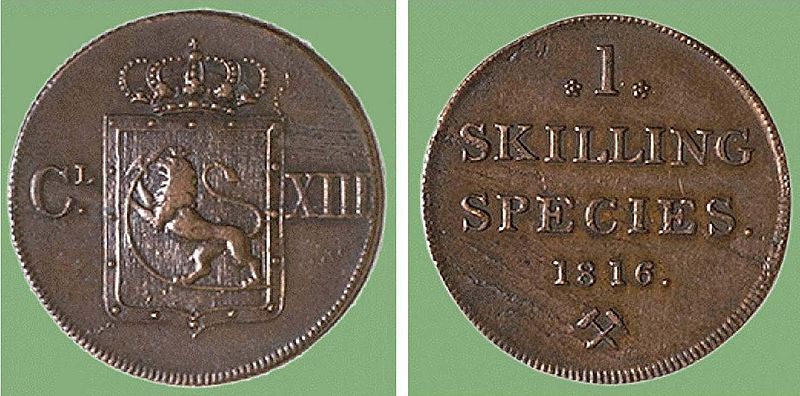
Further down the list on farm 49, the Mosenden Farm, was information about my 3GreatGrandfather Joen Olsen.  Joen and his family lived on the Mosenden North section.  His property had already been registered as being 7 units in area and having a tax of 3 ort and 13 skillings,  So far I haven't been able to determine the value of skylddalers, orts, and skillings in today's US currency, but I was able to find the picture below.

Norwegian Skilling, source: Wikipedia Commons

I also found another 2GGrandfather, Syver Hansen, recorded as the farmer for the south portion of the Bellen / Belden / Belle farm.  According to a family history, this farm had passed to Syver from his father Hans Syversen at the time of Syver's marriage in 1830. Quite a wedding present, and one I would like to be able to document.

A 4th Great Uncle, Hans Jorgensen, was recorded as the primary tenant of the Little Bjøkne section of Bjøkne farm.  Also living on Bjøkne farm on the Upper Bjøkne section was another 4th Great Uncle, Hans Bjørnersen.  Again, descendants of these two continued to live on these farm sections through the 1875 census.

The Overlien South section of the Overlien farm was home for yet another 4th Great Uncle, Syver Syversen.  His farm was taxed at a rate of 1 skylddaler, 2 ort, and 14 skilling.

I felt like doing the Genealogist's Happy Dance as I "read" over the property register.  Without the focused research of the past two months, I would not have recognized names of ancestors, relatives, farm names and sections.  And I would not have stayed so focused without the encouragement of Thomas MacEntee's Genealogy Do-Over.

Now if I plot the various farm locations on Google Map, I can see where people lived and perhaps better understand some of the relationships between the two Norwegian branches of my family tree.  Maybe I should take a look at the Real Estate Registers available on the Archives site to learn more about those living on the farms into the early 20th century.  And someday, I need to get my hands on a copy (or photocopy) of the Bydgebok for Lesja, a book tracing the history and land ownership in the Lesja Parish which was home to virtually all of my Norwegian relatives.  I might then do more of the Cluster Research that is a part of Genealogy Do-Over Week 9.  There is always something new just around the bend.

Sunday, January 11, 2015

Finding My Ancestoral Score

Family Tree, source: Commons.WikiMedia.org

Randy Seaver's topic for the recent Saturday Night Genealogy Fun was interesting.  He suggested we calculate our "Ancestoral Score".  In other words, how many direct ancestors have we identified by name?  It sounded like a different way to look at our research and a way I wanted to try.

After reading Christa Cowan's article (which started interest in this whole process), I got busy.  After trying to count the names on my family tree in Family Tree Maker, I soon decided that had to be a better way.  There was - generate an Ahnentafel Report in FTM, a report which listed my direct ancestors by generation.

Using a template similar to the one Seaver had in his post about Ancestoral Scores, I counted the names from my Ahnentafel Report and added them into my scoring template.  I was a real stickler in this and only counted an ancestor as being identified if I had both a first name and surname for an individual.  

Here is the data that determined my Ancestoral Score of having identified 18% of my ancestors.

DateGenerationRelationship# in generation# identified% identified
1/20151Self11100%
2Parents22100%
3Grandparents44100%
4GreatGrandparents88100%
52 GreatGrandparents1616100%
63 GreatGrandparents323094%
74 GreatGrandparents644266%
85 GreatGrandparents1283628%
96 GreatGrandparents256208%
107 GreatGrandparents512265%
Totals102318518%

I can see this as a worthwhile activity to do annually.  It lets me know how I've progressed in identifying individuals in the past seven or eight years and also to see areas on which to focus some of my research in the future.  Printing out the Ahnentafel Report and highlighting names where I need to identify a spouse will give me a good starting place when I'm wanting to change my research focus for a while.  This way I really hope to find the names of those two 3GreatGrandparents for whom I currently have no hint of a name.  Meanwhile I'll still be plugging away with the Norwegian lines in my family for a while longer.  Perhaps next year's Ancestoral Score will be greater due to identifying more of my Norwegian ancestors, actually finding both a first name and a surname (or farm name) for some of them.

So what is your Ancestoral Score?

Sunday, June 29, 2014

Between Friends and Family

Hedge Maze, St Louis Botanical Gardens
photo source: Wikipedia Commons

It all started when I was trying to find the death date for the first wife of my 4GreatUncle Burrell Marion Camp.  One thing lead to another as I kept coming across more marriages between the same families and friends.  Here's the brief outline of some interesting family connections.

Connection #1  Mary E Stegall was the first wife of Burrell Marion Camp.  Two years after Mary's death, Burrell married the widow Sarah Holland Elsberry in 1871.  Earlier in 1864, Sarah's brother, George Washington Holland, had married Lydia Camp, the daughter of Burrell Camp and Mary Stegall Camp.  This meant that after 1871 Sarah Holland Elsberry Camp was Lydia Camp Holland's sister-in-law as well as being Lydia's stepmother.

Connection #2  Prior to her marriage to Burrell Camp, Sarah Holland had been married to Lindsay Elsberry, Jr, one of the members of the 40th Georgia Infantry, CSA, who died during the Civil War.  It turned out that Lindsay Elsberry had a sister Sarah Sally Elsberry who married Archibald Holland, the widowed father of Sarah Holland.  This meant that Sarah Elsberry Holland was both a sister-in-law and a stepmother to Sarah Holland Elsberry Camp.  I'm beginning to see a pattern here.

Connection #3  Sarah Holland Elsberry Camp's first husband, Lindsay Elsberry, Jr, had a brother Matthew, also a member of the 40th Georgia, who also died during the Civil War.  Matthew left a widow, Mary Jane Henderson Elsberry.  In December, 1883, she then married the now widowed George Washington Holland, brother of her sister-in-law Sarah Holland Elsberry Camp.  No doubt about it, Mary Jane Henderson Elsberry Holland and Sarah Holland Elsberry Camp were definitely sisters-in-law.

Connection #4  According to the findagrave memorial for Mary Jane Henderson Holland "the story was shared among many family members, that when Lydia Camp Holland was near to her passing she told George [Holland] that her wishes were for him to remarry and that if she could choose his next wife for him, it would be Mary Jane Henderson Elsberry".  I continued to find this story posted on several online family trees and family genealogy web sites.  Maybe it is true, maybe not, but it is still a great story.

 As I checked census records, Civil War widow pension data, findagrave.com pages, and Georgia marriage records, I kept bumping into repeated connections between the Camp-Elsberry-Holland families.  It made for an interesting afternoon, all of which started when I found a photo of Mary Stegall Camp's grave marker and took the time to see who else was buried at Old High Shoals Cemetery in Paulding County, Georgia.

Thursday, September 5, 2013

Those Places Thursday - Welcome to Wildcat

Map by Wyndell O Taylor (1)

Today the area of Cherokee County, Georgia, formerly known as Wildcat, is part of the ever growing Metro Atlanta area.  Today it is home to sprawling planned developments, strip malls, manicured lawns, and rolling hills, but 150 years ago, it was a different place.

I became interested in the Wildcat area while looking for information about my husband's second great grand uncle, Samuel Hillhouse, the gold digger.  In the 1860 census for Wildcat, Cherokee County, Georgia, I found several of my husband's relatives plus a few of mine as well as a variety of occupations.(2)  The teacher in me quickly started tallying the occupations found in the census pages in order to get a better view of life years ago in Wildcat.

Below is a listing of the occupations identified by the census enumerator of Wildcat, together with a few personal comments placed in [ ]s.  The census covered 177 families and 946 people living in the Wildcat District.  Listing the occupations ending up providing an informative snapshot of life in the 1860s.  The occupations of folks in Wildcat included:

     88 laborers [none of the laborers had a value listed for land, few had personal property values listed, apparently they were farming rented land]
     86 farmers [all the farmers had a value listed for their farm land which they apparently owned]
     14 students [all males, 15-21, other non-student males of that age were listed as farmers or laborers]
     8 miners
     6 blacksmiths [I was surprised at this number until I looked at the number of farmers and laborers and the equipment necessary for them to farm the land.  The blacksmith was essential for making and maintaining their farming implements.]
     5 gold diggers [including my husband's uncle Samuel Hillhouse]
     3 millers
     3 prostitutes [surprise!]
     2 carpenters
     2 machinists
     2 merchants
     2 ministers
     2 school teachers
     1 bridge keeper [a woman]
     1 cabinet workman
     1 carriage maker
     1 engineer [probably for the railroad]
     1 hatter
     1 mechanic
     1 millwright
     1 physician
     1 silversmith
     1 vagabond

The area had virtually everything necessary for a period mini-series on A&E.  Such was life back in Wildcat!  

(1) Taylor, Wyndell O. Land and Militia Districts of Cherokee County GA. www.rootsweb.ancestry.com, 1998.
(2) Georgia. Cherokee County, Wildcat. 1860 U.S. census, population schedule. Digital images. Ancestry.com. http://www.ancestry.com : 2013.


Monday, April 8, 2013

Military Monday : Saying "I Do" During World War II

Celebrating their wedding during World War II,
photo courtesy Wikimedia Commons

Last week I transcribed several hundred wedding records from the mid-1940s and realized what a picture they gave of life during World War II.  Before my last upload to FamilySearch, the teacher in me ended up doing a quick item analysis of the records.  It resulted in an interesting snapshot of life.

Calhoun County, Alabama, the county of the records I was transcribing, was home to an Army base, Ft. McClellan.  It was not surprising that over 50% of the records I transcribed were for soldiers stationed at the base, along with several Navy and Marine personnel apparently home on leave.  Over 5% of the records involved brides in the military, one indicator of the number of women serving in the military at that time.

Others not in the military listed their occupation as working in a defense plant, ship builder, aircraft  inspector, or bomb maker, again showing the jobs that were supporting the war effort.

Some days were busy ones for the base’s Army chaplains as almost 15% were married on base, with chaplains sometimes performing three or four weddings on a single day.  I also came to recognize the names of several local ministers who married a number of the couples.

In the past I sometimes had found marriage record registers in the South segregated by race, but these 1944-1945 records I transcribed had all races recorded in the same register.  Another small sign of changes in society.

I felt some kinship with many of these couples.  My husband and I set our wedding date according to when he could get a week-end off, knowing that he would soon be heading to Vietnam.  My father was a soldier in World War II and my mother a nurse, married at the base chapel.  A brother-in-law is a retired Army chaplain.  So to all those couples associated with the military whose marriages I indexed, Happy Anniversary!

Thursday, February 14, 2013

NOT Your Average Love Story ...

This is a story about love and marriage.  And love and marriage.  And ...  It also has a moral.  NEVER be surprised by what you learn about someone.  That's NEVER in capital letters, written with a purple felt-tip pen, underlined five times on that note you passed to your best friend in the hallway back in seventh grade.

It has been that time of year when I tackle indoor projects because the weather is just plain yukky.  During one project, I decided to use my breaks to sit at my computer and do some bits of research trying to learn the name of a relative's first wife


Manchester Public Library's collection of City Directories
My primary source of family information turned out to be Ancestry.com's collection of U.S. City Directories.  From a family letter I knew that the first wife's name was Frances, but that was the extent of my knowledge about her.  Neither the 1930 nor the 1940 U.S. Federal Census showed a wife in the household of my relative, but the city directory collection showed Frances as my relative's wife for two consecutive years in the mid-1930s.  At long last, I had an approximate wedding and a possible separation date for this short term marriage.

Because I wanted each genealogy break to last as long as possible, I took the time to read all the information about this relative and his wife in the entries I found.  I learned details about his role in the family business, its location, even checked for an ad for the business.  In addition to the two years where I found the couple listed in the city directories, I also looked in several years before and after the two "marriage" years to see if they contained additional information about the wife.  This wasn't as successful because she apparently did not reside in that city prior to or following their brief marriage.

One important detail in the city directory was their home address for those two years, so I used Google Earth to get a more recent street view of their house.  On a later break, using that street address, I was able to find an index of realty transfers for the county where they had lived.  Apparently, the house had always  been in the wife's name, and the documents for both the purchase and the later resale of the house provided the first, maiden, and married name of the wife.  Finally, a complete name.

A day later, I continued working on my project, this time using my breaks to look at every city directory available for the town.  I was amazed to find another wife listed for several years in the early 1950s.  The relative's name, address, and business affiliation established that I had the right relative's name.  Before the day was over, I found still another wife in the late 1950s, again with the address and family business information to confirm her existence.  I had always heard how this relative had been married "several times", and a collection of city directories seemed to provide some support for that family story.


My family history is growing one detail at a time as I search for, evaluate, and reconsider information.  If I hadn't yearned so for breaks from my project, I might not have searched quite so diligently for facts about these mystery wives.  Without the city directory address, I might still be searching for the maiden name of that first wife.  Now, I'll start looking for marriage and divorce records, lots of them!  Details, details, and more details, along with quite a few surprises.

As for the love story, this relative married again in the mid 1960s, this time for good.  Theirs was a long and happy thirty-year marriage, ending only with the death of this final wife.  At last, this relative had finally met his soul mate.  Finally, written in capital letters, purple ink, and underlined.

Monday, January 21, 2013

Amanuensis Monday: Miriam and Her "Variety Book"

Miriam F. Vaughan, ca 1900
Imagine being 17 and suddenly have to move over 700 miles, just because your father got a new job.  It isn't that unusual today, but in 1898, it was much less common.  Miriam Frances Vaughan was 17 years old when her father, my Great Grandfather Albert Bell Vaughan, left Canton, Georgia, to become the minister of the Baptist Church in Nacogdoches, Texas.  The family moved to Texas and lived in Nacogdoches from July 28, 1898, to Nov. 26, 1899, after which they returned to Georgia.  From Miriam's vantage point, it turned out to be interesting time.

During those 16 months in Nacogdoches, Miriam kept a diary of sorts, penning her first entry the morning after they arrived in Nacogdoches and her final entry being written their last night in Texas.  Perhaps the book had been given to her as a farewell gift by family or a Georgia friend.  Her "Variety Book" is filled with quotes from literature, song lyrics, pressed flowers carefully attached to pages, and details of daily life.  Scattered throughout the 200 page book were also sermon topics, lines from hymns, and scripture - after all she was the preacher's daughter.   For me, her small book gave a personal and interesting look at being a young lady in the late 1890s.

The 4x6 inch faux leather book was given to me about 14 years ago by an elderly cousin.  For years, I had kept it just sitting on a table with a few other family heirlooms.  Recently I took the time to transcribe the book, and by doing so I started getting to know my Great Aunt Miriam.

The first thing that was apparent was how well educated Miriam was.  Her vocabulary was extensive, and running my 36 page transcription through a spell checker showed only ONE word which she had spelled incorrectly!  Even more impressive were her personal reading lists written in several parts of her Variety book.  Miriam had attended college in Georgia prior to their move but did not while in Texas.  On her own, between late September and early July she read four plays by Shakespeare, Vanity Fair by Thackeray, David Copperfield, Lorna Doone, works by George Eliot, Oliver Wendell Holmes, and popular writers of the day, plus my favorite on her list, Little Women.  Miriam obviously loved to read, sometimes receiving books and magazines as gifts from others.

Being an 18 year-old, single female in 1898-1899 was quite different from life today.  Her social activities were almost always planned by ladies of the community - picnics, parties, watermelon cuttings, simple activities.   Perhaps because her mother was looking after seven younger children, Miriam also spent a lot of time "calling on" ladies of the church.  For other entertainment Miriam also wrote of seeing a traveling minstrel show that was in Nacogdoches, a theater production of Christopher Colt, Jr., a popular play of the time, and attending band concerts at the local college.

Whenever Miriam and any of the eligible young men of Nacogdoches kept company, they were always with others.  Even an invitation for a buggy ride was to a public area and sometimes accompanied by friends.   Since her father was the minister, It wasn't surprising to see the number of gentleman who asked to accompany her to church services.  One Sunday evening, a dinner invitation prevented her from being able to attend the evening church service.  Her entry for that night showed how torn she had been between having fun with friends and doing what she knew was expected of her.  The other suitable escort for social activities turned out to be her 16-year old brother who was apparently willing to exercise this task so he could talk with some of the other young ladies present.

Miriam seemed to have made friends easily in Texas and wrote often about spending time with a close group of girls.  Early on Miriam was invited to be a member of the newly formed Pierian Chataque Circle, a literary and social club for young ladies.  This same group of friends spent the night at each other's homes, wrote notes to each other, went for walks, laughed, shared "confidences" (Miriam's term), and yes, even had some spats, all complete with emotional highs and lows. Sound familiar?

Before carefully reading and transcribing the Variety book, Miriam had been a rather shadowy figure to me.  I never met her, had only heard of her as being the oldest sibling in my Grandmother Perkinson's family, and had only the one picture of her.  Now she is much more real to me, thanks to her Variety book. 

Monday, January 14, 2013

Military Monday: "Going to School" With Albert

One of my genealogy resolutions for 2013 was to do a better job of citing my sources, and a personal resolution was to actually go through several drawers in an attic file cabinet to see what was there.  A few unscheduled days recently provided the time to get started doing just that.  This became the time, to quote one of my grandchildren, "to go to school" as I sorted through the military records that had belonged to my uncle, Albert Thomas Vaughan, Jr.


Lt. Albert T. Vaughan, Jr.
Albert loved to talk about being in the Army during World War II, but we were never sure exactly what he did, where he had been stationed, and whether he had always been an officer or had first been an enlisted man.  The answers to these questions surfaced as I spent several days going through close to three inches of military files.

As soon as I started looking through the files, I was hesitant about what to do with all of this stuff.  Denise May Levenick had earlier written a really helpful article on FamilyTreeMagazine.com about What to Keep and What to Toss.  It gave me just the direction I was needing.

Her simple guidelines gave three options to consider "save ... skim then trash ... [or]  trash".  As I removed each item from a folder to read, I made one of the three choices.  Some of his papers contained multiple copies, as many as 10, of a single letter or order so it was easy to select the copy in best condition and trash the rest.  I kept those papers and forms that documented where he had been stationed, his rank at the time, and what he did.  A number of brittle, crumbling newspaper articles were scanned and then trashed.

Using the saved documents, now in a slim folder, I was able to construct a timeline for Albert's military service.  My husband, a former Marine, was interested in reading the documents and shedding light on what was happening, my own personal military consultant.  What resulted was a clearer picture of Albert's time in the Army Air Force between 1942 and 1946.

Albert first enlisted in the Army in June, 1942, and was immediately sent to Texas for training as a glider pilot.  When he was determined to be slightly color blind, he was given an honorable discharge in August, 1942, only to be allowed to reenlist several weeks later.  He spent the next months being trained and was assigned as an aircraft armorer, all in the United States.

Soon Albert was selected to attend Officer Candidate School.  After finishing OCS, he was discharged from being an enlisted man and granted a commission as a 2nd Lieutenant in August of 1943.  As a new lieutenant he served as a personnel officer at Randolph Field, Texas, before finally getting into the position about which we had heard so many stories.  By July 1944, Albert was put in charge of a Mobile Training Unit, traveling from one Army Air Field to another, assigned at each base for about six weeks.  His unit was charged with training pilots and maintenance personnel on the changes being made with the B-17 bombers.  His papers also included some great 8x10 glossy photos of the cockpit and engine mock-ups that were used in the training process.  Many of the newspaper articles I scanned were interviews from base newspapers telling about the Training Unit's visit and its purpose, all front page articles with quotes from Albert.
B-17 Mobile Training Unit No. 14, ca 1944
Denise May Levenick's article had been the first part of my schooling using Albert's papers.  Next, there was a lot of military and personal information in his records that I wanted to document in my research.  The second part of my schooling came as I dug repeatedly into Evidence Explained to get an understanding as to how to correctly cite privately held military records.  After lots of reading, writing, rewriting, and even a post to the Evidence Explained Forum followed by their prompt answer (Thanks, EE), I think I've finally learned how to correctly write this type of citation.  Practice does make perfect when you write 14 of them!

In the end, I've learned a lot about Albert, how to correctly cite one type of source, and more about stateside military service during World War II.  All of this was thanks to a stack of dusty, crumbling military records, the Levenick article, Evidence Explained, and my husband.

Monday, December 31, 2012

In 2013 I will ...

 calendar by 
Yes, I've made my standard New Year's Resolutions - work out more frequently, eliminate (or maybe try to control) that pile of clutter on the kitchen counter, etc.  This year I'm also adding a few resolutions that relate to genealogy.  What started me thinking along this line was Lisa Alzo's blog post 13 Easy Genealogy Resolutions You Can Make and Keep that was mentioned last week in Eastman's Online Genealogy Newsletter.  I probably need to print the list out and keep it posted near my desk.  The blog post is a quick read, full of common sense ideas.  The list is bound to help me develop some better habits with its links to free, purchased, and subscription resources.

From Alzo's list here are three on which I really plan to focus in 2013.
  • Attend conferences - I'm looking for a stimulating genealogy conference to attend in the Southeast, preferably around the Atlanta area.  I've attended local workshops, heard interesting speakers, and followed webinars, but now I'm ready for more.  What would be a great first conference to attend?  Any suggestions?
  • Tidy your sources - Recently I purchased the download edition of Evidence Explained.  As I have started following the analysis and citation practices it contains, I see how much clean up is ahead for me with my old record sources.  And yes, I know I will be reading and rereading sections many times!
  • Back up your data - This means my genealogy software, digital photos, and scanned documents, not just occasionally or when I think of it but monthly.  I'm putting a monthly event in Google Calendar so I'll get annoying alerts and actually do it!
There it is, posted for others to see.  And thanks to Lisa Alzo, I may finally have made some resolutions that I will be keeping this year.

Monday, November 5, 2012

Census Tips - We're Only Human

We use census records for a lot of basic information about our ancestors and relatives, but sometimes what we find leaves us with more questions.  I found one relative whose birth date seemed to change with each census!  On several census records, he had different birth years recorded as well as an age listed that indicated yet a third possible birth year.  Another person I was researching, according to different census records, was born in North Carolina, South Carolina, and Georgia, more questionable data.

How can we analyze conflicting data in an official government record?  First, notice who gave the information to the census taker.  Some records indicate an (X) by the name of the person supplying the information for the census.  Maybe Uncle Jim thought his sister-in-law who lived with them was born in North Carolina rather than South Carolina, and that was how he answered the census taker's question.  An answer of "Carolina" or "Dakota Territory"  could be recorded as different states.  Other errors could come if the census taker used ditto marks for the birthplaces of family members, perhaps assuming that everyone was born in the same state or country.

Variations in the spelling of names could reflect the literacy of the person giving the information or just be the way the census taker heard or spelled a name.

Some discrepancies in birth dates are really based on when the census was recorded. Not every US census has been in April of the enumeration year. Perhaps what looks like a difference in a person's age is really based on when her actual birth date was and when the census was recorded.

Finally, there's the matter of handwriting.  Bless those census takers who had neat, precise handwriting.  Others obviously did not.  A 9 can look like a 4 or an 8, a 7 like a 2, all of which can cause problems if I only look at one census year.  For several years I have done volunteer transcription of census and other genealogical records for free database projects.  Transcribers attempt to record data as accurately as possible, but we realize that what is seen by us might not be what was actually written.

After all we're only human - information givers, census takers, and transcribers.  It makes for one more reason to look for information in a variety of sources.