Showing posts with label Workday Wednesday. Show all posts

Wednesday, June 10, 2015

Workday Wednesday : Scientist

By U.S. Department of Energy (http://ma.mbe.doe.gov/me70/history/photos.htm) [Public domain]
 via Wikimedia Commons

One of the unexpected pleasures of researching your family history is coming across an individual who played a part in history. I was simply looking for birth, marriage, and death records for some first cousins, once removed, the children of my grandfather’s siblings. My research led me to a learn more about a noted scientist in our family, Jesse Dean Perkinson, Jr.

Jesse was born in Tennessee, the son of a railroad conductor and a teacher. He was listed as a student in both the 1920 and 1940 federal censuses. Thanks to the abbreviated curriculum vitae I found in a conference report, I learned about Jesse’s education.(1)  After receiving his BS from the University of Tennessee, he later earned a PhD in biochemistry in 1943 at the University of Rochester.

 From the late 1940s to 1952, Jesse, now Dr. Perkinson, was a senior research scientist at the Oak Ridge National Laboratory in Tennessee.(1) Late, he was affiliated with the University of Tennessee Medical School in Memphis, Tennessee where he was worked in the area of cancer research.(2)

In 1957, Jesse was tapped to be the head of the Education and Training Branch of the Division of International Affairs of the Atomic Energy Commission.(3) Through this position, he was involved in helping other countries explore the peaceful uses of atomic energy.
Dr. Jesse Perkinson, after two years with the AEC, joined the Pan American Union as Chief of Science Development. He continued to work in this capacity for a number of years even after this entity became known as the Organization of American States.  The website of the John F Kennedy Presidential Library includes several photos showing Jesse meeting with President Kennedy during his tenure with the Pan American Union.

Learning more about Jesse Dean Perkinson, Jr, lead me to examine a number of collegiate and scientific journals. My favorite reference to Jesse was in a calendar of upcoming events at Walla Walla College in 1969. The listing referred to Jesse as the person ... “who implemented the Eisenhower Atoms for Peace plan … an authority on the peaceful use of nuclear energy and … presently chairman of the American Inter-Nuclear Committee.”(4)

One individual, working at the Oak Ridge National Laboratory, involved in Eisenhower’s Atoms for Peace Plan, head of a Branch of the Atomic Energy Commission, a scientific leader in the Pan American Union and the Organization of American States. Quite a brush with history, a veritable twentieth-century history lesson as seen through the life of one person, Dr. Jesse Dean Perkinson, Jr.

(1)   Mason, Henry Lea Herbert Steffen Peiser. Metrology and Standardization in Less-developed Countries: The Role of a National Capability for Industrializing Economies; Proceedings of a Seminar Held at Airlie House, Warrenton, Virginia, February 1-4, 1971. : National Bureau of Standards, 1971. Digital images. GoogleBooks. www.books.google.com : 2015.
(2)   “U-T Awarded $4000 By Cancer Society”, Rogersville Review, 19 Apr 1954; digital images, FultonHistory.com (www.fultonhistory.com, accessed 3 Jun 2015).
(3)   “50 Years Ago”, Memphis Commercial Appeal, 4 Aug 2007; online archives (www.commercialappeal.com, accessed 3 Jun 2015).
(4)   “Walla Walla College", North Pacific Gleaner, 15 Sept 1969; digital images, Adventist Archives (http://documents.adventistarchives.org, accessed 3 Jun 2015.


Wednesday, June 3, 2015

Workday Wednesday : Nursing *


It was the mid-1930s, still a difficult time for many people to find a job. After holding several positions as a nanny or a housekeeper, my mother decided to attend nursing school in hopes of finding a more promising career. Through the assistance of a relative, she was able to attend the nursing school affiliated with St Thomas Hospital in Nashville, Tennessee. The picture above shows my mother as a nursing student relaxing in the garden area of the hospital.

This turned out to be a wise career choice for my mother. She secured a nursing position immediately upon graduation. After she and my father married, she was always able to find work as a nurse wherever his military assignments took him. Sometimes she worked as a nurse anesthetist, other times as a hospital floor nurse. Later, as a mother with young children, she worked one day each week as "the shot lady", giving childhood immunizations at the local health department. Other times she did private duty nursing for critical care patients as well as volunteering to help with Red Cross Blood Drives.


Although my mother later held other jobs outside of the nursing field, she proudly kept her nursing pin and her diploma from St Thomas tucked in a drawer along with the pin indicating she was a registered nurse. She looked back at these years of service and friendships she formed as special times in her life.


* This is one in a series of old family photos showing my ancestors at work.

Wednesday, May 27, 2015

Workday Wednesday : Blacksmith *


Photo taken by unknown photographer to accompany an article in the Calhoun (GA) Times, Feb 4, 1970.

Years ago almost every small town had its village blacksmith. Sugar Valley, Georgia was no exception. Jud Nelson, pictured above, was a blacksmith who plied his trade and practiced his craft for many years in Gordon County, Georgia. The photo above is one of many taken through the years picturing my father-in-law at his forge.

Judge Russell Nelson, better known as Jud, was a fifth-generation blacksmith, learning the craft from his father and adding his own unique touch to things. Jud was "discovered" in January of 1970 when he was interviewed by the late Charles Kuralt at the first meeting of the Artists-Blacksmiths of North America (ABANA). His folksy humor, ready wit, and skills made him an interesting person to be around.  For many years, Jud was a featured presenter at area fairs and craft shows in Georgia.  In 1981, he was a featured part of the Smithsonian Institute's Festival of American Folklife.

Jud's blacksmithing took many forms. He made tools, kept them sharpened, and fabricated parts for wagons.  In a more artistic vein, he designed decorative handles, holders, and fireplace tools as well as fashioning repairs for the vandalized statue of Chief Sequoyah. Then, as now, there are few limits as to what a skilled blacksmith can create.

* This is one in a series of old photos showing our family's ancestors and relatives at work.

Wednesday, May 20, 2015

Workday Wednesday : At the Warehouse *

Oscar Perkinson, Sr, ca 1950s


My grandfather, Oscar Dean Perkinson, was a local businessman his entire life. After his father died, he was involved in the management of the family store, Perkinson-McAfee, in Woodstock, Georgia. Later he was an area cotton broker. In his last position, he managed the warehouse for the Jones Mercantile Company of Canton, Georgia.

Here my over six-foot-tall grandfather is standing in front of bags of seed or fertilizer, piled high in the warehouse. The warehouse was filled with a variety of things associated with farming -- bales of cotton or hay, bags of fertilizer, concrete mix, seed -- each with a distinctive smell. An interesting article on PsychologyToday.com speaks of the strength of connections between smells and pleasant memories. I've certainly found that to be true for me. Even today I can be somewhere and smell something like hay or fertilizer, and I am immediately reminded of being that little girl visiting her grandfather down at the warehouse. 

* This is one in a series of old family photos showing my ancestors and relatives at work.

Wednesday, May 13, 2015

Workday Wednesday : Farming *

Farming on the Myren homestead in North Dakota, early 1900s

Whether the crop was wheat in North Dakota or cotton in Georgia, farming has been a part of the life of many of my ancestors and relatives.

* This is one in a series of old family photos showing my ancestors at work.

Wednesday, May 6, 2015

Workday Wednesday : Grandma and Her Chickens *

Grandma's Chickens, 1930s


It is true today. It was true back then. Most families can use some extra money. My grandmother was the church organist as well as a piano teacher, but she also had another way to contribute to the family income - selling eggs and chickens. 

These were definitely free range chickens; no confining cages for her chicks. Through the years, she developed enough of a business that she had regular customers stopping by the house to purchase eggs or to buy a chicken, killed and dressed at the time of purchase. All of this took place just a block off the main street in her hometown. Image the city ordinances she might be breaking today!

* This is one in a series of old family photos showing my ancestors at work.

Wednesday, April 29, 2015

Workday Wednesday : Looking at "The Way We Worked"(1)


"The Way We Worked"
Johnson City Public Library, Johnson City, TN

The Johnson City (TN) Public Library is currently hosting "The Way We Worked", a traveling exhibit developed by the Smithsonian Institute as part of their Museum on Main Street program. We are able to have the exhibit available locally through the sponsorship of the Tennessee Humanities Council. It was a fascinating exhibit to view, one I hope will be in your area someday.

Seeing "The Way We Worked" has also led me to look back at the variety of occupations about which I have written in some previous blogs. These include:

Gold Miner Samuel Hillhouse

Homesteader Peter Petersen Myren

Land Agent  Thomas Smiley

Minister  Albert Bell Vaughan

Musician Gertrude Andrews Myren

Painter Hans Syversen

Soldier Raleigh Spinks Camp

Surveyor Ernest Perkinson

Tax Collector (and Singing Teacher) Elijah Hillhouse

Teachers Charlotte Vaughan  and her sister Louise Vaughan

Tufted Spreadmaker  Nelson relatives

And finally, the post about the Citizens of Wildcat Cherokee County, Georgia

Over the next few weeks, I'll be sharing some photos of other relatives at work.

(1) "The Way We Worked", http://www.museumonmainstreet.org/theWayWeWorked/index.html.

Wednesday, April 2, 2014

Workday Wednesday: Thomas Smiley, Missionary and Minister

White Deer Batist Church, Allenwood, Pennsylvania
photo by Miranda, findagrave.com

When I  last posted about my 4GGrandfather, Thomas Smiley, he had suffered the indignity of being tarred and feathered by those opposed to his peace efforts during the Yankee-Pennamite Wars in Pennsylvania.  At the time of that event, Thomas was the minister of the Chemung Baptist Church on Towanda Creek in eastern Pennsylvania.(1)  To learn what happened to Thomas and his family after they left the Towanda Creek area, I ended up finding a lot of information in books of Baptist church history.  And once again, HathiTrust provided the access to this type of historical information.

Interestingly, Thomas Smiley had been raised in a strict "Seceder Church", an offshoot of the Presbyterian Church, and his beliefs had earlier caused controversy within his own family.  When Thomas became a Baptist, "he became a stranger to the rest of the family and so remained behind when [his parents and siblings] crossed the mountains to ... Washington County, Pennsylvania in 1785".(2)  Until the tar and feather incident, Thomas had remained in the Towanda Creek area where he farmed and served as both a missionary and a Baptist minister.

After leaving the Towanda Creek / Wyoming area, Thomas and his family moved to the White Deer Valley in central Pennsylvania.  There Thomas Smiley founded the White Deer Baptist Church, a church which is still active today.  According to an article in the Williamsport SunGazette, "White Deer was the second Baptist church established in the area, but is the oldest existing church along the West Branch of the Susquehanna River.  It was founded Oct 23 1808, with just 10 members."(3)

In 1810 this area of Pennsylvania was still considered to be part of our country's western frontier.  The Philadelphia Baptist Missionary Society listed Thomas Smiley as one of its frontier missionaries in 1810 and recognized his work along the western boarders of the Susquehanna River.(4)  In a letter to the American Baptist Foreign Missionary Society written in 1814, Thomas told the group, "I do not entertain a doubt but that if it were in our power we would be among the first to assist in the propagation of the gospel among the heathen".(5)  It sounded as if Rev. Smiley considered himself to be both a  minister to the Native Americans as well as to others who had settled in that area.

Between 1820 and Thomas' death in 1832, the number of Baptist churches was growing in that area of Pennsylvania.  The churches began holding yearly associational meetings in which Thomas Smiley often played an important role.  For a number of years he give the opening sermon for the meetings, as well as sometimes serving as moderator and / or clerk for recording the meeting's activities.  The chart below, taken from a book on the history of this part of Pennsylvania, lists Thomas' part in these annual events.


Thomas Smiley's role in the Northumberland Baptist Association, 1821-1832 (6)

Elder Smiley, as Thomas was referred to, remained  the pastor of White Deer Baptist Church until his death in 1832.  Shortly before his death, Thomas wrote a history of the Chemung Baptist Association.(8)  His manuscript had a daunting title, History of the Chemung Baptist Association: containing an account of the rise of the churches, a sketch of their travel, together with the cause of some of them disappearing, including also, a Narration of the Association, the substance of the circular letters and other business done.  A copy of the Chemung manuscript remained in the Smiley family for a number of years.  According to WorldCat, the University of Wisconsin in Madison today holds a copy of the manuscript on microfilm.

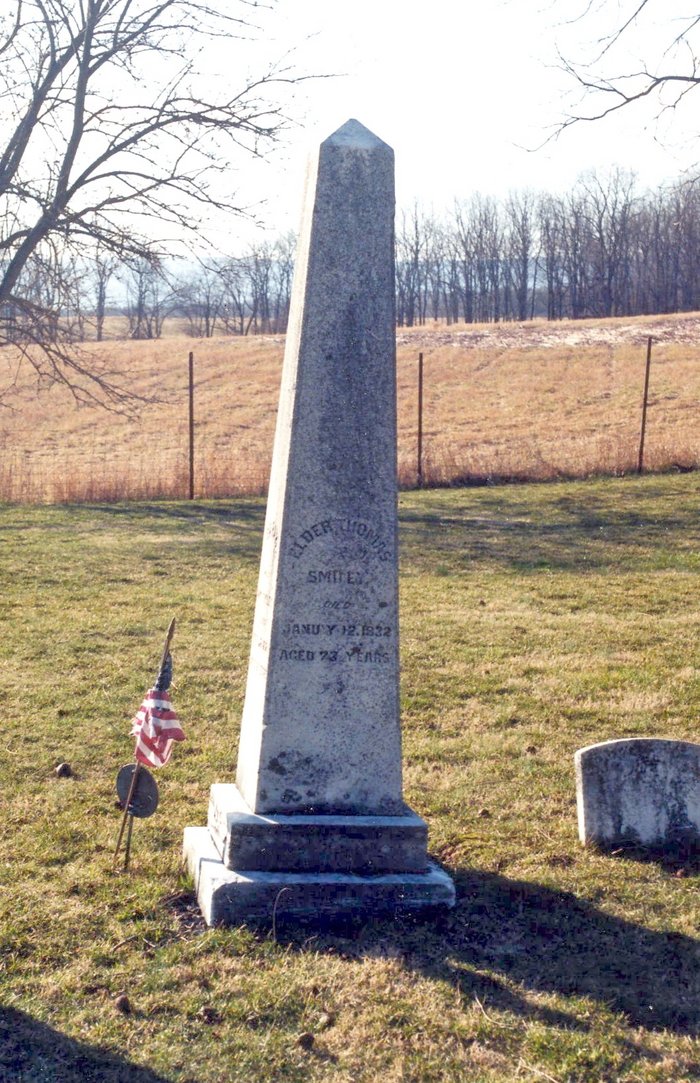
Following his death, Thomas was buried in the White Deer Baptist Church Cemetery.  Later a marker was placed there in memory of the church's first minister.  Although parts of his earlier life had been tumultuous, once Thomas Smiley and his family come to the White Deer Valley section of Pennsylvania, he founded a new church and apparently found a more peaceful and rewarding life.


Elder Thomas Smiley grave marker
White Deer Baptist Church Cemetery, Allenwood, Pennsylvania
photo by Dave on findagrave.com

(1) Vedder, Henry C.  A History of the Baptists in the Middle States.   Philadelphia: American Baptist Publication Society, 1898; accessed through www,hathitrust.org.
(2)  Commemorative Biographical Record of Washington County, Pennsylvania: Containing Biographical Sketches of Prominent and Representative Citizens and of Manh of the Early Settled Families.  Chicago: J H Beers, 1893. 
(3) Long, Eric.  "White Deer Valley Baptist Church Observing Bicentennial Year", Williamsport SunGazette,  17 Mar 2008.
(4) Spencer, David.  The Early Baptist of Philadelphia.  Philadelphia: W Syckelmoore, 1877; accessed www.hathitrust.org.
(5) American Baptist Foreign Mission Society.  Proceedings of the Baptist convention for missionary purposes: held in Philadelphia, in May, 1814.  Philadelphia: Printed for the Convention, by A Coles, 1814; accessed www.hathitrust.org.
(6) Meginness, John Franklin.  Otzinachson: Or, a History of the West Brance Valley of the Susquehanna ...  Philadelphia: H B Ashmead, 1857; accessed  www.hathitrust.org.
(7)  Bailey, Edward L.  History of the Abington Baptist Association: From 1807-1857.  Philadelphia: J A Wagenseller, 1863; accessed www.hathitrust.org.

Wednesday, March 5, 2014

Workday Wednesday -- Working Along "Peacock Alley"


"Two Ladies Hand Tufting Spreads"
photo courtesy of Shaw Industries, Inc. (1)

Looking back at some entries for the 1930 census, I learned that some of my husband's female relatives had been part of an important cottage industry in Northwest Georgia.  The five ladies were all involved in the making of tufted or chenille bedspreads.

The New Georgia Encyclopedia has an interesting article relating how Catherine Evans Whitaker began working in this home craft in the 1890s.(2)  The making of the chenille bedspreads became a way for many woman in the areas around Dalton and Calhoun, Georgia, to work at home and supplement the family income.

The bedspreads were made using a design stamped essentially upon a sheet, much like pillowcases with stamped designs that can be purchased at craft stores today.  The threadwork (or tufting) was done by hand, stitching thick cotton thread onto the design.  After the design had been completely stitched onto the sheet, the bedspread was returned to the spread house that had initially provided the workers with the sheet and thread.  Back at the spread house the chenille bedspread would be heat set to fluff the thread.  Then it was ready to sell.

It was interesting to look at the families of the five relatives who were home spreadmakers in the 1930s.  My husband's aunts, Ozella Nelson and Aurelia Nelson, were both living with their parents near Calhoun, Georgia, at the time of the 1930 census.  Both Ozella, age 30, and Aurelia, 16, were single, but the spread making enabled them to contribute to the family's income.

One cousin, Nancy Hughes Bohannon, age 65, had been widowed in 1928.  By 1930, she was listed in the census as a spread maker, indicating that she was able to turn to spread making for income rather then having to rely solely on farming.  At the time of the 1930 census, Nancy's daughter Marietta Bohannon Underwood and her husband Claud Underwood were living with Nancy.  Marietta, 25 and the mother of two young children, was another home spread maker.

Another cousin, Minnie Caldwell Scott, 39, also turned to making the chenille spreads at home.  With three young children, the income was sure to be important to the family, and spread making was work that could be done at home while looking after her growing family.

As for the term "Peacock Alley", it was used in the 1930s to 1950s and beyond.  This was before the arrival of the interstate system when the main road between Atlanta and Chattanooga was the Dixie Highway, US Highway 41.  Many of the local spread houses and individuals displayed their wares outdoors all along US Highway 41 in the areas around Dalton, Georgia.  Peacocks were such a popular bedspread design that this strip of highway became known as "Peacock Alley".(3)  The Bandy Heritage Center in Dalton, Georgia, has an informative online exhibition, "Homemade Industry - From Chenille to Carpet", which provides photographs of some of the tufters as well as pictures of peacock chenille bedspreads.

Prior to the 1930 census I had noticed almost no employment, other than farming, listed in census records for female relatives in this area of the South.  Home tufters were paid at a rate of .25 to $2.50 per finished bedspread.(4)  The work of these relatives brought money to the family as they were living in the years following the Depression.  This cottage industry was one "work at home" plan that was legitimate.

Today chenille bedspreads can be purchased on ebay, through etsy.com shops, or found on vintage textile websites.  Photos of vintage and repurposed chenille items have been pinned to  Pinterest boards.  Periodically the fabric even makes its way to the runway or clothing catalogs.  The October 2014 Prater's Mill County Fair in Dalton, Georgia, will even feature a display of chenille work.  I'm glad these relatives pointed me toward learning more about chenille making in Northwest Georgia and revived memories of the bedspreads and pillows I saw as a child.

Looking at these five ladies showed, once again, that where and when our ancestors lived were influencing factors on their lives.

(1) "Hand Tufting." New Georgia Encyclopedia. Web. 26 February 2014.
(2) Patton, Randall L. "Chenille Bedspreads." New Georgia Encyclopedia. 19 August 2013.
(3) "Chenille Bedspreads."
(4) "Hand Tufting."