Showing posts with label Pennsylvania. Show all posts

Saturday, July 29, 2017

It Never Hurts to Go Looking: Civil War Records

"Binoculars"; source Pixabay

Last week I finally updated to Family Tree Maker 2017. The process went smoothly, and I was anxious to try out some of its new features. I also started reading with renewed interest Russ Worthington's blog posts on FTM2017, especially his post on Color Coding and Civil War Soldiers. This post inspired me to follow his steps in a search for Civil War records for my Second Great Grandfathers. Here is how my search went.

Although past versions of Family Tree Maker had the ability to filter the index of persons in a tree, I had not found it to be particularly helpful. I just seemed to generate a long list of names for a specific time period. Now, with the color coding of my ancestral lines, after using the filters Russ had suggested, I still had a long list of names of possible Civil War soldiers, but I also had the color coding dots to help me quickly locate just those direct ancestors who might have military records for the Civil War.

I quickly had a short list of eight names, four for whom I had already located Civil War records from a variety of resources and four for whom I had no military information. Interestingly, two were from Georgia, likely Confederate soldiers or sympathizers; the other two were from Pennsylvania, most likely with information to be found in Union records. Because of  ancestors from just two states, I ended up searching for the two individuals from a state in each state database or source rather than searching through a variety of records for just one person at a time.

As I searched, I noted my negative research in the Notes section of the Person Workspace for that ancestor. Below are the notes of my search for my 2nd Great Grandfather William Wallace Andrews of Crawford County, Pennsylvania. My sources and results are indicated with blue. This has become my standard format for a simple research log since particapating in the Genealogy Do-Over several years ago. If I later find other Ancestry databases, I will add it to the Ancestry list in the Notes. If I come across a totally different source, I just add " // " after fold3 then add the source and name of the new database. If I find information in a record, I will change "no record" to "information found in ... record".


It turned out that none of the four direct ancestors in question had any military records, but now I had a research log to indicate that I had searched for records of their military involvement. In addition, the whole process didn't stop me from seeing other family names listed in some of the Georgia records. The surprise for me was learning more about William S Vaughan, the son of my 2nd Great Grandfather Albert Bell Vaughan, Sr. Through the same records in which I found nothing about his father Albert, I learned that William had enlisted in the Confederate Army at the age of 15.(1) At Andersonville in 1864 William contracted measles and became blind in one eye. Later William received an allowance from the state of Georgia to compensate him for his loss of sight. Apparently William was able to return home to Pike County, Georgia for he was listed in the 1864 Census for Reorganizing the Georgia Militia where it was noted that he had an exemption (to any further service) due to his eyes.(2) No more military service for William.

This search period gave me the opportunity to see how the color coding and filters in Family Tree Maker 2017 can help me focus on a specific group of individuals in my research. It also let me see that the Notes field of the Person Workspace in FTM2017 remains a useful place to keep an individual's research log. Finally, using the same geographical databases to search for different people provided to be an efficient strategy, one I'll use again in future research.

Thanks to Russ Worthington's post, I was able to give FTM2017 a good work out and to learn some new information. After all, it never hurts to be looking for new strategies or techniques in researching our ancestors and their families.

#andrewsgenealogy #civilwargenealogy #familytreemaker2017 #georgiagenealogy #pennsylvaniagenealogy #researchtips #vaughangenealogy

1. Compiled Service Records of Confederate Soldiers Who Served in Organizations From the State of Georgia, packet for William S Vaughan, accessed www.fold3.com.
2. Cornell, Nancy J. 1864 Census for Re-Organizing the Georgia Militia; accessed Ancestry.com.

Wednesday, April 2, 2014

Workday Wednesday: Thomas Smiley, Missionary and Minister

White Deer Batist Church, Allenwood, Pennsylvania
photo by Miranda, findagrave.com

When I  last posted about my 4GGrandfather, Thomas Smiley, he had suffered the indignity of being tarred and feathered by those opposed to his peace efforts during the Yankee-Pennamite Wars in Pennsylvania.  At the time of that event, Thomas was the minister of the Chemung Baptist Church on Towanda Creek in eastern Pennsylvania.(1)  To learn what happened to Thomas and his family after they left the Towanda Creek area, I ended up finding a lot of information in books of Baptist church history.  And once again, HathiTrust provided the access to this type of historical information.

Interestingly, Thomas Smiley had been raised in a strict "Seceder Church", an offshoot of the Presbyterian Church, and his beliefs had earlier caused controversy within his own family.  When Thomas became a Baptist, "he became a stranger to the rest of the family and so remained behind when [his parents and siblings] crossed the mountains to ... Washington County, Pennsylvania in 1785".(2)  Until the tar and feather incident, Thomas had remained in the Towanda Creek area where he farmed and served as both a missionary and a Baptist minister.

After leaving the Towanda Creek / Wyoming area, Thomas and his family moved to the White Deer Valley in central Pennsylvania.  There Thomas Smiley founded the White Deer Baptist Church, a church which is still active today.  According to an article in the Williamsport SunGazette, "White Deer was the second Baptist church established in the area, but is the oldest existing church along the West Branch of the Susquehanna River.  It was founded Oct 23 1808, with just 10 members."(3)

In 1810 this area of Pennsylvania was still considered to be part of our country's western frontier.  The Philadelphia Baptist Missionary Society listed Thomas Smiley as one of its frontier missionaries in 1810 and recognized his work along the western boarders of the Susquehanna River.(4)  In a letter to the American Baptist Foreign Missionary Society written in 1814, Thomas told the group, "I do not entertain a doubt but that if it were in our power we would be among the first to assist in the propagation of the gospel among the heathen".(5)  It sounded as if Rev. Smiley considered himself to be both a  minister to the Native Americans as well as to others who had settled in that area.

Between 1820 and Thomas' death in 1832, the number of Baptist churches was growing in that area of Pennsylvania.  The churches began holding yearly associational meetings in which Thomas Smiley often played an important role.  For a number of years he give the opening sermon for the meetings, as well as sometimes serving as moderator and / or clerk for recording the meeting's activities.  The chart below, taken from a book on the history of this part of Pennsylvania, lists Thomas' part in these annual events.


Thomas Smiley's role in the Northumberland Baptist Association, 1821-1832 (6)

Elder Smiley, as Thomas was referred to, remained  the pastor of White Deer Baptist Church until his death in 1832.  Shortly before his death, Thomas wrote a history of the Chemung Baptist Association.(8)  His manuscript had a daunting title, History of the Chemung Baptist Association: containing an account of the rise of the churches, a sketch of their travel, together with the cause of some of them disappearing, including also, a Narration of the Association, the substance of the circular letters and other business done.  A copy of the Chemung manuscript remained in the Smiley family for a number of years.  According to WorldCat, the University of Wisconsin in Madison today holds a copy of the manuscript on microfilm.

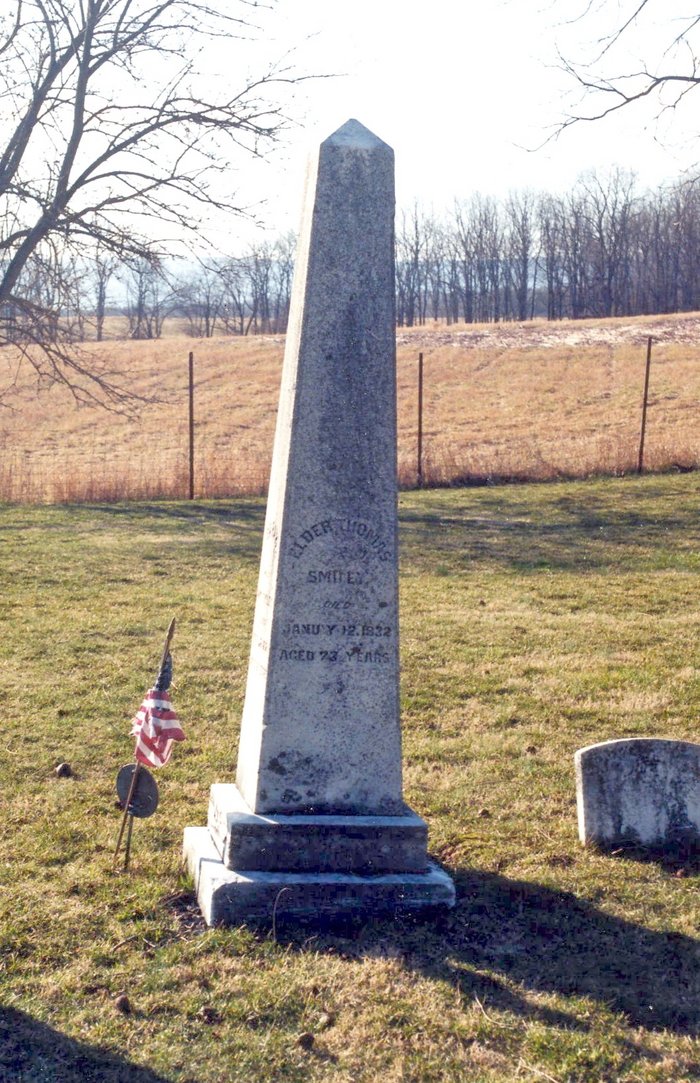
Following his death, Thomas was buried in the White Deer Baptist Church Cemetery.  Later a marker was placed there in memory of the church's first minister.  Although parts of his earlier life had been tumultuous, once Thomas Smiley and his family come to the White Deer Valley section of Pennsylvania, he founded a new church and apparently found a more peaceful and rewarding life.


Elder Thomas Smiley grave marker
White Deer Baptist Church Cemetery, Allenwood, Pennsylvania
photo by Dave on findagrave.com

(1) Vedder, Henry C.  A History of the Baptists in the Middle States.   Philadelphia: American Baptist Publication Society, 1898; accessed through www,hathitrust.org.
(2)  Commemorative Biographical Record of Washington County, Pennsylvania: Containing Biographical Sketches of Prominent and Representative Citizens and of Manh of the Early Settled Families.  Chicago: J H Beers, 1893. 
(3) Long, Eric.  "White Deer Valley Baptist Church Observing Bicentennial Year", Williamsport SunGazette,  17 Mar 2008.
(4) Spencer, David.  The Early Baptist of Philadelphia.  Philadelphia: W Syckelmoore, 1877; accessed www.hathitrust.org.
(5) American Baptist Foreign Mission Society.  Proceedings of the Baptist convention for missionary purposes: held in Philadelphia, in May, 1814.  Philadelphia: Printed for the Convention, by A Coles, 1814; accessed www.hathitrust.org.
(6) Meginness, John Franklin.  Otzinachson: Or, a History of the West Brance Valley of the Susquehanna ...  Philadelphia: H B Ashmead, 1857; accessed  www.hathitrust.org.
(7)  Bailey, Edward L.  History of the Abington Baptist Association: From 1807-1857.  Philadelphia: J A Wagenseller, 1863; accessed www.hathitrust.org.

Tuesday, March 25, 2014

Thomas Smiley, Adventures on the Western Frontier


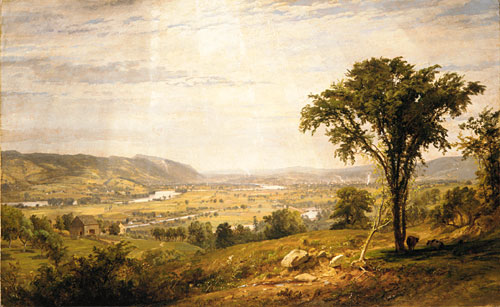
Wyoming Valley, Pennsylvania by Jasper Francis Cropsey
[Public domain], via Wikimedia Commons

So many times when I am researching an ancestor, I find I am also researching the ancestor's time period.  This has been so true as I have been learning more about my 4GGrandfather, Thomas Smiley.  Thomas, born in 1759, was the grandfather of George W Smiley, the subject of a previous post.  He lived virtually his entire life in the area of Pennsylvania, being there as it changed from being the western frontier of America through the years of the Yankee-Pennamite Wars to statehood and the growth of cities and towns in Pennsylvania.

Philadelphia, in 1782, was a bustling city, but 130 miles away in Wyoming County, Pennsylvania was still the frontier.  In April, 1782, Thomas Smiley was living in the Hanover Township section of Wyoming County, Pennsylvania.  A band of Indians had come into the area and captured a Mrs. Franklin and her four children.  Thomas and eight other settlers tracked the Indians for several days in an attempt to rescue the Franklins.  During the morning of the third day, the settlers and Indians exchanged gunfire a number of times.  When the skirmish had ended, the older Franklin children had been rescued.  Sadly, Mrs. Franklin had been killed apparently by the Indians, and the baby had disappeared, never to be seen again.  The townsmen then built a raft and returned by river to Hanover, traveling at night, until they finally returned home.  This account had been related to Thomas Smiley by Joseph Eliot in 1831; it was later published in the Annual of the Bradford County Historical Society.(1)

A second article in the Society's Annual, "Bradford County Pioneers: Men Who First Entered the Wilderness and Carved Out Homes", also mentioned Thomas Smiley.(2)  This time Thomas was listed as an early resident of the Franklin Township in Bradford County, arrived in that area after 1796.

The next recorded adventure for Thomas Smiley concerned his involvement with the Yankee-Pennamite Wars.  This was a series of three wars, both verbal and physical among groups of settlers in northeastern Pennsylvania.  The Yankee-Pennamite Wars occurred between 1769 and 1799.  Both The Society of Colonial Wars in the State of Connecticut and the Luzerne County (Pennsylvania) web site provide background about this period in Pennsylvania history.  A fascinating blog, "Philadelphia Reflections" summarizes the nature of the conflicts.
The matter boils down to the undisputed fact that King Charles II gave what is now the northern third of Pennsylvania to Connecticut in 1662, and in 1681 the same king gave it to William Penn. Eighty years after that, in 1769, Connecticut moved in, and Pennsylvania threw them out. It all happened twice more, and the Continental Congress became distressed that two of the thirteen colonial allies were fighting each other instead of the British. So it had to be resolved in court, and therefore we all have to get a little education in the fine points of real estate law in order to understand why Pennsylvania won the case. In short, Connecticut claimed that Charles II had cruelly and unjustly reversed himself, while the Penn Proprietorship simply maintained they were nonetheless legally entitled to the property.(3)
During these years, Yankee referred to those who supported Connecticut's claim to the disputed lands, while Pennamite referred to settlers claiming the land due to William Penn's grant.  Thomas Smiley ended up getting caught in the disturbances while attempting to be part of a solution.

In 1799 the Pennsylvania legislature passed an act which would essentially buy tracts of the disputed land from Pennsylvanians then give it to the Connecticut settlers living on the land who would then own it and agree to withdraw from taking part in any further land disputes.  A number of affected Pennsylvanians were not wanting to sell their land.  Thomas, now a minister in the area, offered to be a deputy agent in order to talk with some of the settlers about the sale of their land to the state of Pennsylvania.  As Clement Heverly related in his book History of the Towandas, 1776-1886 ...

July 7th [1801], [Rev. Smiley] obtained the signatures of nearly forty to their relinquishments.  A meeting was held and the "Wild Yankees" determined that the business must be stopped.
Mr. Smiley stopped for the night at Jacob Granteer's then living on the Towanda Creek. The party [of Wild Yankees], learning of [Smiley's] lodging-place,  followed him, broke into his room, compelled him to burn his papers, took him near the creek, poured a bottle of tar over his head and beard, then adding feathers, the leader after giving him a kick told him that he might go, but must leave the country.(4)
A second relating of the story mentioned that it was a group of about 20 men in disguise who pursued Thomas.  Six men were eventually brought before a grand jury for the offence against Thomas but no punishment was given to any of the men.(5)  So there was the Reverend Thomas Smiley, tarred and feathered, being told to leave that part of Pennsylvania.  This all happened because he was trying to be a peacemaker.  The upshot was that Thomas Smiley and his family left that area of Pennsylvania.  Thomas Smiley was later compensated for his sufferings related to this experience when he was granted $250 by the Pennsylvania legislature in 1819.(6) 

The rest of his ministry provided a much more peaceful story.

(1) Hallock, Mrs. H J, "Some Wyalusing Pioneers."  Digital images.  www.hathitrust.org, citing Bradford County Historical Society (PA). Annual. Towanda, PA : The Society, 1906-1917.
(2) Heverly, C F, "Bradford County Pioneers". Digital images. www.hathitrust.org, citing Bradford County Historical Society (PA). Annual. Towanda, PA : The Society, 1906-1917.
(3) Fisher, George R, "The Pennamite Wars: Who Had the Last Word?" http://www.philadelphia-reflections.com/topic/43.htm.
(4) Heverly, Clement Ferdinand. History of the Towandas, 1776-1886: Including the Aborigines, Pennamites, And Yankees, Together With Biographical Sketches .... Towanda, PA : Reporter-Journal Print Co, 1886, accessed through www.hathitrust.org.
(5) Bradsby, Henry C.  History of Bradford County, Pennsylvania.  Chicago: S B Nelson, 1891; accessed through www.hathitrustorg.
(6) Craft, David.  History of Bradford County, Pennsylvania.  Philadelphia: L H Everts, 1878; accessed through www.hathitrust.org.