Monday, February 25, 2013

Matrilineal Monday: What's In A Name?

Kari Belle Myren, ca 1898


Lately, I've been trying to learn more about my Great Grandmother Kari Belle Myren.  Sure I can find her listed in a number of records, but each record seems to have her listed with a different name.  Depending on where I looked, she is listed as Carie, Carrie, Cary, Karen, Kari, or Karie for her first name and Belle, Myren, Pederson, Peterson, Petterson, Siem, Sivertsdatter, or Syversdatter as her last name.  Such are the ways of an Norwegian ancestor!

A self-published family history, Overli-Belle-Siem Family by Marion Myhre Chappelle, lists my Great Grandmother as Kari Belle Siem, the daughter of Syver Hanson (Overli) Belle.  To me, my Great Grandmother will always be Kari since that was the way my mother spelled her Grandmother's name.  Below is a quick look at how Kari is listed in various records.  This variety of names is part of why it sometimes takes a while to locate information about Kari.


  • 1853    Norway, Baptism Record, Lesja Parish              Karie Sivertsdatter
  • 1865    Norway, Census, Lesja Parish                            Cari Syversdatter
  • 1868    Norway, Confirmation Record, Lesja Parish       Kari Belle
  • 1885    Dakota Territory Census                                    Cary Petterson (now married)
  • 1900    U.S. Federal Census                                          Karie Myren (same husband)
  • 1910    U.S. Federal Census                                          Kari Myren
  • 1915    Census of North Dakota                                     Carrie Myren

Kari's variety of names reflects her Norwegian birth.  Born in Norway in the mid 1850s, her name reflected the patronymic naming custom used at that time.  Simply put, a child's last name was determined by the father's name and the sex of the child.  Kari's grandfather's first name was Hans and her father was Syver, Han's son, so her father was known as Syver Hanson.  Because her father's first name was Syver, Kari's last name was a form of Syver's daughter, sometimes written as Sivertsdatter or Syversdatter.  All of Kari's sisters had the surname of Sivertsdatter/Syversdatter; all of her brothers were Sivertson/Syverson.  At least this made it easy to know who the father of a child was.

Another part of Kari's name was Belle or Siem, names of two farms that had been owned by Kari's father through the years.  The farm name became attached to Syver Hanson's name and to the names of his children, like Kari.  This helped to distinguish between the Syver Hanson family who lived on the Belle farm and another Syver Hanson family who lived elsewhere.  The Belle as part of Kari's name also suggests that the family might have been living on the Belle farm when her name was recorded as Kari Belle in 1868.

These Norwegian naming conventions took a while to click with me,  but once I grasped the concepts, it has been helpful  in tracing the family back through generations.  A person's name often has clues as to a parent's or grandparent's first name, and the names can also point to where the family lived.  To help us all, FamilySearch.org has a clear explanation of these Norwegian naming customs here.

Final interesting name fact about Kari.  About 1881 in North Dakota, Kari married another Norwegian immigrant, my Great Grandfather Peter Peterson Myren (you got it, Peter, son of Peter, from the Myren farm).   Of their nine children, only one had a name drawn from generations of family back in Norway.  New country, new ways, new names.

Thursday, February 21, 2013

Treasure Chest Thursday - Keeping Time With Thomas


Thomas Nelson's clock
One day in 1878, or so the story goes, Thomas Nelson hitched a horse to his wagon and rode the six miles into Waleska, Georgia, a local center of trade.  In Waleska he walked into a store and purchased the clock that today is sitting on our living room mantel.  The story of Thomas' clock is part family lore and part history but worth knowing.

According to the 1870 U.S. Federal Census, Thomas and his wife Hannah were living with his elderly parents, John and Elvira Nelson.  Neither John nor Thomas seemed to own any real estate, and Thomas' personal estate is valued at $400.  By the 1880 U.S. Federal Census, Thomas and Hannah were living in their own household, had three sons, and Thomas was listed as a farmer.  Although their 1880 real and personal estate values are not given, the $4.50 he paid for the clock probably represented a large amount to this Cherokee County farming family.  MeasuringWorth.com calculates that $4.50 price tag to be about $105 in today's currency.

Since Thomas farmed in the days when you got up with the sun and worked until dark, why would he purchase a clock?  Was this a means of adding a touch of class to their home, like putting curtains on the windows or using a lace tablecloth?  Had Thomas had a really good crop that year and decided to purchase something for the family?  Perhaps the clock had actually been purchased in 1880, the year both Thomas and Hannah would each 
have celebrated their 50th birthdays as well as their 25th anniversary.  Maybe a letter will surface someday, one written by Thomas or Hannah telling us more about the clock's purchase.  Until then, we can only speculate. 

The story my husband had always heard about Thomas' Clock was that it was passed down to the youngest son.  The next recipient of the clock, William Nelson, however, was not the youngest child in Thomas and Hannah's family.  There was a younger son, Samuel, born four years after William.  For reasons we may never know,  the clock was passed on to William who in turned passed it on to his youngest son, Jud, who gave it to my husband, his youngest son.  When we received the clock about five years ago, we once again heard the story of Thomas' Clock.  Later, while traveling around Cherokee County, Jud pointed out to my husband where the clock had been purchased.  Like the clock, the old building was still around.

My husband and I both have memories of Thomas' Clock, even before it came to be in our home.  For my husband, his most vivid memories are of being a young boy, trying to sit still at his grandparents' house on Sunday visits, listening to the ticking of the clock when he would so much rather have been outside playing.  I remember noticing the clock sitting on his parent's kitchen mantel when I was visiting during our courtship days.  Later the clock was moved to a mantel in another room where it continued to sit.  Through the years something had happened to the clock, for I had never heard it ticking back in those days.  Even with some repair attempts by a friend, Thomas' clock sat silently for a number of years at Jud's house.

After we received the clock, my husband and I wanted to learn more about the clock itself.  Thanks to the Internet, especially www.clockhistory.com, and several books from our local library, we determined that the clock was a Seth Thomas 30-hour brass weight driven clock in an Ogee case.  The clock has a Thomaston dial, and the intact label printed by Thomaston Express indicates that the clock was manufactured after 1865.  One curiosity is the word or name "Horn" written in large pencil script on the inside wall of the case.  From our research we also learned that this was a fairly common style of clock, attractive with its simple case design, flat dial, and mirrored door.  
We were pleased when our tentative identification of the clock was confirmed by the clock repairman to whom we took it to be repaired.  

Now the clock has been repaired.  It sits on our mantel, periodically dusted, and lovingly wound each night.  The soft ticking is part of our lives, a sound we immediately miss when we return home after being away for a few days.  Through the years it has acquired several chips in its walnut veneer, but these nicks are just another part of the story of Thomas' Clock.  Someday Thomas' Clock will have a new home with our younger son, and its story will continue.

Monday, February 18, 2013

The Day I Found My GGGrandparents

Norwegian flag in wind  by Hans-Petter Fjeld
My mother's father was the son of Norwegian immigrants.  I had heard mother's stories about her grandparents, Peter Peterson Myren and Kari Siem Myren, and could remember driving by the Myren homestead farm in North Dakota years ago.  However, mother didn't know much about her father's family back in Norway, my Great Great Grandparents. 

Learning more about them had been on my research task list for a long time.  Each August, Family Tree Magazine publishes their annual list of 101 Best Genealogy Websites.  In the category of Best Genealogy Websites in Europe, Family Tree Magazine had information about and a link to Digitalarkivet, the National Archives of Norway.  I took a quick look at Digitalarkivet, hoping to find tons of information, only to find that it (of course) was written in Norwegian.  

In order to even start a search,  I first set my computer to automatically translate printed text from Norwegian to English.  Next,  I opened Google Translator in a separate window so I could key in handwritten passages for a translation into English.  

A Family Search.org wiki provided one more resource that proved very helpful as I prepared to look at Norwegian records, a Norwegian genealogical word list.  This list was definitely worth a bookmark on my laptop, but I went ahead and printed it, storing it eventually in my Norway Search Info folder.  Now I was ready to see what I could find at Digitalarkivet.

One afternoon, using the National Archives of Norway database for the 1865 Census of Norway, I found my Great Grandfather Peter/Petter Peterson listed as a 18-year old living on his family's farm   I also found his father's name, Peter Andersen, but there was no mention of his mother.

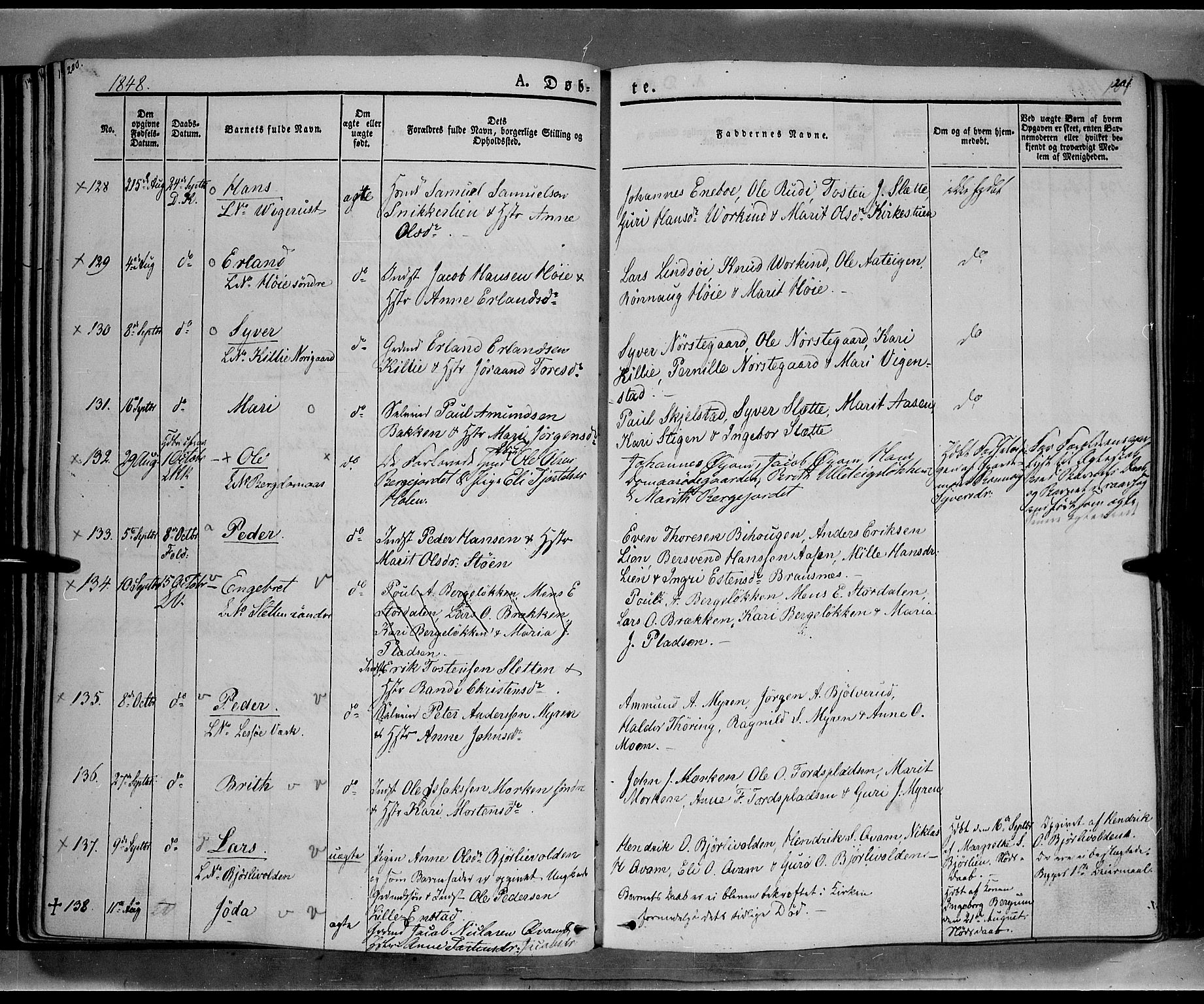
The next afternoon, thanks to those translation aids, I found Peter/Peder's Peterson's baptismal record.  I already knew his birth date (8 Oct 1848), place of birth, father's name, and Myren, the name of their farm.  After making a rough translation of the column headings of the parish registers, I had an idea of where to look as I scanned the parish Minister's Book for Peter's birth date.  I spend about an hour skimming through pages of digitized records, looking for those facts, but it was worth it when I came across the record of his baptism.  There in entry 135 for 1848 was the information I had been seeking.  A column for entry 135 listed "father Peter Andersen of Myren and Anne Johnsdatter", my GGGrandparents, and another column listed the witnesses of Peter's baptism.
Kildelninformasjon: Oppland fryke, Lesja, Ministerialbok nr. 64 , entry 135
Later that evening I printed translation notes and stapled them to my printout of the baptismal record pages.  I was thrilled with my discovery, saddened only that I could not longer share this information with my mother.

Now I've already added more things to my research task list.  Right at the top is finding out what happened to my Great Great Grandmother Anne Johnsdatter.  Next I'll be looking for a marriage record for Peter Andersen and Anne Johnsdatter.  And then, there are Peter's brothers and sisters ...  As long as I'm not attempting to speak Norwegian with my southern accent, I'll probably do OK.

Thursday, February 14, 2013

NOT Your Average Love Story ...

This is a story about love and marriage.  And love and marriage.  And ...  It also has a moral.  NEVER be surprised by what you learn about someone.  That's NEVER in capital letters, written with a purple felt-tip pen, underlined five times on that note you passed to your best friend in the hallway back in seventh grade.

It has been that time of year when I tackle indoor projects because the weather is just plain yukky.  During one project, I decided to use my breaks to sit at my computer and do some bits of research trying to learn the name of a relative's first wife


Manchester Public Library's collection of City Directories
My primary source of family information turned out to be Ancestry.com's collection of U.S. City Directories.  From a family letter I knew that the first wife's name was Frances, but that was the extent of my knowledge about her.  Neither the 1930 nor the 1940 U.S. Federal Census showed a wife in the household of my relative, but the city directory collection showed Frances as my relative's wife for two consecutive years in the mid-1930s.  At long last, I had an approximate wedding and a possible separation date for this short term marriage.

Because I wanted each genealogy break to last as long as possible, I took the time to read all the information about this relative and his wife in the entries I found.  I learned details about his role in the family business, its location, even checked for an ad for the business.  In addition to the two years where I found the couple listed in the city directories, I also looked in several years before and after the two "marriage" years to see if they contained additional information about the wife.  This wasn't as successful because she apparently did not reside in that city prior to or following their brief marriage.

One important detail in the city directory was their home address for those two years, so I used Google Earth to get a more recent street view of their house.  On a later break, using that street address, I was able to find an index of realty transfers for the county where they had lived.  Apparently, the house had always  been in the wife's name, and the documents for both the purchase and the later resale of the house provided the first, maiden, and married name of the wife.  Finally, a complete name.

A day later, I continued working on my project, this time using my breaks to look at every city directory available for the town.  I was amazed to find another wife listed for several years in the early 1950s.  The relative's name, address, and business affiliation established that I had the right relative's name.  Before the day was over, I found still another wife in the late 1950s, again with the address and family business information to confirm her existence.  I had always heard how this relative had been married "several times", and a collection of city directories seemed to provide some support for that family story.


My family history is growing one detail at a time as I search for, evaluate, and reconsider information.  If I hadn't yearned so for breaks from my project, I might not have searched quite so diligently for facts about these mystery wives.  Without the city directory address, I might still be searching for the maiden name of that first wife.  Now, I'll start looking for marriage and divorce records, lots of them!  Details, details, and more details, along with quite a few surprises.

As for the love story, this relative married again in the mid 1960s, this time for good.  Theirs was a long and happy thirty-year marriage, ending only with the death of this final wife.  At last, this relative had finally met his soul mate.  Finally, written in capital letters, purple ink, and underlined.