After spending a number of weeks plowing and plodding through the digitized parish registers for Lesja, Oppland, Norway found on the Digital Archives of Norway, I finally got brave enough to peruse some other records found in the Archives. I decided to look at the digitized records for the 1838 Land Register. This register ended up providing me with new information about some of my ancestors and relatives.
 |
| 1838 Land Register for Lesja Parish, Oppland, Norway; source: Digital Archives of Norway |
As soon as I started to look at the pages, it was clear that my first order of business was to translate the various column headings so it was easier to see what information was actually available here. Using both Google Translate and my Germanic Alphabet Chart, I was able to come up with a loose translation for the column headings. Basically the columns are
- Farm Number
- Name of Farm
- Name of Farm Section or Division
- Occupant of Section
- Amount of land registered
- Tax or Debt Information
My previous look at parish records and the 1801, 1865, and 1875 Norway census records provided clues as to whom might be residing on a specific farm in 1838. It was helpful to read John Follesdal's article on background information about Norwegian farms for a better understanding of how important the Land Register of 1838 was to the country as a whole and to the individual farmers. Another aid in understanding the register was the Norway Glossary on FamilySearch.org which defined a number of terms related to property ownership and farming.
Pulling things together, I was able to find the following information from 1838 concerning some of my ancestors and relatives.
My 2GreatGrandfather Petter Andersen resided on farm 36 on the section recorded as Myren North. At the time of the 1838 registry, the amount of his farm land had apparently not yet been recorded but the tax on it was listed as 2 ort and 13 skillings. Below Petter's name is another Andersen, Isak Andersen, registered as living on the Myren South section. Interestingly, although it might seem logical that two brothers would divide a section of a large farm, I have not yet come across any relative named Isak / Isaac Andersen in my research, so Isak Andersen is a question mark for me at this time.
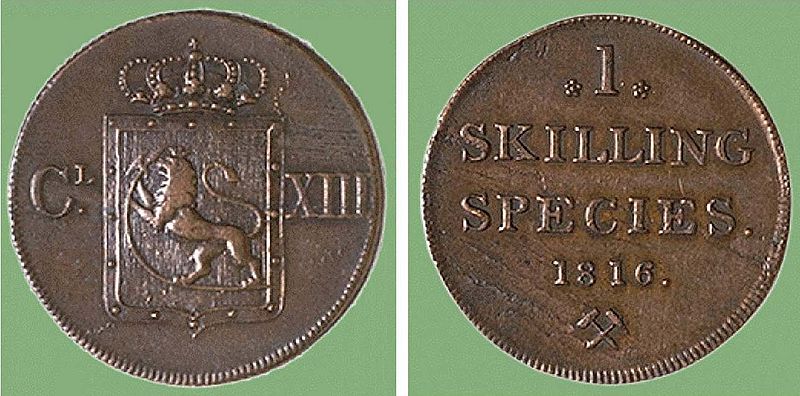
Further down the list on farm 49, the Mosenden Farm, was information about my 3GreatGrandfather Joen Olsen. Joen and his family lived on the Mosenden North section. His property had already been registered as being 7 units in area and having a tax of 3 ort and 13 skillings, So far I haven't been able to determine the value of skylddalers, orts, and skillings in today's US currency, but I was able to find the picture below.
 |
| Norwegian Skilling, source: Wikipedia Commons |
I also found another 2GGrandfather, Syver Hansen, recorded as the farmer for the south portion of the Bellen / Belden / Belle farm. According to a family history, this farm had passed to Syver from his father Hans Syversen at the time of Syver's marriage in 1830. Quite a wedding present, and one I would like to be able to document.
A 4th Great Uncle, Hans Jorgensen, was recorded as the primary tenant of the Little Bjøkne section of Bjøkne farm. Also living on Bjøkne farm on the Upper Bjøkne section was another 4th Great Uncle, Hans Bjørnersen. Again, descendants of these two continued to live on these farm sections through the 1875 census.
The Overlien South section of the Overlien farm was home for yet another 4th Great Uncle, Syver Syversen. His farm was taxed at a rate of 1 skylddaler, 2 ort, and 14 skilling.
I felt like doing the Genealogist's Happy Dance as I "read" over the property register. Without the focused research of the past two months, I would not have recognized names of ancestors, relatives, farm names and sections. And I would not have stayed so focused without the encouragement of Thomas MacEntee's Genealogy Do-Over.
Now if I plot the various farm locations on Google Map, I can see where people lived and perhaps better understand some of the relationships between the two Norwegian branches of my family tree. Maybe I should take a look at the Real Estate Registers available on the Archives site to learn more about those living on the farms into the early 20th century. And someday, I need to get my hands on a copy (or photocopy) of the Bydgebok for Lesja, a book tracing the history and land ownership in the Lesja Parish which was home to virtually all of my Norwegian relatives. I might then do more of the Cluster Research that is a part of Genealogy Do-Over Week 9. There is always something new just around the bend.